Regulated waste: A Detroit property owner's cleanup guide
Regulated waste: A Detroit property owner’s cleanup guide
Properly classifying regulated waste prevents costly fines and ensures legal disposal in Michigan.
Key regulated waste includes blood, sharps, pathological, and microbiological materials from medical sources.
Follow strict containment, labeling, storage, and documentation rules, and seek professional help if uncertain.
Most property owners in Detroit assume that any blood, bodily fluid, or hazardous-looking material found after an incident automatically qualifies as “regulated waste” subject to strict legal controls. That assumption is wrong, and it cuts both ways. Misidentifying ordinary waste as regulated can cost you thousands in unnecessary disposal fees. Missing actual regulated waste can trigger EGLE enforcement actions, fines, and serious liability exposure. This guide breaks down exactly what regulated waste means under Michigan law, what you will likely encounter in Detroit properties, and the practical steps to stay compliant from the moment you discover a problem.
Table of Contents
What is regulated waste: Definitions and Detroit-specific context
Not all waste is regulated: Key exceptions and compliance nuances
Detroit’s regulated waste process: Safe handling and legal compliance
The catch-22: Why over- or under-classifying regulated waste backfires
Professional support for regulated waste compliance in Detroit
Key Takeaways
Knowing what Michigan and federal law consider regulated waste keeps you legally protected. Not all hazardous waste is regulated. Household and lightly contaminated items often fall outside strict rules, reducing unnecessary costs.Proper handling is required. Always use labeled, leak-proof UN-rated containers and follow the 90-day storage rule for compliance. Documentation protects your business. A written waste management plan and retained manifests are your best defense during inspections or incidents. When in doubt, consult a pro. Ambiguous cases should always be checked with Michigan experts or Hazwash to minimize risk.
What is regulated waste: Definitions and Detroit-specific context
With common misconceptions in mind, let’s clarify what authorities actually mean by “regulated waste,” especially for Detroit properties.
The term gets used loosely, but it has a precise legal meaning. Regulated medical waste (RMW) is defined under OSHA, EPA, and Michigan state law, specifically under the Medical Waste Regulatory Act (MWRA), Part 138 of the Public Health Code. These are not interchangeable definitions, and that distinction matters when you are deciding how to dispose of materials found during a cleanup.
Michigan’s framework, enforced by EGLE (the Department of Environment, Great Lakes, and Energy) and MDHHS, is specific about which materials qualify. Under Michigan’s MWRA)/documents/mcl/pdf/mcl-368-1978-12-138.pdf), regulated medical waste includes:
Cultures and stocks of infectious agents
Liquid human or animal blood, blood products, and body fluids (urine is excluded)
Pathological waste (human tissues and organs)
Sharps (needles, lancets, broken glass from medical settings)
Contaminated waste from animals exposed to human-infectious agents
Critically, the law specifically excludes household waste, farm waste, waste from aging-in-place home settings, and waste generated by home health agencies under certain conditions. This is where many Detroit landlords and property managers get tripped up. If a tenant leaves behind used bandages or non-saturated bloody clothing from a minor home injury, that material very likely does not meet the legal threshold for regulated waste.
Important: Not every blood-stained item in your building is regulated waste. Michigan’s MWRA definition requires that the material fall into specific categories. Guessing wrong creates legal and financial risk in either direction.
Understanding biohazard disposal regulations at the state level is where compliance work starts. For anything that crosses into hazardous chemical territory, federal hazardous cleanup compliance adds another layer.
Common types of regulated waste found in Detroit properties
With the legal definition clear, let’s break down the typical forms of regulated waste you might find in a Detroit property emergency.
Detroit properties, particularly older residential buildings, multi-unit complexes, and commercial spaces, encounter a predictable set of regulated waste scenarios. Knowing what each type looks like, and what it means for your response, prevents both over-reaction and dangerous inaction.
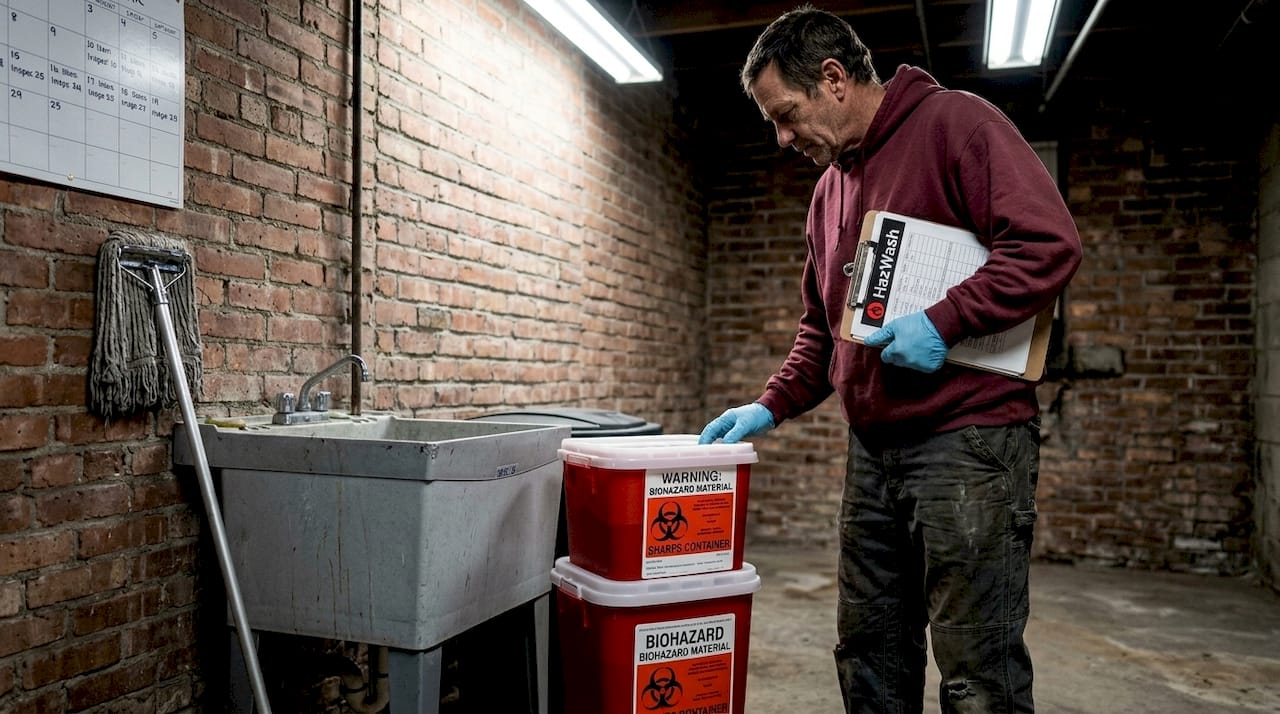
Here is a practical comparison of regulated waste types most common in Detroit properties:
The OSHA Bloodborne Pathogens Standard defines regulated waste as liquid or semi-liquid blood or other potentially infectious materials (OPIM), dried blood caked on items capable of releasing particles during handling, items that release blood or OPIM if compressed, sharps, and pathological or microbiological wastes containing blood or OPIM. That definition drives practical decisions on the ground.
Understanding the medical waste and health risks involved with improperly handled materials reinforces why the correct classification is not just a paperwork issue. It is a genuine safety concern for you, your workers, and future occupants.
When you encounter suspected regulated waste on your property, follow this sequence:
Stop all activity in the affected area immediately. Do not allow tenants, staff, or contractors to enter.
Assess the material based on MWRA and OSHA definitions before touching anything.
Put on proper PPE including gloves, goggles, and respiratory protection appropriate to the hazard.
Contain the area using physical barriers to prevent cross-contamination.
Contact a certified biohazard cleanup company if regulated waste is confirmed or strongly suspected.
Document everything: photographs, written descriptions, timestamps, and names of everyone involved.
Arrange compliant disposal through a registered Michigan medical waste hauler.
A critical rule many property managers overlook: regulated waste storage is legally limited to a maximum of 90 days on your property, even when properly containerized. After that point, disposal is not optional. Violation of storage timelines is one of the most common enforcement triggers in Michigan.
For situations involving sharps found in units after tenant turnover, refer to hazmat waste guidance specific to Detroit families and property owners.
Not all waste is regulated: Key exceptions and compliance nuances
Understanding exceptions is just as important as knowing the baseline rules, so here’s how you stay off the compliance hot seat.
This is where property managers make the most costly errors. Assuming that everything blood-related is regulated waste leads to unnecessary spending on disposal services and mislabeled waste manifests. Assuming too little leads to fines. Michigan and federal rules both carry significant exceptions, and knowing them protects you legally.
Key categories that are not regulated waste under Michigan’s MWRA:
Waste generated in households, including from home medical care
Waste from farms and agricultural settings
Waste from home health agencies operating under specific exemptions
Waste generated by small quantity generators below threshold volumes (tiered rules apply)
Lightly contaminated materials that pose no release or exposure risk
The OSHA saturation rule is one of the most misunderstood standards in property cleanup. According to OSHA’s definition, dry or lightly blood-stained items do not automatically qualify as regulated waste. The key question is whether the material can release blood or OPIM if handled or compressed. A slightly stained piece of clothing from a minor cut, for example, would not typically qualify. A heavily soaked mattress from a trauma scene almost certainly would.
Chemotherapy waste adds another layer of complexity. These materials may be dual-regulated, meaning they fall under both the MWRA medical waste rules and the federal RCRA (Resource Conservation and Recovery Act) hazardous waste regulations. If a tenant received home chemotherapy and left behind drug-contaminated materials, you could be managing a two-track compliance requirement that involves both EGLE and potentially federal oversight.
Pro Tip: Any time you classify a material as non-regulated waste, write it down. Record the specific reason the material does not meet the MWRA or OSHA threshold. That documentation is your legal defense if an inspector or litigant challenges your disposal decision later.
Detailed guidance on navigating these gray zones is available through our waste disposal guide for Detroit property managers and our resource on Michigan hazardous waste rules.
Detroit’s regulated waste process: Safe handling and legal compliance
Having covered what is and isn’t regulated waste, here’s how Detroit property managers can execute compliance in real-life cleanup scenarios.
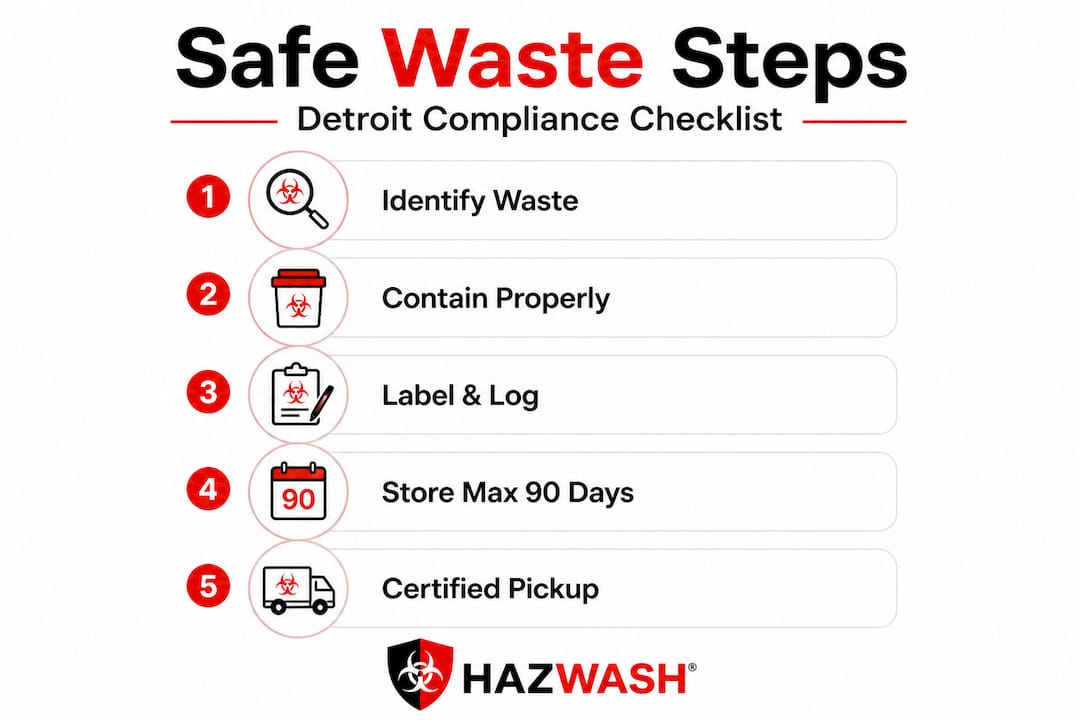
Knowing the definition is only half the job. Executing the actual handling, containment, storage, transport, and documentation process is where compliance is won or lost. Michigan’s rules are specific, and cutting corners at any stage exposes you to significant liability.
Follow these steps for every regulated waste incident on your property:
Containment: Place regulated waste in leak-proof, rigid, puncture-resistant containers immediately. Bags must be sealed, and sharps must go into approved sharps containers. Double-bagging is standard practice for liquid or semi-liquid materials.
Labeling: Every container must be clearly labeled with the universal biohazard symbol and the words “Medical Waste” or “Biohazardous Waste.” Do not use generic trash bags or unlabeled containers under any circumstances.
Temporary storage: Store containers in a secure, restricted-access area away from general waste. Maintain temperature controls if decomposition risk is present. Remember the 90-day maximum.
Transport: Only registered and permitted medical waste haulers can legally transport regulated waste in Michigan. Do not attempt to transport it yourself in a personal or company vehicle.
Treatment: Regulated waste must be treated by incineration or autoclaving (steam sterilization) at a licensed facility. Your hauler arranges this, but you should confirm it in writing.
Documentation: Maintain a written medical waste management plan and keep all waste manifests and transport records for a minimum of 3 years.
Here is a quick-reference table of Michigan’s compliance requirements:
Pro Tip: Create and maintain a written medical waste management plan for your property even if regulated waste incidents are rare. Having the plan already in place when an incident occurs allows your team to respond correctly under pressure rather than improvising.
Our guides on biohazard protocols and biohazard risk indicators provide further operational detail specific to Detroit property management situations.
The catch-22: Why over- or under-classifying regulated waste backfires
Now that you’re equipped with process knowledge, let’s look at the hidden dangers of misclassifying regulated waste on your property.
Here is the honest assessment most guides won’t give you: both directions of error are expensive. Over-classifying sends you down a costly compliance path that involves registered haulers, treatment facilities, manifests, and management plans for materials that did not require any of it. Under-classifying exposes you to EGLE enforcement, civil liability from occupants or workers who were exposed, and potential criminal violations under Michigan public health statutes.
The federal picture adds its own complication. The EPA baseline standard covers 11 categories under the Medical Waste Tracking Act, but federal enforcement is limited. States like Michigan enforce through EGLE and the MWRA with far more specificity. Meanwhile, RCRA excludes most medical waste unless it carries hazardous chemical characteristics, creating a dual-track system that trips up even experienced property managers. You may think you’re managing a straightforward medical waste disposal when RCRA requirements actually apply too.
The most common real-world mistake we see in Detroit properties is a property manager or maintenance worker making a quick, visual judgment call about whether blood is “old” or “dry enough” to skip regulated procedures. That judgment, made without documentation or professional assessment, is legally indefensible. If it later turns out the material carried bloodborne pathogens, the liability for any resulting exposure falls on the property owner.
Documentation is your legal safety net. Every classification decision, whether you determine something is or is not regulated waste, should be written down with the reasoning behind it. Review hazardous waste examples to build a reference baseline for your own property records.
When genuinely uncertain, do not guess. The text of Michigan’s MWRA is publicly available, and certified biohazard professionals can provide written assessments that serve as compliance documentation. A professional assessment costs far less than an enforcement action.
Professional support for regulated waste compliance in Detroit
For property managers ready to take the next practical step or facing a cleanup now, here’s how to connect with expert help.
Managing regulated waste compliance correctly is not something most property owners should handle alone, especially after a traumatic incident. The stakes are too high, and the regulatory framework is too specific.
HazWash LLC provides certified biohazard cleanup and regulated waste management services across Detroit and surrounding Michigan areas. Our team holds OSHA HAZWOPER, IICRC, and DOT certifications, and we operate under strict compliance with EGLE and MWRA requirements. Whether you need a compliance review before an incident or an emergency response right now, we work discreetly, thoroughly, and with full documentation at every stage.
Review our federal compliance hazardous cleanup guide to understand how federal and state requirements interact on your property. For specific incident types, our biohazard incident response services cover the full range of scenarios Detroit property managers face. You can also explore top Detroit biohazard cleaners to see how certified service providers compare. Call us 24/7 for immediate assistance.
Frequently asked questions
What items are considered regulated waste under Michigan law?
Regulated waste in Michigan includes infectious cultures, blood and body fluids (except urine), pathological waste, sharps, and contaminated animal waste, but Michigan law excludes)/documents/mcl/pdf/mcl-368-1978-12-138.pdf) household, farm, and home health agency waste from these requirements.
If I find dried blood in my building, is it regulated waste?
Only if the dried blood could release particles during handling or if the material is saturated enough to release blood when compressed, based on the OSHA saturation rule. A lightly stained surface is treated very differently from heavily soaked materials.
How long can I store regulated waste on my Detroit property?
Regulated waste may be stored up to 90 days maximum if properly contained in leak-proof, labeled, puncture-resistant containers stored in a secure, restricted area.
What should I do if I am unsure whether a material is regulated waste?
Consult Michigan’s Medical Waste Regulatory Act text directly or contact a certified biohazard professional for a written assessment that can serve as compliance documentation.