Detroit biohazard protocols: compliant cleanup guide for 2026
Detroit biohazard protocols: compliant cleanup guide for 2026
TL;DR:
- Detroit biohazard regulations remain stable, but compliance gaps pose serious liability and health risks.
- Proper procedures include scene assessment, PPE use, waste segregation, decontamination, and documentation.
- Hiring certified professionals is recommended for complex incidents to ensure legal compliance and safety.
Many Detroit property managers and homeowners assume biohazard regulations get overhauled every year, prompting a scramble to find the latest rules. The reality is different. The core protocols governing biohazard cleanup in Detroit have remained stable, but compliance gaps are still widespread and the consequences are serious. Liability exposure, health risks, and regulatory penalties are real outcomes when procedures are skipped or poorly documented. This guide walks you through the foundational rules, required procedures, common mistakes, and a clear comparison of your cleanup options so you can manage any biohazard incident safely and lawfully in 2026.
Table of Contents
- Core biohazard regulations for Detroit properties
- Required procedures for safe and lawful cleanup
- Common pitfalls and liability risks to avoid
- DIY vs. certified biohazard cleanup in Detroit
- An expert perspective: Why stable rules still demand vigilance
- Hazwash: Detroit’s trusted biohazard cleanup solution
- Frequently asked questions
Key Takeaways
| Point | Details |
|---|---|
| Regulations remain stable | Detroit biohazard cleanup rules have not changed for 2026 but strict compliance is essential to avoid liability. |
| Document every cleanup | Accurate documentation and proper labeling are required to meet OSHA and Michigan standards. |
| Certified firms limit risk | Hiring certified cleanup professionals greatly reduces legal exposure and safety hazards. |
| Know waste handling types | Different medical waste types need unique containment and disposal processes for lawful management. |
| DIY cleanup carries risks | Cleaning up biohazards yourself may save money but can lead to costly mistakes and liability if protocols are missed. |
Core biohazard regulations for Detroit properties
Having previewed the regulatory landscape, let’s dive into the specific legal requirements for Detroit biohazard cleanup. Two primary frameworks govern what property managers and homeowners must do: federal OSHA standards and Michigan state law.
At the federal level, the OSHA Bloodborne Pathogens Standard requires employers and responsible parties to maintain exposure control plans, provide proper PPE (personal protective equipment), conduct training, and follow strict waste handling procedures. This standard applies to anyone who may encounter blood or other potentially infectious materials during cleanup, including property managers who direct workers.
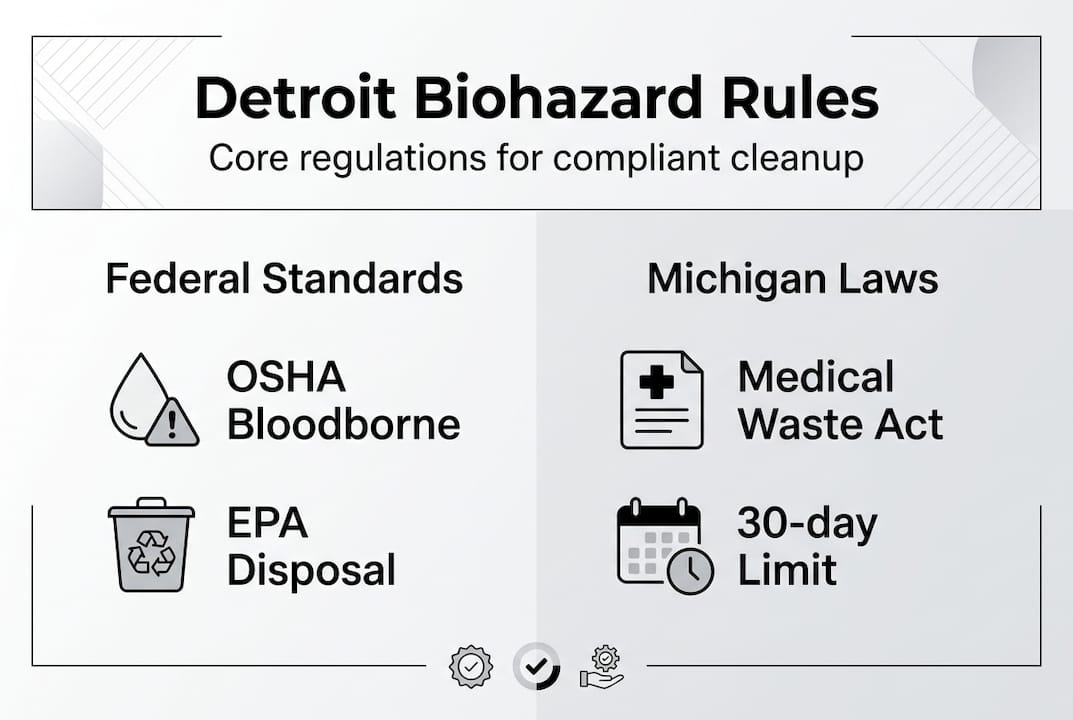
At the state level, the Michigan Medical Waste Regulatory Act mandates registration for medical waste generators, written management plans, and proper containment and labeling of all biohazardous materials. Michigan’s Environmental, Great Lakes, and Energy agency, known as EGLE, enforces these rules. You can review official guidance from EGLE to confirm current requirements for your property type.
Key compliance obligations for Detroit properties include:
- Exposure control plan: Must be reviewed and updated annually, even if no incidents occurred.
- HBV vaccination: Workers exposed to bloodborne pathogens must be offered the hepatitis B virus (HBV) vaccine within 10 days of assignment.
- Waste labeling: All biohazardous waste containers must be clearly labeled with the universal biohazard symbol.
- No mixing or compacting: Medical waste cannot be mixed with regular trash or compacted before disposal.
- Registration: Generators of medical waste in Michigan must be registered with EGLE.
Statistic callout: OSHA estimates that 5.6 million workers in healthcare and related fields face occupational exposure to bloodborne pathogens annually, underscoring why these rules exist and why they apply beyond clinical settings.
For property managers, responsibility does not end at hiring a cleaner. If you direct the cleanup work, you share accountability for OSHA-compliant cleanup steps. Maintaining cleanup documentation compliance is equally critical, as paperwork gaps are a leading source of liability in post-incident reviews.

Required procedures for safe and lawful cleanup
With the regulatory framework in place, let’s move on to the exact steps required for handling biohazard incidents safely and legally. Following a defined sequence protects you, your workers, and future occupants.
Here is the required cleanup sequence for a compliant biohazard response:
- Assess and secure the scene. Identify the type and extent of contamination before anyone enters. Restrict access to prevent cross-contamination.
- Don appropriate PPE. This includes gloves, eye protection, a respirator rated for biological hazards, and a disposable protective suit.
- Contain the affected area. Use plastic sheeting and tape to isolate the contamination zone. This limits the spread of pathogens.
- Remove and segregate waste by type. Different waste streams require different handling. According to the Michigan EGLE Medical Waste Management Plan, sharps require puncture-resistant containers, non-saturated blood can be flushed, and pathological waste must be incinerated.
- Decontaminate surfaces. Use EPA-registered disinfectants appropriate for the pathogens present. Follow contact time requirements on the product label.
- Complete waste manifests. All transported medical waste requires documentation. Haulers must carry an EGLE Waste ID number.
- Store waste no longer than 30 days. Michigan rules cap on-site medical waste storage at 30 days before disposal is required.
- Dispose and document. Retain all manifests, disposal receipts, and incident records.
Pro Tip: Keep a pre-assembled biohazard response kit on your property. Include extra PPE, red biohazard bags, a sharps container, and copies of your exposure control plan. This reduces response time and helps you stay compliant from the first moment of an incident.
For a detailed walkthrough specific to rental properties, the step-by-step biohazard cleaning guide covers landlord-specific scenarios. If you are unsure whether a situation qualifies as a biohazard, reviewing hazard contamination signs can help you make that call quickly.
Common pitfalls and liability risks to avoid
Once you know the correct procedures, it’s crucial to recognize where most property owners go wrong and how these errors can lead to costly consequences.
The most frequent mistakes we see in Detroit properties include:
- Improper waste segregation: Mixing sharps with soft waste, or biohazardous materials with regular trash, violates both OSHA and Michigan rules.
- Missing or incorrect labeling: Containers without the biohazard symbol or without proper identification create legal exposure.
- Incomplete training records: OSHA requires documented training for anyone handling biohazardous materials. Missing records are treated the same as no training.
- Skipping the exposure control plan update: Many property managers write a plan once and never revisit it. Annual review is mandatory.
- Relying on untrained workers: Assigning cleanup to maintenance staff without proper HAZWOPER (Hazardous Waste Operations and Emergency Response) training is a direct OSHA violation.
“Prioritizing certified firms reduces liability compared to DIY cleanup, particularly when documentation and waste disposal chains are involved.”
DIY cleanup carries significant risk beyond the physical hazards. If a future tenant, worker, or visitor becomes ill due to incomplete decontamination, liability traces back to the property owner. Incomplete paperwork makes that liability harder to defend.
Pro Tip: After any biohazard incident, photograph the scene before and after cleanup, retain all waste manifests, and keep a written incident log. This documentation is your primary defense if a liability claim arises later.
Understanding the full range of incident types and safe response options helps you respond correctly from the start. Reviewing biohazard risk signs on your property can also help you catch problems before they escalate.
DIY vs. certified biohazard cleanup in Detroit
To help you decide the best approach for your situation, let’s compare DIY cleanup versus hiring certified professionals.
| Factor | DIY cleanup | Certified firm |
|---|---|---|
| Cost | Lower upfront | Higher upfront, lower liability risk |
| OSHA compliance | Difficult without training | Guaranteed with certified firm |
| Documentation | Owner’s responsibility | Handled by firm |
| Waste disposal | Owner arranges hauler | Firm manages full chain |
| Health risk | High without proper PPE | Minimized with protocols |
| Legal protection | Limited | Strong, with documentation trail |
DIY cleanup is not automatically illegal for homeowners. However, it demands full compliance with every OSHA and Michigan rule, including proper PPE, waste manifests, licensed haulers, and documented training. Most homeowners and property managers simply do not have the equipment, training, or time to meet every requirement.
Certified firms are recommended to limit liability, especially when incident severity, waste volume, or property type increases the stakes. Here is when you should always call a certified firm:
- Any incident involving large blood volumes or decomposition
- Rental properties with future occupants
- Commercial or multi-unit buildings
- Incidents involving sharps or pathological waste
- Any situation where you are uncertain about waste classification
For specific scenarios like feces and urine cleanup or trauma scenes, certified teams bring the right equipment and documentation that DIY simply cannot replicate. Reviewing emergency cleanup best practices can also clarify when professional response is the safer call.
An expert perspective: Why stable rules still demand vigilance
After reviewing the facts and best practices, it’s important to consider a broader perspective on regulatory stability and everyday vigilance.
Here is something we see consistently: when regulations stay the same year after year, complacency sets in. Property managers stop reviewing their exposure control plans. Maintenance teams assume they already know the steps. Documentation gets treated as optional. Then an incident happens, and the gaps become visible in the worst possible way.
Stable rules do not mean stable compliance. Enforcement activity and civil liability claims have continued to increase even as the underlying regulations hold steady. The OSHA Bloodborne Pathogens Standard has not changed significantly since the 2001 Needlestick Safety and Prevention Act update, yet violations remain common.
The smart approach is to treat each year as a fresh review cycle. Pull out your exposure control plan. Confirm your workers’ training is current. Check your PPE inventory. Review your waste disposal contracts. These are not bureaucratic exercises. They are the steps that protect you when something goes wrong.
We recommend reviewing Detroit cleanup best practices annually, even if nothing has changed on your property. Real-world incidents consistently reveal gaps in what owners assumed was full compliance.
Hazwash: Detroit’s trusted biohazard cleanup solution
For Detroit property managers and homeowners seeking peace of mind, professional biohazard cleanup firms provide a reliable solution.
HazWash LLC provides certified, regulation-compliant biohazard cleanup across Detroit and surrounding areas. Our team holds OSHA HAZWOPER, IICRC, and DOT certifications, and we handle every incident with discretion, care, and full documentation. Whether you are managing a safe incident response on a rental property or need guidance on biohazard risk indicators, we are available 24/7. For sensitive situations including suicide cleanup services, we respond with compassion and full compliance. Contact HazWash today to protect your property and your peace of mind.
Frequently asked questions
What biohazard protocols apply to Detroit property owners in 2026?
The OSHA Bloodborne Pathogens Standard and the Michigan Medical Waste Regulatory Act set stable rules for Detroit; property owners must use PPE, label all waste properly, and maintain current exposure control plans.
Is it legal for homeowners to perform their own biohazard cleanup?
Homeowners may handle cleanup but must follow all PPE, containment, and documentation rules to avoid liability; certified firms are advised to reduce the risk of incomplete compliance.
What kinds of biohazard waste need special containers or handling?
Sharps require puncture-proof containers, pathological waste must be incinerated, and blood can be flushed if non-saturated; the Michigan EGLE management plan mandates specific handling by waste type.
How long can medical waste be stored on Detroit properties before disposal?
EGLE’s 30-day storage limit applies to all medical waste held on-site; disposal must be arranged before that deadline to remain compliant.
Are there new biohazard protocols for 2026 compared to previous years?
No, protocols are unchanged since the OSHA 2001 Needlestick update; routine annual reviews and compliance checks are still required regardless of the absence of new rules.