
Michigan hazardous waste rules: A property manager's guide
Michigan hazardous waste rules: A property manager’s guide
TL;DR:
- Michigan hazardous waste laws surpass federal standards, imposing specific legal duties on generators and handlers.
- Property managers and families must identify their generator category and adhere to detailed container, labeling, and disposal rules.
- Proper recordkeeping, notification, and proactive safety measures are essential to avoid penalties and manage contamination risks.
Most property managers and landlords in Michigan assume that hazardous waste compliance is straightforward. Label the container, call a hauler, done. That assumption is wrong, and it can cost you. Michigan operates under a layered regulatory system that goes well beyond federal minimums, placing specific legal duties on anyone who generates, stores, or disposes of hazardous waste, including families cleaning out an estate, landlords renovating between tenants, and property managers overseeing multi-unit buildings. The stakes include civil penalties, criminal liability, and contaminated properties that become nearly impossible to sell or rent.
Table of Contents
- How hazardous waste is regulated in Michigan
- Hazardous waste generator categories: Which one are you?
- Essential duties for property managers and families under VSQG
- Manifests, records, and reporting: Stay compliant, avoid fees
- Special cases: Contaminated property and land use restrictions
- The overlooked dangers of ‘just following the rules’
- Get expert help with Michigan hazardous waste
- Frequently asked questions
Key Takeaways
| Point | Details |
|---|---|
| Know your generator status | Your compliance requirements in Michigan depend on how much hazardous waste you generate each month. |
| Follow VSQG rules closely | Most property managers qualify as VSQGs, but must handle storage, labeling, and disposal correctly to avoid violations. |
| Document and report everything | Proper manifests, timely submission, and recordkeeping are essential for legal protection and to avoid state fees. |
| Use restrictions for tough cases | Land use restrictions may allow you to manage contamination without full removal, but require strict state oversight. |
How hazardous waste is regulated in Michigan
Michigan does not simply adopt federal hazardous waste rules and stop there. The state regulates hazardous waste under Part 111 of the Natural Resources and Environmental Protection Act (NREPA), administered by the Department of Environment, Great Lakes, and Energy (EGLE). Part 111 incorporates the federal Resource Conservation and Recovery Act (RCRA) as a baseline and then adds Michigan-specific requirements on top of it.
That distinction matters. Federal RCRA sets minimum national standards. Michigan’s Part 111 expands on those standards with state-specific fees, additional notification requirements, and stricter enforcement authority. EGLE has the power to inspect facilities, issue compliance orders, assess civil penalties, and refer cases for criminal prosecution. Ignoring state-level rules while following only federal ones is not a defense.
Key principle: Compliance with federal RCRA rules does not guarantee compliance with Michigan law. Always check Part 111 requirements separately.
Here is what makes Michigan’s framework distinct from federal rules alone:
- Michigan charges state-specific fees on hazardous waste disposal at landfills and solidification facilities.
- EGLE requires separate state notifications for certain generator activities that RCRA does not mandate.
- Michigan’s episodic generator allowances have specific procedural steps that differ from federal guidance.
- EGLE conducts independent inspections separate from any federal EPA oversight.
Understanding Michigan biohazard disposal rules is the first step before you handle any waste on a property you own or manage.
Hazardous waste generator categories: Which one are you?
Your compliance obligations depend entirely on how much hazardous waste you generate each month. Michigan uses the same three-tier generator classification system as federal RCRA, but the practical implications under Part 111 are significant.
Generators are classified as Very Small Quantity Generators (VSQG), Small Quantity Generators (SQG), or Large Quantity Generators (LQG) based on monthly waste output:
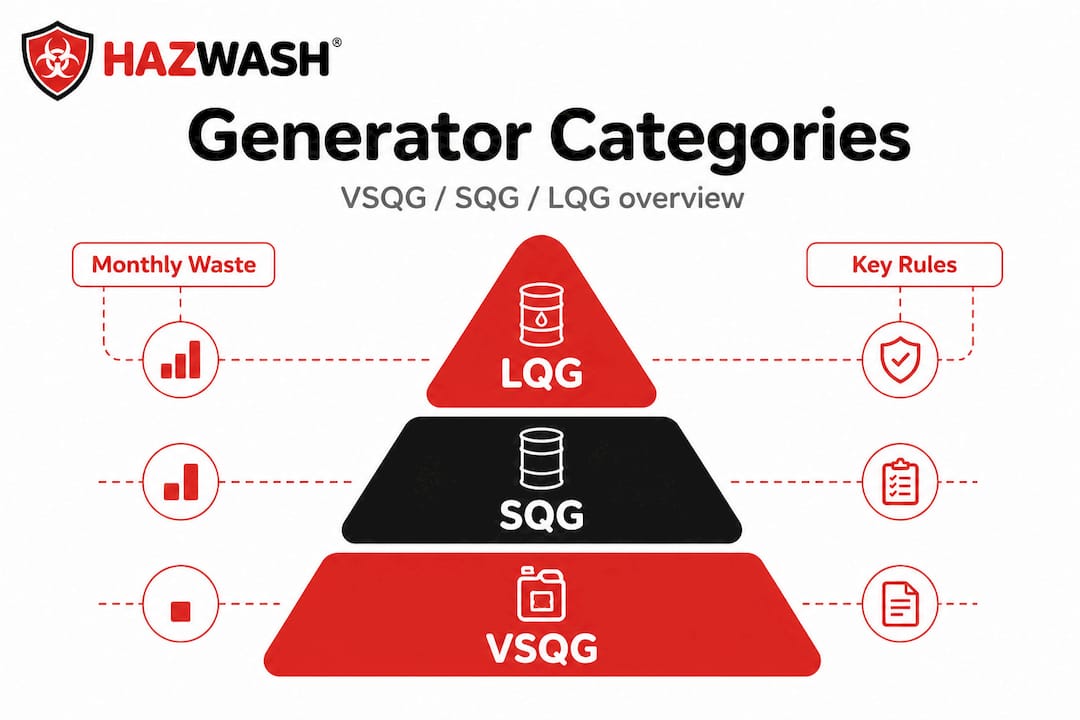
| Category | Non-acute waste per month | Acute waste per month | Key obligations |
|---|---|---|---|
| VSQG | 100 kg or less | 1 kg or less | Minimal paperwork, no accumulation time limit if sent to permitted facility |
| SQG | 100 to 1,000 kg | Less than 1 kg | 270-day accumulation limit, biennial reporting, emergency planning |
| LQG | 1,000 kg or more | 1 kg or more | 90-day accumulation limit, full RCRA/Part 111 permit required, contingency plans |
Most property managers, landlords, and families fall into the VSQG category. A landlord cleaning out a unit after a tenant leaves, disposing of old paint, solvents, or cleaning chemicals, typically generates well under 100 kg of hazardous waste in any given month. Families handling estate cleanouts are almost always VSQGs as well.
However, there are important exceptions. A large property management company overseeing dozens of units simultaneously could cross into SQG territory during a major renovation cycle. A landlord who discovers an illegal drug lab on a property could generate acute hazardous waste, which carries far stricter limits. Even one kilogram of acute hazardous waste per month triggers LQG status.
Pro Tip: Track your waste generation monthly, not annually. Generator status is determined month by month. One heavy month can change your classification and your compliance obligations for that period.
The concept of an “episodic event” is critical for VSQGs and SQGs. If you have an unusual, one-time situation that causes you to generate more waste than normal, such as a major cleanout or a spill remediation, Michigan allows you to handle that event under a temporary allowance without permanently changing your generator status. You get one planned episodic event per year. Unplanned events require immediate notification to EGLE. Failing to notify can turn a manageable situation into a serious violation.
Reviewing hazardous waste examples and understanding Detroit families’ hazmat responsibilities will help you identify what counts as hazardous waste before you generate it.
Essential duties for property managers and families under VSQG
Now that you know your likely generator status, let’s get practical about day-to-day compliance. VSQGs have the lightest regulatory burden, but “lightest” does not mean “none.”
VSQGs must follow these core requirements:
- Containers must be in good condition. No leaks, no corrosion, no damage that could cause a release.
- Containers must be compatible with the waste. Do not put acid waste in a metal drum that will corrode.
- Containers must be kept closed except when adding or removing waste.
- Containers must be labeled to identify the contents as hazardous waste.
- Waste must be sent to a permitted facility. You cannot dispose of hazardous waste in regular trash, down a drain, or on the ground.
- Episodic events require proper notification if unplanned, and advance planning if planned.
| Requirement | VSQG standard | Common mistake |
|---|---|---|
| Container condition | Good condition, no leaks | Using damaged or corroded containers |
| Labeling | “Hazardous Waste” plus contents | Unlabeled or vague labels |
| Storage limit | No time limit if sent to permitted facility | Assuming no limit means no action needed |
| Disposal destination | Permitted treatment/disposal facility | Using unlicensed haulers or landfills |
| Episodic events | One planned per year, unplanned requires notice | Failing to notify EGLE for unplanned events |
The most common mistakes we see from property managers and families are over-accumulation and mislabeling. Over-accumulation happens when waste sits on a property for months with no plan for disposal. Even though VSQGs have no strict time limit, leaving hazardous waste on-site indefinitely creates liability, especially if a tenant or visitor is exposed. Mislabeling is equally dangerous. A container labeled only “old chemicals” does not meet the standard and can result in improper handling downstream.
Pro Tip: Schedule quarterly walkthroughs of your property specifically to identify and properly dispose of accumulated hazardous materials. Do not wait for a complaint or inspection to trigger action.
For step-by-step guidance on handling a biohazard situation on a rental property, the step-by-step biohazard cleaning guide and the landlord safe cleanup guide are practical starting points.
Manifests, records, and reporting: Stay compliant, avoid fees
Practical handling goes hand-in-hand with the paperwork. Here is what every property manager must track and file.
A hazardous waste manifest is a tracking document that accompanies waste from your property to its final disposal destination. Property managers must use manifests for all off-site transport of hazardous waste. After the waste is transported, you must submit copies to EGLE within 10 days of the end of the month in which the waste was shipped. You are required to retain those records for a minimum of three years.
If you do not receive a signed return copy of the manifest from the disposal facility within 45 days of shipment, you must file an exception report with EGLE. That report explains the discrepancy and documents your efforts to locate the waste. Missing this deadline does not just create paperwork problems. It signals to regulators that your waste may have been mishandled or illegally dumped, which opens you to broader scrutiny.
Record retention rule: Keep all manifests, exception reports, and related correspondence for at least three years from the date of the shipment. Store them in a format you can produce quickly during an inspection.
Michigan also imposes state-specific landfill fees of $10 per ton (or equivalent) on hazardous waste disposed at landfills and solidification facilities. Exemptions exist, but they must be formally certified. Generators who falsely certify an exemption face liability for the full fee plus potential penalties. This is not a technicality. EGLE actively audits these certifications.
Key documentation steps to follow:
- Obtain a signed manifest before any hazardous waste leaves your property.
- Keep a copy of the manifest for your records immediately.
- Confirm receipt of the signed return copy from the disposal facility.
- If no return copy arrives within 45 days, file your exception report promptly.
- Certify any fee exemptions accurately and retain supporting documentation.
- Store all records for a minimum of three years in an accessible location.
The Detroit property manager disposal guide covers the full disposal process in detail, including how to select a permitted hauler and what to verify before waste leaves your site.
Special cases: Contaminated property and land use restrictions
For the tough cases: What if your property is already compromised, or contamination cannot be fully cleaned up?
This scenario is more common than many property managers realize. A landlord purchases a property with prior industrial use and discovers soil contamination. A family inherits a home where a previous owner stored chemicals improperly. A tenant vacates a unit and leaves behind materials that have already leached into the floor or walls.
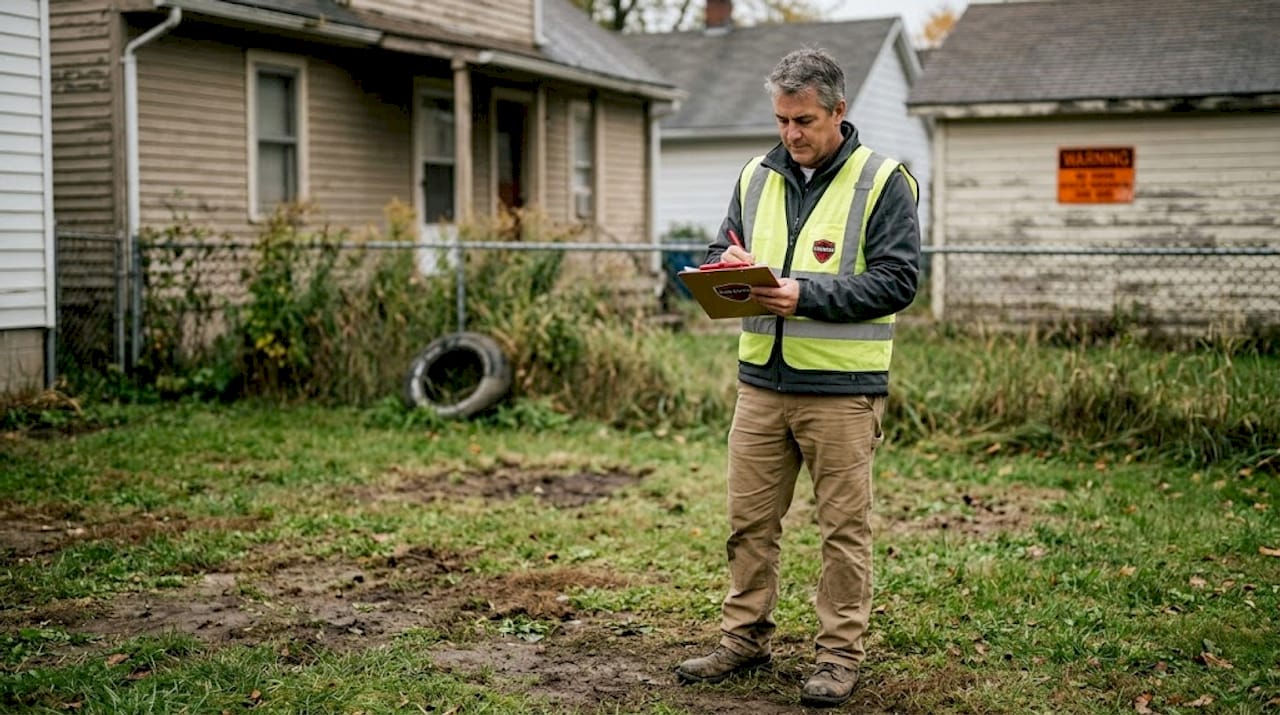
Michigan’s approach under Part 201 and Part 213 does not always require full removal of contamination. Instead, the state allows “in-place management” through land use restrictions. These are legally binding restrictions recorded with the property deed, such as restrictive covenants, that limit how the property can be used to prevent exposure to the contamination.
Key points for contaminated property situations:
- Notification is required if contamination could migrate off-site. EGLE must be informed promptly.
- Land use restrictions must be recorded with the county register of deeds to be legally effective.
- Restrictions run with the land, meaning future buyers and tenants are legally bound by them.
- Buyers and renters have a right to know about recorded restrictions before entering a transaction.
- Failure to notify EGLE about off-site migration can result in enforcement action independent of cleanup obligations.
- Families and renters in properties with recorded restrictions should receive written disclosure of what is restricted and why.
The practical challenge for landlords is that in-place management sounds like a convenient solution, but it creates long-term obligations. You must maintain the restrictions, ensure they are properly recorded, and disclose them to future tenants and buyers. Failing to do so can void the legal protection the restriction was designed to provide.
Understanding biohazard risk indicators on a property can help you identify contamination concerns before they escalate into formal regulatory matters.
The overlooked dangers of ‘just following the rules’
Here is an uncomfortable truth that most compliance guides will not tell you: meeting the minimum legal standard is not the same as managing your actual risk.
We work with property managers who have done everything technically right. Proper labels, manifests filed on time, waste sent to a permitted facility. And then something goes wrong. A tenant reports a chemical smell that was never investigated. A maintenance worker handles unlabeled containers left by a previous occupant. An unplanned spill occurs and the notification deadline passes because no one knew it applied to them.
Michigan’s regulatory framework is detailed, but it cannot account for every real-world scenario. VSQGs avoid most of the heavy paperwork burden, but that lighter touch means less built-in structure for safety planning. The managers who get into trouble are often the ones who treat compliance as a checklist rather than a safety strategy.
The practical gaps we see most often:
- No written protocol for unexpected discoveries. A maintenance worker finds unknown chemicals. Without a clear procedure, the instinct is to move them, which can trigger a violation.
- Tenant-generated waste ignored. Tenants sometimes store hazardous materials on your property. As the property manager, you may still bear responsibility for proper disposal.
- Episodic events handled informally. A major cleanout happens, waste volume spikes, and no one thinks to check whether EGLE notification was required.
The solution is not more paperwork. It is building a proactive inspection and response plan before something goes wrong. Schedule regular property inspections that specifically look for hazardous materials. Train maintenance staff on basic identification and reporting. Know your EGLE contact before you need them. And when a situation exceeds your expertise, bring in OSHA-compliant cleanup professionals who understand both the regulatory and practical dimensions of the work.
Compliance is the floor, not the ceiling. Safety-first thinking is what keeps you, your tenants, and your properties genuinely protected.
Get expert help with Michigan hazardous waste
Michigan’s hazardous waste regulations are detailed, layered, and unforgiving of honest mistakes. Reading this guide gives you a strong foundation, but some situations require certified, hands-on expertise that goes beyond what any property manager or family should handle alone.
HazWash LLC provides certified biohazard and hazardous waste cleanup services across Detroit and the surrounding Michigan area. Our team holds OSHA HAZWOPER, IICRC, and DOT certifications, and we document every step of the process to protect your legal standing. Whether you are dealing with a contaminated rental unit, an estate cleanout, or an unexpected spill, we respond 24/7 with discreet, compliant service. Review our federal compliance hazardous cleanup guide and our DOT hazardous waste guide for additional detail, or contact HazWash directly to discuss your situation with a certified specialist.
Frequently asked questions
Who enforces hazardous waste rules for Michigan landlords?
Michigan’s Department of Environment, Great Lakes, and Energy (EGLE) enforces hazardous waste regulations, including those under NREPA Part 111. EGLE has authority to inspect properties, issue orders, and assess penalties.
How much hazardous waste can a Michigan property manager store without a permit?
VSQGs have no strict accumulation time limit as long as waste is sent to a permitted facility and containers are properly managed. However, indefinite storage still creates liability exposure.
What happens if you miss a hazardous waste reporting deadline in Michigan?
Missing a deadline triggers the requirement to file an exception report with EGLE, and failure to submit manifests on time can invite regulatory scrutiny and civil penalties.
Is it legal to leave contamination in place on a Michigan property?
Yes, under Part 201 and Part 213, in-place management is permitted using land use restrictions recorded with property deeds, provided EGLE is properly notified of any off-site migration risk.
What’s a hazardous waste ‘episodic event’ for landlords?
An episodic event is a temporary, non-routine spike in waste generation that lets you exceed your normal VSQG limits. One planned event per year is allowed, and unplanned events require immediate notification to EGLE to maintain your generator status.