DOT Hazardous Waste Explained: Detroit Property Guide
DOT Hazardous Waste Explained: Detroit Property Guide
Property managers are liable for hazardous waste packaging and documentation, even when hiring haulers.
Understanding DOT and EPA regulations is essential for safe hazardous waste transport and compliance.
Proper classification, labeling, and record-keeping prevent costly penalties and legal exposure.
Many Detroit property managers assume DOT hazardous waste regulations are a trucking company problem. That assumption is costly. The moment hazardous materials are packaged for transport off your property, you share liability under federal law. Whether you’re managing a residential complex, a commercial building, or a vacant industrial site, you need to understand how DOT (Department of Transportation) and EPA rules intersect, what triggers compliance obligations, and why simply hiring a hauler doesn’t end your responsibility. This guide breaks down exactly what DOT hazardous waste means, what documentation you need, and how to protect yourself and your Detroit properties.
Table of Contents
How Detroit properties achieve DOT hazardous waste compliance
A property manager’s blind spot: Why ‘just hiring a hauler’ isn’t enough
Key Takeaways
PointDetailsDOT vs. EPA rolesDOT rules cover hazardous waste transportation while EPA focuses on waste generation and storage.Liability remains localDetroit property managers are responsible for classification, packaging, and documentation—even when hiring a pro.Emergency responses matterImmediate spill containment and the right emergency calls prevent fines and legal issues.Know the exceptionsHousehold and small quantity hazardous waste may be exempt, but check details before acting.Professional help reduces riskLicensed haulers and cleanup teams make compliance smoother and lower penalty risk for Detroit properties.
What is DOT hazardous waste?
Most people use “DOT hazardous waste” and “EPA hazardous waste” interchangeably. They shouldn’t. These are two distinct regulatory frameworks with different triggers, requirements, and enforcement agencies.
The EPA, under the Resource Conservation and Recovery Act (RCRA) and 40 CFR Part 261, defines what qualifies as hazardous waste from the point it’s generated through its storage, treatment, and final disposal. DOT, under 49 CFR 172.101, governs how that waste is classified, packaged, labeled, and transported once it leaves a property. Both agencies regulate hazardous materials, but DOT and EPA cover different phases of the waste lifecycle.
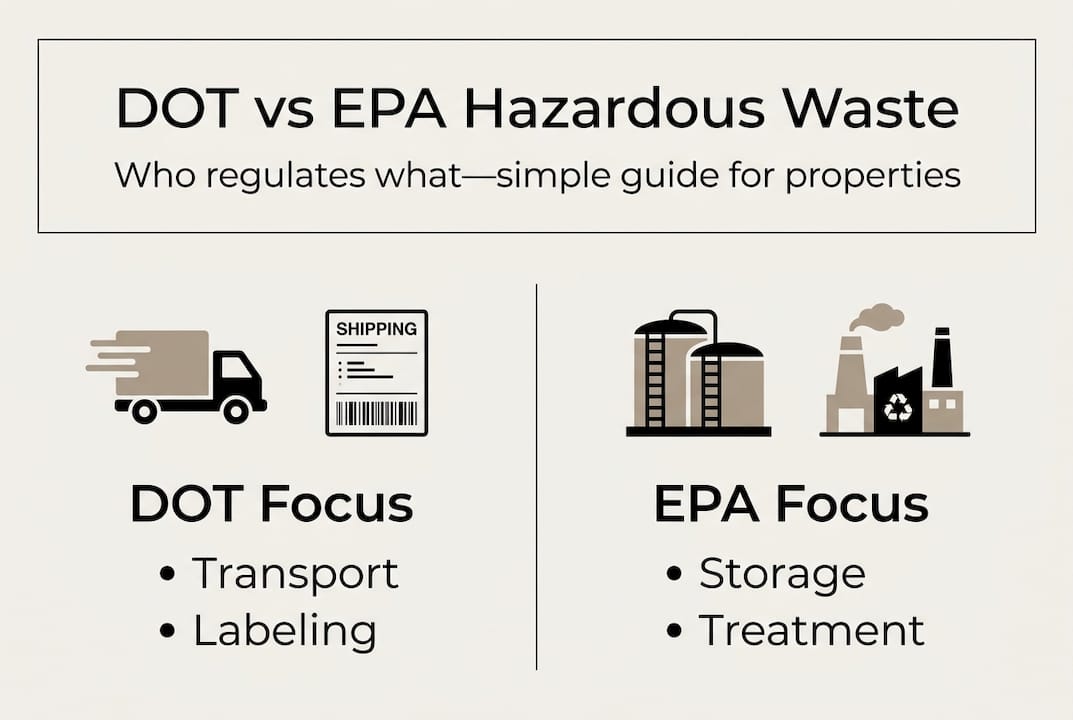
Here’s a clear comparison:
CategoryDOTEPA/RCRAPrimary focusTransport, labeling, packagingGeneration, storage, treatment, disposalKey regulation49 CFR 172.101 HMT40 CFR Part 261Triggers complianceOffer for off-site transportWaste generation on-siteHazard classes9 hazard classesListed and characteristic wastesWho enforcesDepartment of TransportationEnvironmental Protection Agency
Note this critical distinction: not every EPA-regulated waste is automatically DOT-regulated, and not every DOT hazardous material qualifies as EPA hazardous waste. The overlap exists, but gaps create real liability traps for property managers.
Common types of waste that fall under DOT rules during transport include:
Flammable liquids (Class 3): paints, solvents, gasoline
Corrosives (Class 8): battery acid, industrial cleaners
Toxic materials (Class 6): pesticides, mercury compounds
Oxidizers (Class 5): pool chemicals, peroxides
“DOT regulates transportation risks across 9 hazard classes per 49 CFR 172.101, while EPA/RCRA defines and regulates hazardous waste generation, storage, treatment, and disposal under 40 CFR Part 261.”
Review examples of regulated hazardous waste specific to Detroit properties if you’re unsure which category applies to materials on your site. Understanding the classification step is where compliance either starts well or falls apart immediately. The disposal steps for Detroit properties build directly from this classification foundation.
DOT regulations for transporting hazardous waste
With definitions clear, it’s crucial to see how these rules impact the actual movement of waste from your property. DOT compliance isn’t just a hauler’s job. If you direct packaging, sign shipping documents, or prepare waste for pickup, you’re a regulated party.
Here’s what DOT transport requirements look like broken down into steps:
Classify the waste. Identify the correct hazard class (e.g., flammable liquid, corrosive) and assign the proper UN number.
Use DOT-approved packaging. Non-bulk containers must hold 119 gallons (450 liters) or less. UN-specification drums are required for most wastes.
Label every container correctly. Diamond-shaped hazard class labels, proper shipping names, and UN numbers must appear on all packages.
Prepare the manifest. The Uniform Hazardous Waste Manifest is a legal document tracking the waste from origin to final disposal.
Placard the vehicle. If the shipment exceeds 1,001 pounds aggregate, placards identifying the hazard class must be displayed on the transport vehicle.
Verify training. Everyone who prepares hazardous waste for shipment must complete hazmat training every 3 years.
RequirementThreshold or SpecificationNon-bulk container limit119 gal / 450 L maxVehicle placard triggerOver 1,001 lbs aggregateHazmat training cycleEvery 3 yearsManifest requiredAll off-site hazardous waste transport
Property managers often don’t realize that signing a manifest makes them a legally accountable party. That signature confirms the waste was properly identified and packaged before transport. Errors in that process, even if made by a contractor, can still result in penalties traced back to the property owner.
Pro Tip: Before any hauler picks up waste from your property, request copies of their DOT operating authority, RCRA permits, and current hazmat training records. Verify these before signing anything. Proper documentation for Detroit hazardous cleanups protects you if regulators ever audit the chain of custody.
The reality is that DOT compliance starts at your property, not at the truck. The moment materials are classified and packaged for removal, the clock is running on your liability exposure.
Key scenarios and exceptions for property managers
Transportation rules are one part of the compliance puzzle, but what happens in less typical or emergency situations? Detroit properties face a range of real-world scenarios that complicate standard procedures.
Emergency spills: If a spill occurs that threatens off-site health or the environment, you must immediately contain the flow, remove contaminated soil or materials, and notify the National Response Center at 800-424-8802. Failing to report a qualifying spill carries separate penalties on top of any cleanup violations. Post emergency coordinator contact information on-site and maintain spill kits and extinguishers at the ready.
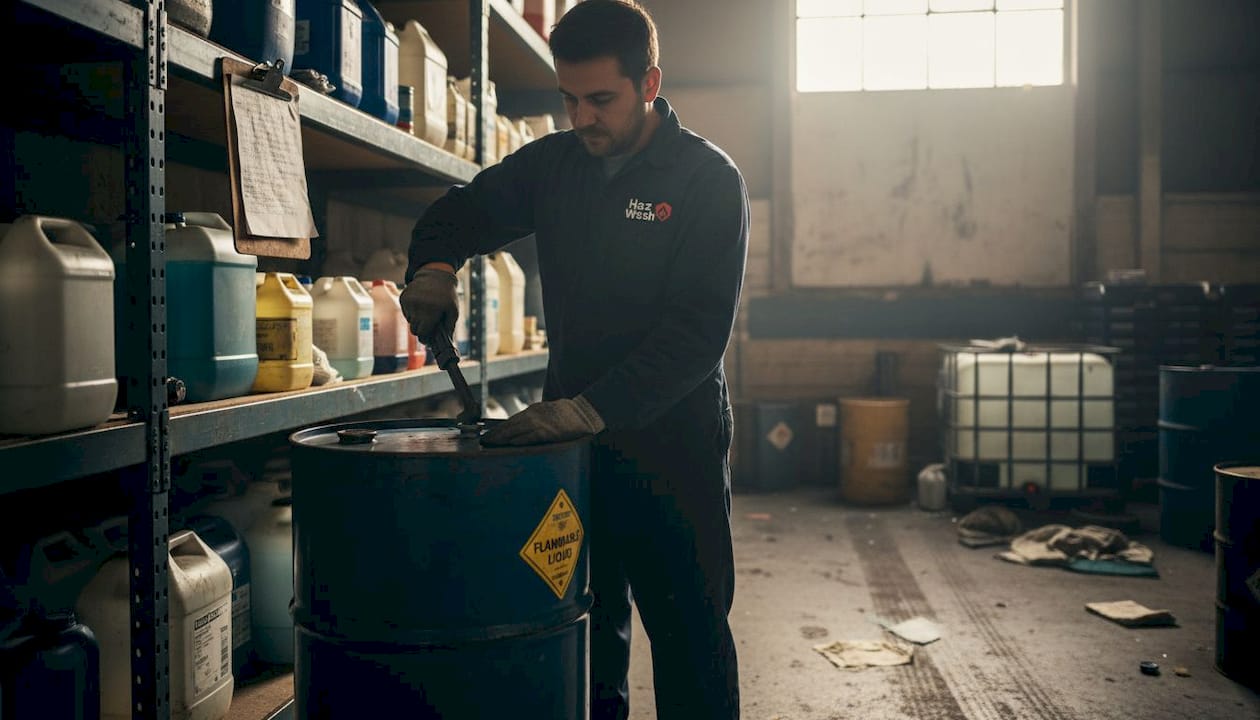
Vandalism, fire, or illegal dumping: These are common in Detroit’s vacant and distressed properties. When fire or criminal activity introduces hazardous materials, the property owner may still be liable for proper disposal. The EPA-led cleanup at Detroit’s former EMCO Chemical Facility is a documented example: over 1,000 drums of flammables, corrosives, and chlorinated chemicals required licensed professional haulers for safe removal and disposal.
Key exceptions you should know:
Household hazardous waste is generally exempt from RCRA regulations. Residential landlords dealing with tenant-generated household chemicals may qualify, but commercial properties do not.
Small quantity exceptions under DOT allow limited quantities (inner packaging of 1.2 liters or less in a barrier bag) without full hazmat labeling in some cases.
Lab pack rules permit certain wastes in open-head drums for specific chemical categories.
Mixed radiological wastes are dual-regulated by both the Nuclear Regulatory Commission and the EPA, requiring additional compliance steps.
“For property managers, hire licensed contractors for DOT and EPA-compliant cleanup to avoid liability in emergencies, and notify the National Response Center at 800-424-8802 if there’s any threat to off-site health or the environment.”
Familiarize yourself with safe biohazard response scenarios so you’re never making containment decisions under pressure without a plan. Properties affected by drug lab incidents carry especially complex DOT and EPA obligations that require specialized licensed response.
How Detroit properties achieve DOT hazardous waste compliance
Knowing what’s required and what can go wrong, let’s walk through how Detroit property managers can put DOT and EPA best practices into action.
Start with a clear checklist:
Identify all hazardous materials on-site. Walk the property and catalog chemicals, drums, tanks, and any waste streams.
Classify each material. Use the EPA waste characterization process to determine if materials are listed (F, K, P, U lists) or characteristic wastes (ignitability, corrosivity, reactivity, toxicity).
Hire a licensed hazardous waste contractor. Verify RCRA generator status, DOT registration, OSHA HAZWOPER certification, and active state permits from Michigan EGLE (Environment, Great Lakes, and Energy, formerly MDEQ).
Complete all manifest paperwork before transport. Never allow a hauler to leave without a signed Uniform Hazardous Waste Manifest on file.
File records and retain copies. Federal rules require manifests to be retained for at least 3 years. Michigan EGLE may require longer retention in some cases.
Report to the right contacts. For state-level guidance, contact EGLE directly. For federal emergencies, the National Response Center handles initial spill notifications.
Key contacts for Detroit property managers:
Michigan EGLE Hazardous Waste: 800-662-9278
National Response Center: 800-424-8802
EPA Region 5 (Chicago, covering Michigan): 312-353-2000
The EPA-led EMCO cleanup in Detroit stands as a real-world benchmark. When licensed haulers and certified contractors managed the removal of over 1,000 drums, it demonstrated exactly how coordinated DOT and EPA compliance works at scale.
Statistic worth noting: DOT civil penalties for hazardous materials transport violations can reach $84,425 per violation per day under 49 U.S.C. 5123. Non-compliance is not a budget line item. It’s an existential risk for property managers.
Refer to the Detroit disposal guide for local vendor requirements and the property disposal checklist to structure your on-site process step by step.
A property manager’s blind spot: Why ‘just hiring a hauler’ isn’t enough
Here’s the uncomfortable reality most property managers don’t hear until after a penalty notice arrives: hiring a certified waste hauler does not transfer your regulatory liability.
Under both DOT and EPA frameworks, the property owner or manager who generates, identifies, or initiates the removal of hazardous waste carries responsibility for accurate classification and proper documentation up to the point of transport. If your contractor mislabels a drum or skips a manifest entry, regulators can trace that gap directly back to you as the responsible party on the paperwork you signed.
The shortcuts we see repeatedly are the same: missed NRC notifications after spills, improperly completed manifests, expired hauler permits that no one verified, and labels that don’t match the waste inside the container. Each one is a separate violation.
Treat every step as auditable. Assume every manifest, label, and permit will be reviewed by a federal inspector. That mindset shift alone changes how property managers engage with contractors and protect themselves. The property manager compliance guide walks through exactly what audit-ready documentation looks like for Detroit properties. Compliance isn’t delegated. It’s owned.
Get professional hazardous waste help in Detroit
DOT and EPA compliance demands are real, and the cost of getting it wrong is high.
HazWash specializes in DOT and EPA-compliant hazardous waste cleanup for Detroit property managers and landlords. From initial waste classification to manifest preparation, licensed removal, and final disposal documentation, we manage every step of the process. Our team holds OSHA HAZWOPER, IICRC, and DOT certifications, and we respond 24/7 to emergency incidents. Review our biohazard incident expertise or request a biohazard risk assessment to identify exposure on your specific Detroit properties. We make compliance straightforward so you can focus on managing your portfolio without regulatory risk.
Frequently asked questions
Do I need to worry about DOT hazardous waste if my waste never leaves the property?
DOT rules apply only when waste is offered for off-site transport. However, EPA/RCRA still governs how you store and manage hazardous waste on-site, so both sets of rules may apply depending on your situation.
What counts as proper DOT packaging and labeling for hazardous waste?
DOT requires UN-specification packaging, diamond-shaped hazard class labels, and correct shipping names and UN numbers on all non-bulk containers. Placards are required on transport vehicles when the aggregate shipment exceeds 1,001 pounds.
Who do I call for a hazardous waste spill emergency in Detroit?
Contact the National Response Center at 800-424-8802 immediately if the spill threatens off-site health or the environment. Also contact Michigan EGLE at 800-662-9278 for state-level guidance and reporting.
Are there any exceptions for small quantities or household hazardous waste?
Household hazardous waste is generally exempt from RCRA regulations. Limited quantity exceptions exist under DOT for inner packaging at or below 1.2 liters. Property managers should verify whether these exemptions apply before assuming reduced obligations.
What is the penalty for non-compliance with DOT hazardous waste transport?
DOT civil penalties can reach over $84,000 per violation per day under federal law. Improper labeling, packaging, or incomplete documentation are the most common triggers for these fines.