Federal compliance for hazardous cleanup: Michigan property guide
Federal compliance for hazardous cleanup: Michigan property guide
Federal regulations apply directly to property cleanup, requiring owner oversight and proper documentation.
Compliance involves creating plans, verifying vendor credentials, using approved disinfectants, and retaining records.
Property owners remain liable and must ensure post-cleanup validation and proper waste disposal.
Most Michigan property owners assume that hazardous cleanup compliance is largely a state matter. That assumption is costly. Federal regulations, including OSHA’s Bloodborne Pathogens Standard, EPA and DOT rules, and CERCLA liability provisions, apply directly to traumatic and biohazard incidents on your property. These laws govern how cleanup is performed, how waste is handled and transported, and who bears financial responsibility when something goes wrong. Whether you manage a single rental or a multi-unit commercial building, federal obligations exist alongside Michigan state requirements. This guide walks you through what those obligations are, how they apply in practice, and what you need to do to protect yourself.
Table of Contents
Key Takeaways
PointDetailsFederal rules matterFederal OSHA, EPA, DOT, and CERCLA regulations apply to most hazardous cleanup situations in Michigan.Documentation is essentialProper manifests, exposure plans, and validation testing help protect owners from liability during biohazard cleanup.Certified vendors reduce riskHiring IICRC or ABRA-certified cleanup professionals shifts some operational liability but requires ongoing oversight.Edge cases require cautionNot all incidents trigger professional remediation, but unattended deaths or hazardous spills demand expert intervention.State and federal laws integrateMichigan property owners must comply with both federal and state cleanup regulations, which reference each other.
Understanding federal regulations for hazardous cleanup
Federal law sets the baseline for safe biohazard and trauma scene cleanup across the country. Michigan state rules build on that foundation, but ignoring the federal layer is where many property owners run into serious trouble.
The two primary regulatory pillars are OSHA and the EPA. OSHA’s Bloodborne Pathogens Standard (29 CFR 1910.1030) is the cornerstone rule governing worker safety during biohazard cleanup. It requires exposure control plans, proper personal protective equipment (PPE), and the use of EPA-registered disinfectants. This standard applies to any worker with potential occupational exposure to blood or other potentially infectious materials (OPIM). For property owners, it means any cleanup crew you hire must follow these requirements, and you need to verify that they do.
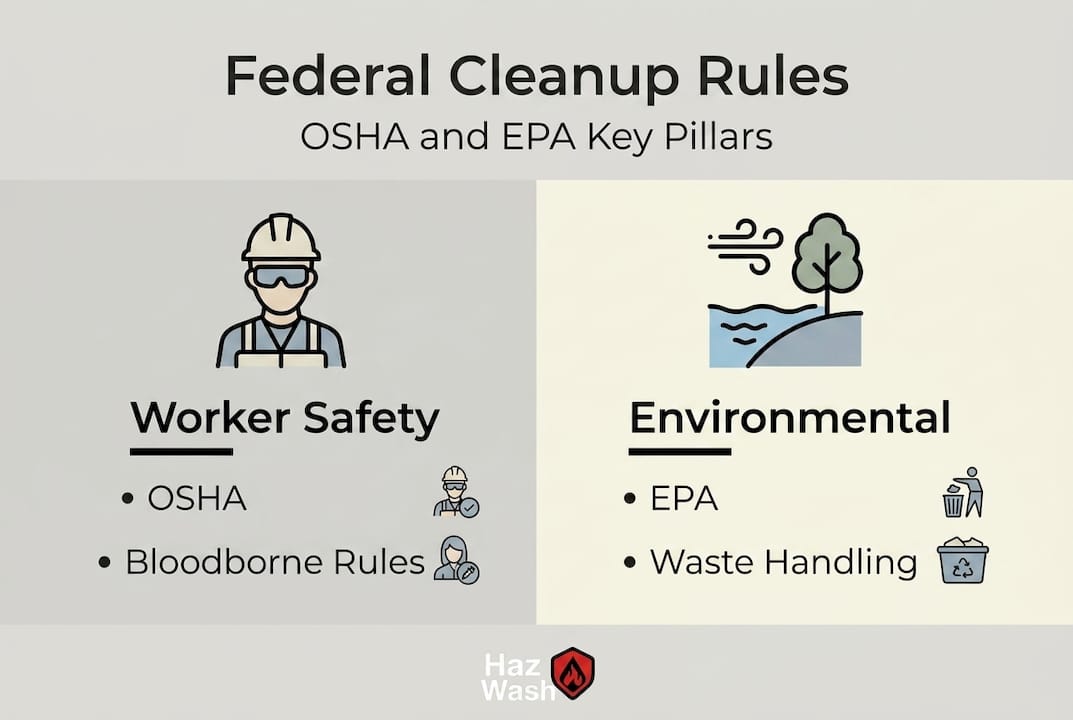
On the environmental side, EPA medical waste rules under the Resource Conservation and Recovery Act (RCRA) govern how biological waste must be packaged, stored, and disposed. The Department of Transportation (DOT) regulates the transport of that waste from your property to a licensed disposal facility. These are not optional guidelines. Violations carry civil penalties.
Then there is CERCLA, commonly called the Superfund law. CERCLA imposes liability on property owners when hazardous substances are released into the environment, even if the release was accidental or caused by a tenant. This is the law most property owners have never heard of until they are facing cleanup costs they did not budget for.
Michigan does not operate independently of these rules. The state integrates federal requirements through Part 111 (hazardous waste management) and Part 201 (environmental remediation) of the Natural Resources and Environmental Protection Act. For a deeper look at how OSHA cleanup standards apply locally, that resource is worth reviewing alongside Michigan EGLE guidance.
Here is a quick comparison of the major federal regulations:
RegulationAgencyGovernsApplies to property owners?Bloodborne Pathogens StandardOSHAWorker safety, PPE, disinfectionYes, via hired contractorsRCRA / Medical Waste RulesEPAWaste packaging, storage, disposalYes, waste generated on propertyDOT Hazmat RulesDOTTransport of biological wasteYes, through contracted haulersCERCLA (Superfund)EPAEnvironmental release liabilityYes, directly
Key takeaway: Federal regulations apply to what happens on your property, not just to the professionals performing the work. Your oversight role creates legal exposure if compliance breaks down.
For property managers in the Detroit metro area, Detroit biohazard protocols provide jurisdiction-specific guidance layered on top of these federal requirements.
With regulatory groundwork set, let’s map how these rules intersect for Michigan properties.
How federal rules apply in Michigan property cleanup
Understanding the rules is one thing. Executing compliant cleanup on your property is another. Here is the operational sequence every Michigan property owner and manager should follow after a traumatic or biohazard incident.
Step-by-step compliance process:
Create an exposure control plan. Before any cleanup begins, document who is at risk, what tasks involve exposure, and what protective measures will be used. Per OSHA Bloodborne Pathogens Standard requirements, this plan must be written and site-specific.
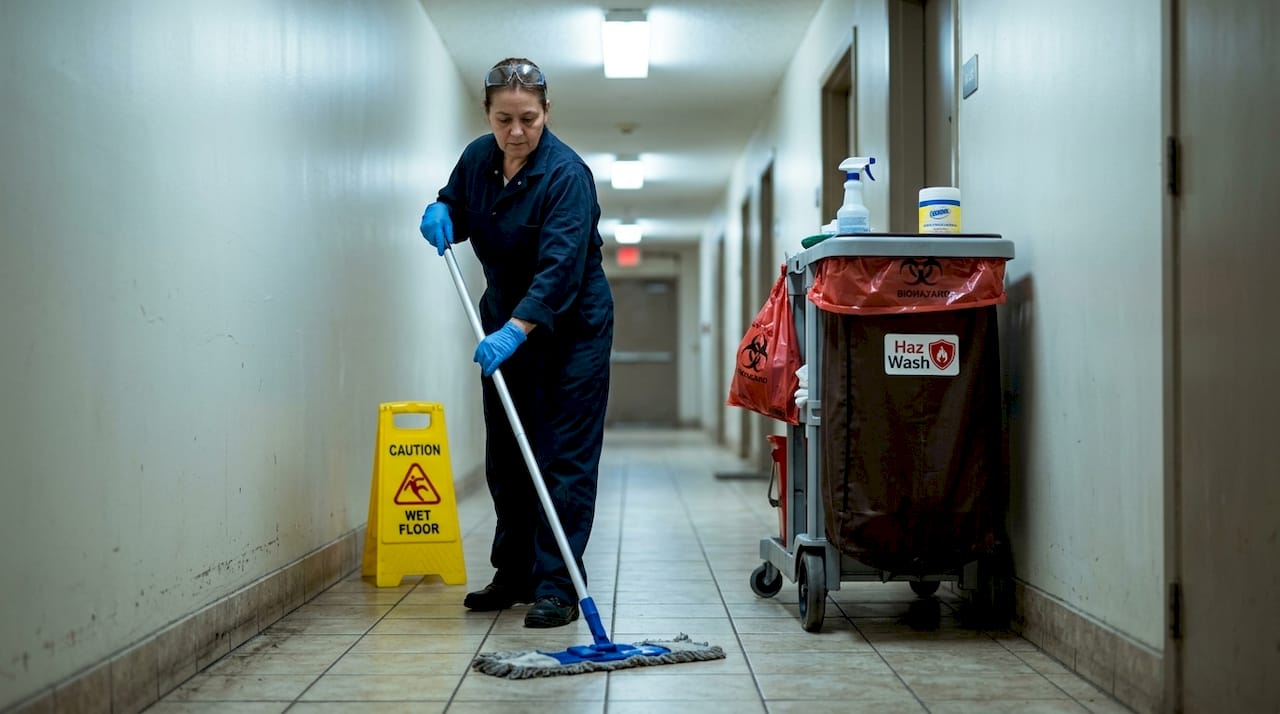
Confirm appropriate PPE. Workers must use gloves, respirators, eye protection, and protective clothing at a minimum. Verify your contractor is equipped before they enter the scene.
Use EPA-registered disinfectants. Not all cleaning products qualify. Confirm the products used appear on EPA’s List N or an equivalent approved registry.
Package waste in compliant containers. Biohazardous waste must go into leak-proof, labeled, puncture-resistant containers. This is non-negotiable under both EPA and DOT requirements.
Ensure DOT-compliant transport. The hauler must have proper DOT registrations and use labeled vehicles. Request documentation before waste leaves your property.
Confirm licensed disposal. Waste must be delivered to a facility permitted for biological or hazardous waste. Get the name and permit number.
Collect and retain all manifests. Waste transport manifests are your paper trail. Keep them for at least three years, or longer if your state requires it.
Michigan adds another layer. Michigan EGLE enforcement under Part 111 requires that hazardous waste generated at your property is tracked from creation to disposal. Part 201 applies when soil or groundwater contamination is suspected, which can occur in cases involving severe decomposition or large chemical spills.
Here is a practical reference for documentation timelines:
Document typeMinimum retention periodWho needs itExposure control planDuration of incident + 3 yearsProperty owner / contractorDOT transport manifest3 yearsProperty ownerDisposal facility confirmation3 yearsProperty ownerPost-cleanup validation test3 yearsProperty owner
Pro Tip: Keep digital copies of all manifests and test results in a dedicated folder for each property. If a regulatory review happens months later, disorganized records are treated the same as missing records.
For a full breakdown of what to retain and when, the cleanup documentation requirements resource provides a structured checklist. And for urgent situations, emergency cleanup best practices outlines how to sequence these steps under time pressure.
With rules aligned, let’s see how property owners should execute compliant cleanup procedures.
Key edge cases, liability, and common pitfalls
Even with best practices in place, specific scenarios create extra risk. Knowing where the edges are keeps you out of trouble.
Common edge cases Michigan property owners face:
Unattended deaths and decomposition. These incidents produce significant biological hazard beyond visible surfaces. Fluids can penetrate subflooring, drywall, and HVAC systems. Professional remediation is almost always necessary.
Small spills with no occupational exposure. A minor spill may not require full professional remediation if there is no worker exposure risk. However, disposal must still follow federal and state guidelines, even for property owners who are not classified as employees under OSHA.
Dual hazard incidents. Situations involving both biological material and chemical substances (such as drug labs or industrial accidents) trigger multiple regulatory frameworks simultaneously.
Tenant-caused incidents. You, as the property owner, remain responsible for proper cleanup and disposal even when a tenant caused the incident.
On the CERCLA side, Superfund landowner liability protections exist but require that you take immediate action, cooperate with authorities, and did not cause or contribute to the contamination. Passive property owners who delay action rarely qualify for these protections.
Critical reminder: CERCLA liability in biohazard situations typically arises only when there is a significant environmental release, such as contamination reaching soil or groundwater. Most trauma scene incidents do not rise to that level. However, operational liability under OSHA and EPA rules applies regardless.
Common documentation mistakes that create legal exposure:
Failing to obtain a signed waste manifest from the hauler
Hiring vendors who cannot provide proof of IICRC or DOT credentials
Skipping post-cleanup validation testing and relying only on visual inspection
Not retaining records long enough for potential regulatory review
For landlords specifically, the landlord cleanup tips resource addresses tenant-related incident response in detail. And for a broader look at incident categories, types of hazardous incidents clarifies which scenarios escalate compliance requirements.
Pro Tip: Always ask vendors for their DOT registration number and IICRC certification before work begins. A vendor who hesitates to provide these documents is a risk you should not take.
Practical compliance actions for Michigan property owners
Now, here is how to turn theory into everyday practice for property owners and managers.
Compliance is not a one-time action. It is an ongoing management responsibility. These are the steps that separate property owners who are protected from those who are exposed.
Selecting the right vendor:
Verify IICRC S540 certification, which is the industry standard for trauma and crime scene cleanup.
Confirm ABRA (American Bio-Recovery Association) membership or equivalent credentials.
Ask for proof of OSHA HAZWOPER training for all technicians on the job.
Request their DOT registration and EPA waste hauler permits before signing any agreement.
Recordkeeping and oversight:
Collect DOT manifests on the day of waste removal. Do not wait.
Retain all vendor documentation including certificates of completion.
Log every incident, cleanup date, and disposal confirmation in a property management file.
Note that federal medical waste tracking responsibilities shifted to states after 1991, meaning Michigan EGLE is your primary enforcement contact for disposal compliance.
Post-cleanup validation:
Require ATP (adenosine triphosphate) testing after every biohazard cleanup. ATP testing measures biological residue at a microscopic level that visual inspection cannot detect. A clean-looking surface can still fail ATP validation.
Request written test results with pass/fail thresholds documented.
Hiring certified professionals shifts much of the operational liability away from you. But as EPA Superfund protections clarify, oversight and documentation responsibilities remain with the property owner. Handing off the physical work is not the same as handing off compliance.
For a structured approach to managing these responsibilities, the step-by-step landlord guide and the hazardous waste disposal tips resource both offer practical frameworks built for Michigan property managers.
Pro Tip: Schedule a compliance review every six months even when no incidents have occurred. Confirm that your vendor agreements, documentation templates, and staff training are current. Regulatory requirements can shift, and staying ahead of updates protects you before an incident happens.
What most Michigan property owners miss about federal hazardous cleanup compliance
Here is what we see consistently in our work: property owners treat federal compliance as a backup concern, something that only applies in extreme situations. That mindset is wrong, and it creates real exposure.
Federal rules engage the moment a biohazard incident occurs on your property. OSHA requirements apply to your cleanup crew. EPA rules govern the waste that leaves your building. These are everyday operational realities, not edge-case scenarios.
Many owners also assume that hiring a certified vendor transfers all liability to that vendor. It does not. Odor removal guidance and broader compliance resources make this point clearly: you retain oversight responsibility regardless of who performs the physical work. If the vendor mishandles waste disposal and you did not verify their credentials or collect their manifests, regulators will look at you.
The property owners who stay compliant share three habits: they document everything, they verify vendor credentials before each job, and they request post-cleanup validation testing without exception. None of these steps are complicated. They just require discipline.
Do not rely solely on Michigan state rules when managing a biohazard incident. Federal protocols exist in parallel and carry independent enforcement authority.
Get help with hazardous cleanup compliance
Navigating federal and Michigan state compliance after a traumatic or biohazard incident is not something you should handle alone. The regulatory layers are real, the documentation requirements are specific, and the liability exposure is significant.
HazWash LLC provides certified biohazard cleanup services across Detroit and surrounding Michigan communities. Our team holds OSHA HAZWOPER, IICRC, and DOT certifications, and we handle every job with the documentation your compliance record requires. Whether you need immediate hazardous incident response, guidance on emergency suicide cleanup, or full biohazard remediation with proper waste disposal, our biohazard cleaning experts are available 24/7. Reach out to protect your property, your tenants, and your liability standing.
Frequently asked questions
What federal regulations govern biohazard cleanup in Michigan?
OSHA’s Bloodborne Pathogens Standard, EPA and DOT medical waste rules, and CERCLA all apply to biohazard cleanup incidents. Michigan state laws under Part 111 and Part 201 reference and build on these federal requirements.
Are property owners personally liable for hazardous cleanup violations?
Yes. Under CERCLA, property owners can be held financially responsible for hazardous substance releases and improper cleanup, even when contractors perform the actual work.
What documentation is required for compliant hazardous cleanup?
You must maintain exposure control plans, DOT and EPA manifests, vendor certifications, and written ATP validation testing results for a minimum of three years.
Do small spills or unattended deaths require professional biohazard cleanup?
Small spills may not require professional remediation if no occupational exposure is involved, but unattended deaths and decomposition incidents almost always require certified professional cleanup due to the depth and scope of biological contamination.
How can property owners validate that cleanup meets federal criteria?
Request written ATP validation testing results from your cleanup vendor and confirm that all process documentation, including waste manifests and disinfection records, aligns with EPA medical waste and OSHA standards.