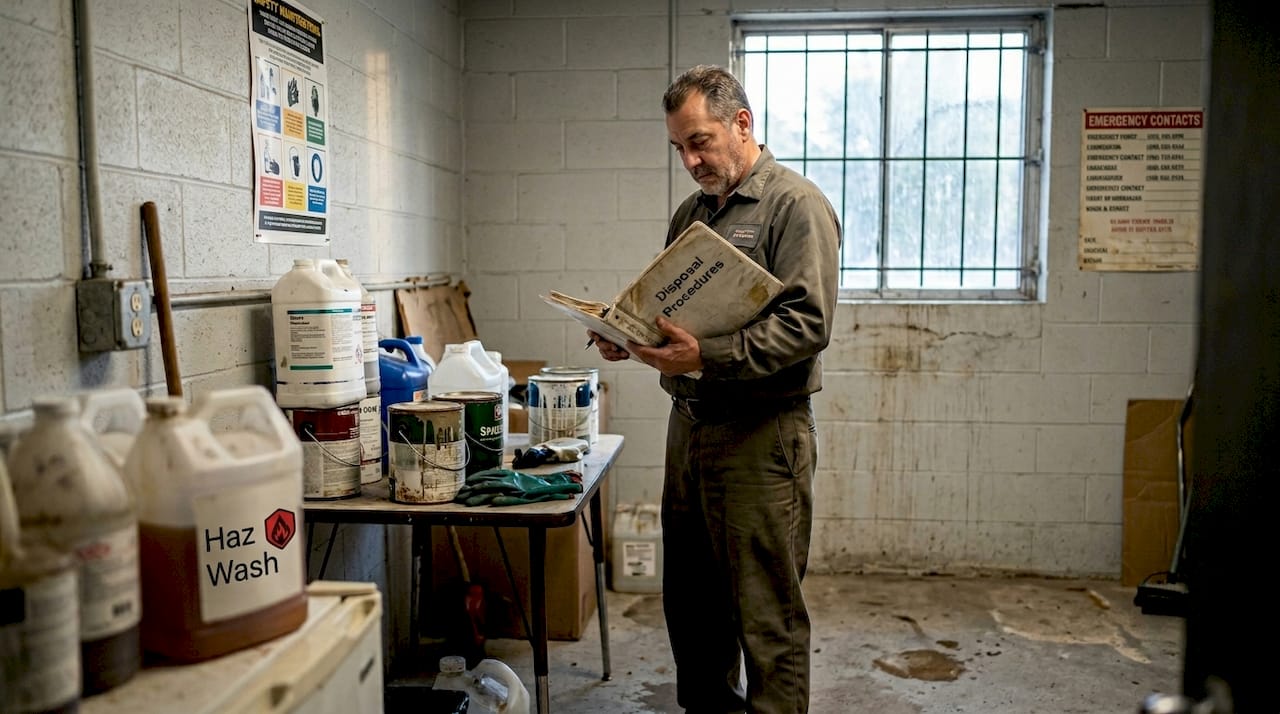
Hazardous waste disposal guide for Detroit property managers
Hazardous waste disposal guide for Detroit property managers
TL;DR:
- Michigan law holds property owners responsible for hazardous waste cleanup in Detroit rentals.
- Proper identification, preparation, and documentation are essential for compliant hazardous waste disposal.
- Professional assistance and thorough recordkeeping protect landlords from fines and liability.
As a Detroit property manager or landlord, discovering hazardous waste left behind by a tenant is not just an inconvenience. It is a legal liability. Michigan law places cleanup responsibility squarely on the property owner, and mishandling even small amounts of chemical or biohazard waste can trigger EPA fines, insurance denials, and health risks for future residents. This guide walks you through every stage of compliant hazardous waste disposal in Detroit, from identifying what you are dealing with to final recordkeeping. Follow these steps and you protect your property, your tenants, and your business.
Table of Contents
- Understand hazardous waste categories and regulations
- Prepare for hazardous and biohazard waste cleanup
- Step-by-step hazardous waste disposal process in Detroit
- Final verification, recordkeeping, and compliance best practices
- Our take: What most guides get wrong about hazardous waste disposal
- Need help with hazardous or biohazard waste in Detroit?
- Frequently asked questions
Key Takeaways
| Point | Details |
|---|---|
| Know waste categories | Correctly identifying hazardous and biohazard waste is essential for legal compliance. |
| Prepare before problems | Having contracts and emergency response plans in place speeds cleanup and reduces liability. |
| Follow all disposal steps | Use licensed haulers, complete all records, and track waste cradle-to-grave as the law requires. |
| Verify and document | Testing, visual checks, and recordkeeping close the loop—protecting your business from legal issues. |
Understand hazardous waste categories and regulations
To address disposal correctly, first understand what counts as hazardous waste and which rules apply.
Not all dangerous materials are treated the same under the law. Hazardous waste includes chemicals, solvents, paints, pesticides, and industrial byproducts. Biohazard or medical waste covers blood, body fluids, sharps (needles), and pathological materials. Each category has its own regulatory framework, and mixing them up creates serious compliance gaps.
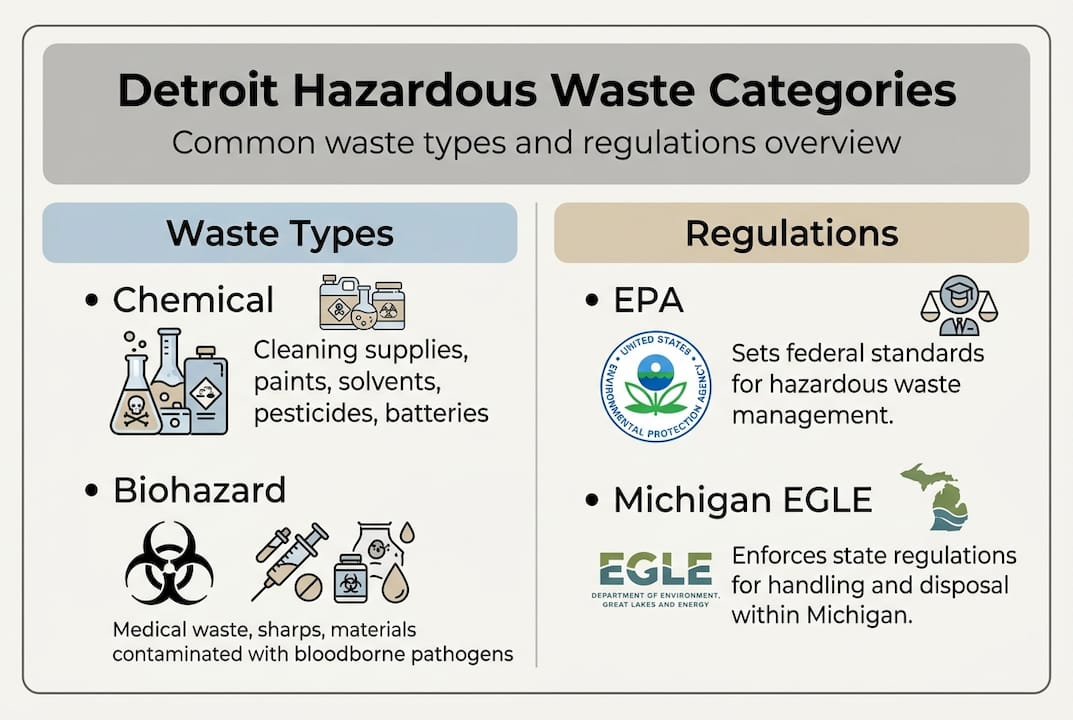
| Waste type | Common examples in Detroit rentals | Governing regulation |
|---|---|---|
| Hazardous chemical waste | Solvents, paint thinner, batteries, pesticides | EPA RCRA, Michigan EGLE Part 111 |
| Biohazard / medical waste | Blood, body fluids, sharps, bandages | Michigan Medical Waste Regulatory Act, MWRA Part 138 |
| Universal waste | Fluorescent bulbs, electronics, thermostats | EPA Universal Waste Rule |
| Infectious waste | Cultures, pathological waste | EGLE MMD, MWRA Part 138 |
For hazardous chemical waste, Michigan’s EGLE Part 111 governs storage, transport, and disposal. For biohazards, the Medical Waste Regulatory Act requires specific segregation, labeled containers, and licensed disposal. These are not interchangeable processes.
Key Michigan and federal laws every Detroit property manager should know:
- EPA RCRA (Resource Conservation and Recovery Act): Sets the federal cradle-to-grave framework for hazardous waste
- Michigan EGLE Part 111: State-level hazardous waste management rules
- MWRA Part 138: Michigan’s medical and biohazard waste disposal requirements
- OSHA Bloodborne Pathogens Standard (29 CFR 1910.1030): Applies when workers may contact blood or body fluids
The cradle-to-grave process means your responsibility begins the moment waste is generated on your property and does not end until it reaches a licensed disposal facility.
Pro Tip: Determine your generator status before anything else. Very Small Quantity Generators (VSQGs) generate under 100 kg of hazardous waste per month and have fewer requirements. Small Quantity Generators (SQGs) and Large Quantity Generators (LQGs) face stricter storage limits and reporting rules. Most Detroit landlords fall under VSQG, but a single large incident can push you into SQG territory.
For a practical breakdown of what qualifies, review hazardous waste examples specific to Detroit rental situations. Misclassification is one of the most common reasons property owners face unexpected fines during inspections.
Prepare for hazardous and biohazard waste cleanup
With clear regulations in mind, Detroit property managers must prepare for swift, compliant hazardous incident response.
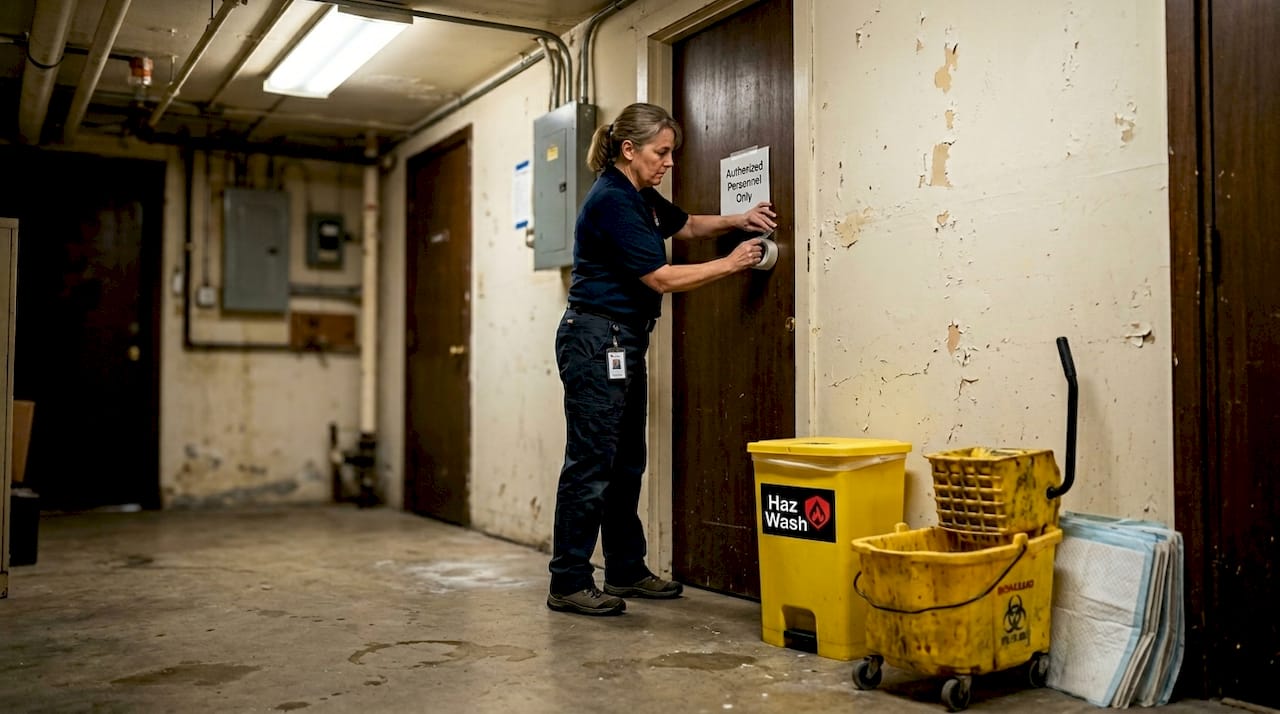
Preparation is not something you do after an incident. It is something you do now, before a tenant ever leaves behind a problem. Having the right supplies, contracts, and documentation ready cuts your response time and protects you legally from day one.
| Preparation item | Details |
|---|---|
| PPE (personal protective equipment) | Nitrile gloves, N95 or higher respirator, Tyvek suit, eye protection, boot covers |
| Containment supplies | Biohazard bags (red/yellow), sealable containers, absorbent materials |
| Documentation tools | Incident report forms, camera, chain-of-custody forms |
| Contractor contracts | Pre-signed agreements with EGLE-licensed cleanup firms |
| Emergency contact list | Licensed hauler, EGLE hotline, local health department, insurance agent |
When an incident occurs, follow these steps immediately:
- Secure the scene. Restrict access to the affected area. Do not allow other tenants, workers, or visitors near the contamination.
- Notify the appropriate authorities. Depending on the incident, this may include local police, the Detroit Health Department, or EGLE.
- Contact your licensed cleanup contractor. Call your pre-arranged, EGLE-licensed firm. Do not wait to assess the situation yourself.
- Document everything. Photograph the scene before any cleanup begins. Note time, date, and visible contamination.
- Notify your insurer. Report the incident to your insurance carrier as soon as possible to preserve your claim.
Safety warning: Untrained personnel should never attempt to clean blood, body fluids, or unknown chemical spills. Exposure to bloodborne pathogens like HIV, Hepatitis B, and Hepatitis C can occur through skin contact or inhalation of dried particles. Improper handling also voids most insurance claims and violates OSHA standards.
Pro Tip: Store your emergency contractor contact list in at least three places: your phone, your property management software, and a printed sheet posted in your office. A 2 a.m. incident is not the time to search for a phone number.
Review the full biohazard cleaning steps process so you understand what your contractor should be doing. Knowing the process helps you verify the work and supports your documentation for insurance and compliance purposes. You can also review biohazard risk indicators to recognize warning signs early.
Property managers who have pre-signed contracts with licensed firms and documented response plans are in a far stronger position during insurance claims and regulatory audits.
Step-by-step hazardous waste disposal process in Detroit
With tools and contracts ready, Detroit property managers can follow a defined disposal workflow to prevent costly missteps.
The EPA’s cradle-to-grave framework gives you a clear sequence. Here is how it applies to a Detroit rental property incident:
- Identify and categorize the waste. Is it chemical, biohazard, universal, or mixed? This determines every step that follows.
- Secure and document. Photograph, log quantities, and note the location. Start your chain-of-custody record here.
- Accumulate and label correctly. Use DOT-compliant containers. Label with waste type, date accumulated, and generator information. VSQG generators may store on-site up to 1,000 kg at a time.
- Arrange transport with a licensed hauler. Only licensed transporters can legally move hazardous waste in Michigan. Biohazard waste requires a licensed medical waste hauler under MWRA Part 138.
- Disposal at a licensed TSDF or medical waste processor. Treatment, Storage, and Disposal Facilities (TSDFs) like US Ecology Detroit South are EGLE-permitted for hazardous chemical waste. Medical waste goes to licensed processors.
| Method | When it applies | Key risks |
|---|---|---|
| DIY disposal (VSQG only) | Very small quantities, non-biohazard, permitted drop-off events | Limited to specific waste types; no biohazard; no documentation trail |
| Professional removal | All biohazard, SQG/LQG volumes, complex incidents | Higher upfront cost; full compliance and documentation provided |
Pro Tip: Always request a manifest form and written receipt from the disposal facility, even for VSQG deliveries where it is not legally required. This paper trail is your best defense in an audit or insurance dispute.
One critical point: Wayne County’s quarterly household hazardous waste collection events are for residential homeowners only. They are not appropriate for commercial or biohazard waste from rental properties. Using them as a landlord creates compliance exposure.
For a complete local resource, see the Detroit hazardous waste disposal guide and review the range of biohazard response types to understand which disposal pathway applies to your specific incident.
Final verification, recordkeeping, and compliance best practices
After hazardous waste is removed, verification and compliant recordkeeping close out the process and safeguard your business.
Cleanup is not complete when the crew leaves. You need objective proof that the property is safe and that every step was documented. This is what protects you from future liability claims and regulatory penalties.
Verification should include three elements:
- ATP testing: Adenosine Triphosphate (ATP) testing measures biological residue. Industry benchmarks set the post-clean threshold at under 200 RLU (Relative Light Units). A 10-minute bleach dwell time is the standard for surface disinfection. DIY cleanup consistently fails these thresholds on porous surfaces like wood, drywall, and grout.
- Visual inspection: A trained eye checks for staining, odor, and structural contamination that ATP alone may miss.
- Third-party verification: For significant incidents, an independent certified inspector provides documentation that carries legal weight.
Key records to retain after every hazardous waste disposal event:
- Waste manifests and chain-of-custody forms
- Contractor invoices and certificates of completion
- Disposal facility receipts
- Incident photographs and written logs
- ATP test results and inspection reports
- Insurance claim correspondence
Retain all records for a minimum of 3 years. Michigan EGLE and federal EPA audits can reach back that far, and insurance disputes often surface months after an incident. Conduct a brief compliance review every 6 months to confirm your contracts, contacts, and documentation practices are current.
For detailed guidance on what to keep and how to organize it, see cleanup documentation best practices. If you are unsure whether a past incident was fully remediated, use these hazardous contamination signs to reassess your property.
Our take: What most guides get wrong about hazardous waste disposal
Most hazardous waste guides focus on steps and checklists. That is useful, but it misses where Detroit landlords actually fail.
In our experience, the real breakdowns happen before cleanup even starts. Missing contractor contracts, no pre-established documentation system, and generator status confusion are the root causes of most compliance failures. The cleaning technique is rarely the problem.
DIY cleanup looks cheaper on paper. But it exposes you to liability that your insurance will not cover, regulatory penalties that dwarf the cost of a professional crew, and failed ATP tests that force a second remediation anyway. You end up paying more, with less protection.
“In Detroit, the real cost is not the cleanup. It is the risk of cutting corners with compliance.”
Pro Tip: Over-document every step, including decisions that seem obvious. Write down why you made each call. Regulators and insurers require proof, not promises. A written record of your reasoning is as valuable as the cleanup receipt itself.
Review missed biohazard indicators periodically. Many landlords discover contamination late because they did not know what to look for during routine inspections.
Need help with hazardous or biohazard waste in Detroit?
If the steps above sound daunting or if you face a high-risk scenario, professional help is a call or click away.
Most Detroit landlords find the greatest protection and peace of mind with 24/7 access to licensed, certified professionals, especially for urgent or complex incidents involving blood, body fluids, chemical spills, or unknown substances.
At HazWash LLC, we are OSHA HAZWOPER, IICRC, and DOT certified. We respond 24/7, handle all documentation, and provide full compliance records for your insurance and regulatory files. Whether you need immediate response or want to establish a standing contract for your portfolio, we are ready. Review the full range of hazardous incidents we handle and contact us today for a fast, discreet assessment.
Frequently asked questions
What is considered hazardous waste in a Detroit rental property?
Hazardous waste includes chemicals, solvents, and biohazards like blood and sharps, all of which must be identified and handled according to federal and Michigan law. The EPA defines hazardous waste by characteristics such as ignitability, corrosivity, reactivity, and toxicity.
Can I clean up biohazard waste myself as a property manager?
DIY cleanup of blood or body fluids consistently fails compliance and insurance checks. Professional cleanup prevents the ATP threshold failures and porous surface contamination that DIY methods cannot reliably address.
What records do I need to keep after hazardous waste disposal?
Retain manifests, contractor receipts, ATP test results, and all incident documentation for at least 3 years. Recordkeeping is a required component of the cradle-to-grave hazardous waste management process.
Who are licensed hazardous waste haulers and facilities in Detroit?
Licensed haulers include medical waste processors operating under MWRA Part 138, with US Ecology Detroit South serving as a key EGLE-permitted disposal facility for chemical hazardous waste in the Detroit area.