
Michigan biohazard disposal regulations: A property owner's guide
Michigan biohazard disposal regulations: A property owner’s guide
TL;DR:
- Michigan law strictly regulates biohazard waste from non-household trauma scenes to prevent health risks.
- Proper containment, labeling, and timely disposal by licensed transporters are mandatory to ensure compliance.
- Property owners must maintain documentation, train staff, and partner with certified professionals for safe handling.
Most property owners and managers in Michigan assume that biohazard waste from a traumatic incident, whether a death, violence scene, or severe hoarding situation, gets handled the same way as regular trash. It does not. Michigan enforces a specific set of regulations that govern how biohazardous material is contained, labeled, stored, transported, and disposed of, and penalties for non-compliance can include fines and legal liability. This guide breaks down exactly what the law requires, who it applies to, and how you can stay compliant as a property owner or manager when a biohazard incident occurs on your property.
Table of Contents
- Understanding Michigan’s biohazard disposal laws
- Proper containment, labeling, and storage requirements
- Approved disposal methods by waste type
- Legal transport, documentation, and employee requirements
- A property manager’s blind spots: What most compliance checklists miss
- Michigan biohazard disposal help: Partnering for peace of mind
- Frequently asked questions
Key Takeaways
| Point | Details |
|---|---|
| Strict state rules | Michigan law heavily regulates non-household biohazard disposal to protect public health. |
| Proper containment mandatory | Biohazard waste must be separated, securely contained, and labeled before disposal. |
| Only approved transporters | You must use a registered biohazard transporter—property owners cannot move waste themselves. |
| Documentation required | A written management plan, staff training, and record retention are essential for legal compliance. |
| Expert help recommended | Working with certified professionals helps property owners avoid liability and health risks. |
Understanding Michigan’s biohazard disposal laws
With the importance of compliance established, it is vital to know exactly what Michigan law requires and how it applies to property incidents.
Biohazard disposal in Michigan)/documents/mcl/pdf/mcl-368-1978-12-138.pdf) is regulated under the Medical Waste Regulatory Act (MWRA), Part 138 of the Public Health Code (Act 368 of 1978), overseen by the Michigan Department of Environment, Great Lakes, and Energy (EGLE). The Michigan Department of Health and Human Services (MDHHS) also plays a supporting role in public health enforcement.
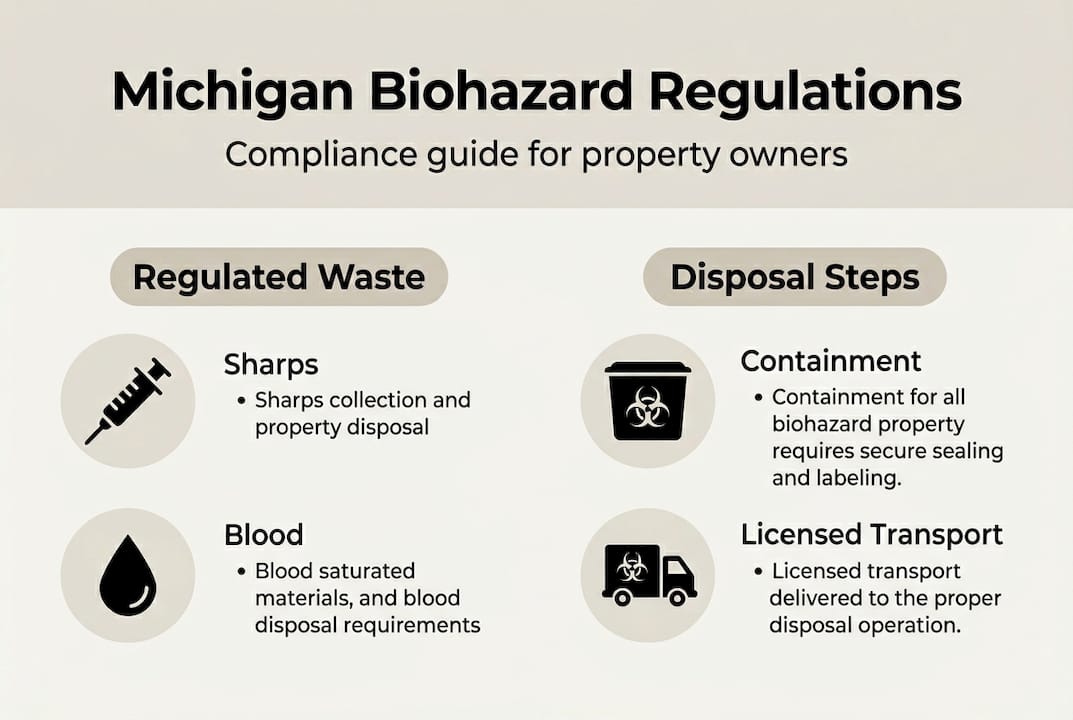
Under this framework, not all waste that looks biological qualifies as “regulated medical waste.” The law draws a firm line between waste generated by households and waste generated by regulated entities.
What counts as regulated medical waste?
- Cultures and stocks of infectious agents
- Human blood and blood products
- Pathological waste (tissues, organs, body parts)
- Sharps (needles, scalpel blades, broken glass with biological contact)
- Animal waste from research or veterinary contexts
- Isolation waste from highly communicable disease sources
What is typically excluded?
- Waste generated by a private household (even if it includes blood or sharps)
- General solid waste with no biological contamination
This distinction creates a gray area for property owners. If a trauma event occurs in a rental unit, apartment building, or commercial property, the resulting biohazardous waste is generally not classified as “household.” You, as the property manager or owner, become the responsible regulated entity once cleanup begins. Knowing the biohazard risk indicators present at your property helps you determine when regulation applies.
“The moment a non-household party initiates cleanup or generates waste from a trauma scene, Michigan law treats that waste under the same rules as medical facility waste.”
Properly understanding medical waste health risks is equally important because exposure to improperly handled biohazards puts both workers and future occupants at serious risk.
| Waste type | Regulated under MWRA? | Common source on property |
|---|---|---|
| Human blood (trauma scene) | Yes, if non-household | Assault, accident, death scene |
| Household sharps (insulin) | No (household exemption) | Resident’s personal use |
| Pathological tissue | Yes | Unattended death scenes |
| Soiled dressings (resident) | No | Personal medical care |
| Animal waste (research) | Yes | Veterinary or lab use |
Proper containment, labeling, and storage requirements
Armed with an understanding of what is regulated, let’s break down how to handle these wastes safely from the very start.
Containers for medical waste must be leak-proof, rigid, puncture-resistant, secured, and labeled with the biohazard symbol or the words “medical waste” or “pathological waste” in letters at least 1 inch tall. This is not optional. Non-compliant containers are one of the most cited violations in Michigan.
Steps for proper containment and storage:
- Place all biohazardous material in a compliant red or orange bag, then seal it tightly.
- Place that bag inside a rigid, leak-proof secondary container.
- Label the outer container clearly with the biohazard symbol and waste type.
- Keep waste streams separated: sharps in dedicated sharps containers, blood-soaked materials in separate sealed bags.
- Store containers in a secure, locked area that restricts unauthorized access.
- Keep waste away from food, food prep areas, and high-traffic spaces.
- Track the date waste was generated or placed in storage.
Storage is limited)/documents/mcl/pdf/mcl-368-1978-12-138.pdf) to a maximum of 90 days on site. Sharps must remain in puncture-resistant containers until they are full, then sealed and sent for disposal. Storage areas must also prevent putrefaction and infection spread.
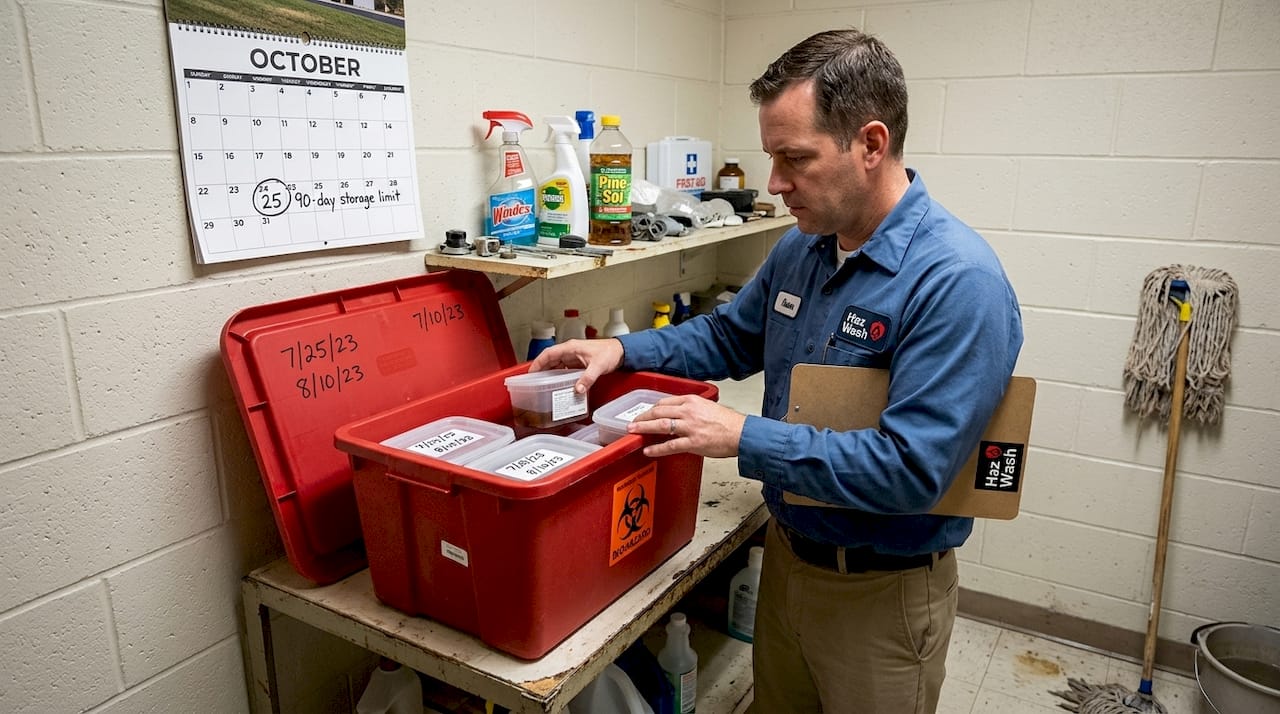
Pro Tip: Never store biohazardous waste outdoors in standard trash receptacles, even temporarily. Outdoor storage of regulated waste requires specific containment conditions and significantly raises your liability exposure if containers are breached or tampered with.
| Container feature | Required? | Common mistake |
|---|---|---|
| Leak-proof liner | Yes | Using standard trash bags |
| Rigid outer container | Yes | Soft-sided bags only |
| Biohazard label, 1-inch text | Yes | No label or incorrect wording |
| Separate sharps container | Yes | Mixing sharps with soft waste |
| Locked secure storage | Yes | Open access storage areas |
For a step-by-step approach specific to rental properties, review the biohazard cleaning steps we’ve outlined for Detroit landlords. If you need a broader regulatory overview, the OSHA cleanup guide covers federal layer requirements as well.
Approved disposal methods by waste type
With items properly contained, property managers must still dispose of each biohazard correctly and legally. The method you use depends entirely on the type of waste involved.
Mixing waste streams or using the wrong disposal method is a violation, even when the original containment was done correctly. Many property owners make the mistake of assuming that sealed and labeled waste can simply go to a landfill or be flushed. That is not always the case.
Legal disposal methods by waste category:
- Cultures and stocks: Must be autoclaved (steam sterilized) or incinerated before landfill placement
- Blood and body fluids: Can be flushed via sanitary sewer in small quantities, or sent for autoclaving, incineration, solidification, or landfill when treated
- Pathological waste (tissue, organs): Must be incinerated or cremated. Landfill is not an approved method.
- Sharps: Must go into puncture-resistant containers, then sent directly to a licensed incinerator
- Animal waste (research/veterinary): Must be incinerated
Disposal methods by type are clearly outlined by EGLE: cultures and stocks require autoclave or incineration before landfill; blood and fluids allow sewer flush, autoclave, incineration, solidification, or landfill; pathological waste requires incineration or cremation; sharps go to a puncture-resistant container then incinerator; animal waste requires incineration.
| Waste type | Approved disposal method | Not allowed |
|---|---|---|
| Cultures/stocks | Autoclave, then landfill | Direct landfill without treatment |
| Blood and body fluids | Sewer (small amounts), autoclave, incinerate | Untreated landfill |
| Pathological waste | Incineration, cremation | Landfill of any kind |
| Sharps | Puncture-resistant container to incinerator | Regular trash, crushing |
| Animal research waste | Incineration | Landfill or composting |
What not to do:
- Never compact biohazardous waste; compaction can rupture containers and cause exposure.
- Never mix sharps with soft waste bags, even in compliant outer containers.
- Never pour large volumes of blood or fluid down a drain without confirming local sewer authority approval.
- Never use an unlicensed waste hauler to remove any regulated medical waste.
For more detail on how different incident types and safe response requirements intersect with disposal choices, review our incident response guide.
Legal transport, documentation, and employee requirements
Even with proper containment and disposal, property owners must remain compliant during waste movement and training processes.
Transport rules:
Transport must be handled only by registered or permitted transporters under Act 138. Producing facilities, which includes property owners managing cleanup of regulated waste, need a written medical waste management plan, documented employee training, and updated records whenever procedures change. You cannot hand a bag of biohazardous waste to a general contractor or unlicensed hauler and consider yourself compliant.
Documentation requirements:
- Maintain a written medical waste management plan on file at your property.
- Keep records of all waste generated, transported, and disposed of for a minimum of 3 years.
- Document employee or contractor training, including Bloodborne Pathogen training (required under OSHA 29 CFR 1910.1030).
- Update your management plan whenever you change procedures, contractors, or waste types.
- Report any suspected illegally abandoned or dumped biohazard waste to EGLE’s reporting portal immediately.
Employee and contractor requirements:
Anyone handling biohazard material at your property must have documented Bloodborne Pathogen training and access to appropriate personal protective equipment (PPE), including gloves, eye protection, and respiratory protection when needed. This applies to your own maintenance staff as well as any outside contractors you bring in.
Pro Tip: Request written proof of transporter registration and Bloodborne Pathogen training from every contractor before they set foot on a contaminated scene. If something goes wrong and you cannot produce that documentation, the liability falls on you as the property owner.
Penalties for lapses can include civil fines, criminal charges for willful violations, and required remediation at your expense. For a detailed breakdown of documentation best practices, our cleanup documentation compliance guide walks through what EGLE expects to see.
A property manager’s blind spots: What most compliance checklists miss
Compliance checklists give you a framework. What they rarely prepare you for is the reality of an actual scene. In our experience, the biggest compliance failures happen not from ignorance of the basic rules but from the unexpected situations that fall between categories.
Property managers often assume that because an incident was small, regulation does not apply. A single trauma event with minimal visible contamination can still generate regulated waste the moment a non-household party initiates cleanup. That technicality has cost property owners significant money and time.
Documentation gaps are the other silent threat. Inspectors and investigators reviewing a major incident do not just check your containers. They look at your management plan, your training logs, and your transporter records. A missing signature or an outdated plan can escalate a manageable situation into a formal violation.
Unlicensed transporters are also a persistent problem. A general cleaning crew may seem willing and able, but using one for biohazard removal can result in illegal dumping liability that attaches directly to you. Reviewing risk indicators for property owners before an incident occurs, rather than after, positions you to act decisively and legally when it matters most. Professional biohazard companies carry the licensing, training, and documentation that eliminates these gaps entirely.
Michigan biohazard disposal help: Partnering for peace of mind
If these requirements sound daunting, expert help can make a real difference, especially when a traumatic incident requires fast, legal, and thorough action.
HazWash LLC specializes in biohazard cleanup and disposal across Detroit and surrounding Michigan communities. Our team is certified under OSHA HAZWOPER, IICRC, and DOT standards, meaning we meet every regulatory requirement for safe incident response from containment through final disposal. We handle all required documentation, use only registered transporters, and provide you with the paperwork you need to protect yourself legally. When you need Michigan biohazard disposal experts available 24/7, HazWash LLC is ready to respond. Contact us today for a confidential, compliant, and compassionate cleanup.
Frequently asked questions
What is considered biohazardous waste under Michigan law?
Michigan regulates medical waste)/documents/mcl/pdf/mcl-368-1978-12-138.pdf) from non-household sources, including sharps, human blood, and pathological waste generated during property incidents such as trauma scenes or unattended deaths.
How long can regulated medical waste be stored onsite in Michigan?
Most regulated medical waste can be stored up to 90 days)/documents/mcl/pdf/mcl-368-1978-12-138.pdf) on site, provided it is secured, properly labeled, and does not risk putrefaction or the spread of infection.
Can I transport biohazard waste myself as a property owner?
No. Michigan law requires that regulated waste transport be performed only by registered or permitted biohazard transporters. Self-transport by a property owner is not a legal option.
Who enforces biohazard disposal laws in Michigan?
EGLE, the Michigan Department of Environment, Great Lakes, and Energy, enforces the MWRA)/documents/mcl/pdf/mcl-368-1978-12-138.pdf) and has authority to inspect, cite, and penalize non-compliant property owners and facilities.
How should sharps like needles be disposed of?
Sharps must be collected in puncture-resistant, labeled containers)/documents/mcl/pdf/mcl-368-1978-12-138.pdf) and transported to a permitted incinerator. They cannot be placed in standard trash or soft-sided biohazard bags.