Hazardous removal in Detroit: A property owner's guide
Hazardous removal in Detroit: A property owner’s guide
TL;DR:
- Hiring unqualified crews for hazardous material cleanup can lead to fines, liability, and regulatory violations.
- Property owners are responsible for understanding and complying with OSHA, EPA, and Michigan laws, not just contractors.
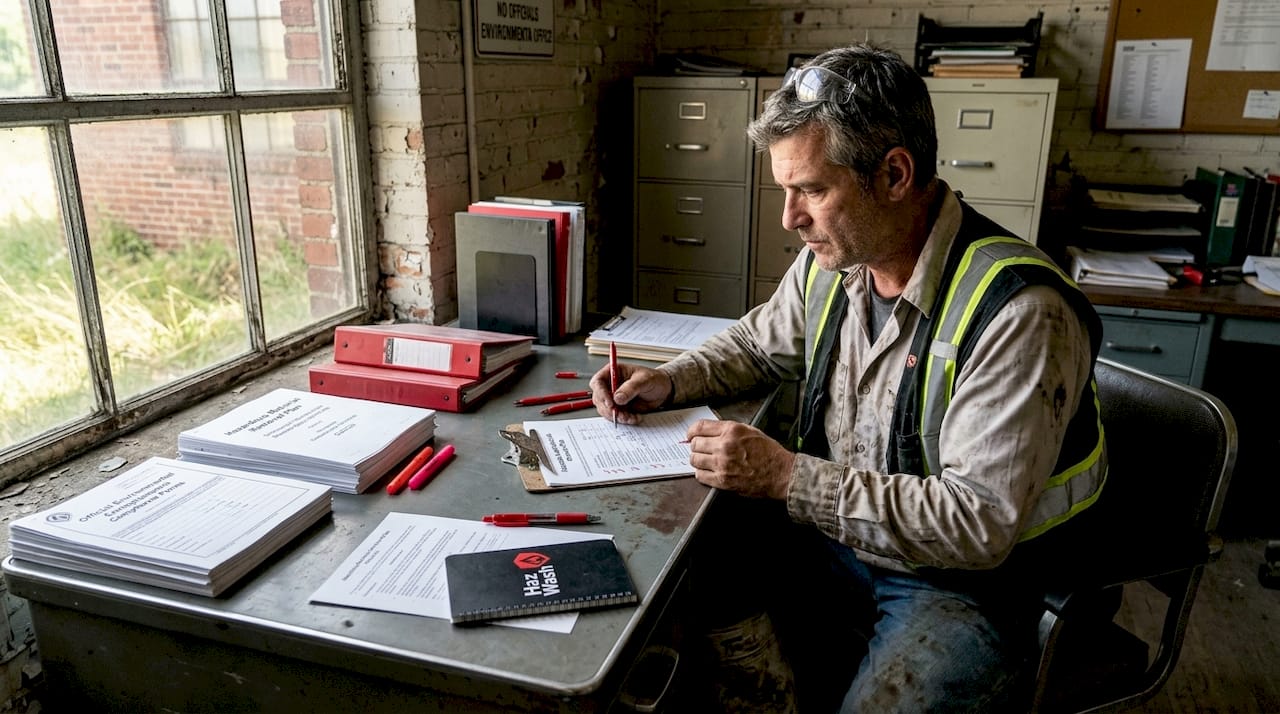
Hiring any cleanup crew and calling it done is a costly mistake Detroit property owners make more often than you might think. Hazardous material removal is a regulated activity governed by overlapping federal, Michigan state, and local legal frameworks. Miss one requirement and you face fines, enforcement actions, or worse, personal liability for harm caused to occupants, workers, or neighbors. Most property owners miss the regulatory requirements entirely, not realizing that enforcement hinges on specific OSHA, EPA, and Michigan standards that apply directly to them, not just to their contractors.
Table of Contents
- Understanding regulatory frameworks: OSHA, EPA, and Michigan law
- The hazardous removal process: Step-by-step industry standards
- Special considerations: PCBs and other regulated material categories
- Transportation and disposal: DOT standards and local responsibilities
- Expert perspective: What most property owners overlook about compliance
- Get compliant, safe hazardous removal in Detroit
- Frequently asked questions
Key Takeaways
| Point | Details |
|---|---|
| Multiple legal standards | Hazardous removal in Detroit must meet OSHA, EPA, DOT, and Michigan regulations for safety and legal compliance. |
| Stepwise professional process | Effective cleanup follows a documented sequence: assessment, planning, site security, handling, transport, and documentation. |
| Material-specific rules | Some hazards like PCBs, lead, or asbestos have special cleanup standards and require additional verification. |
| Owner duties extend beyond cleanup | Property owners are legally responsible for documentation, compliant disposal, and post-removal notification. |
| Demand regulatory proof | Always require contractors to show training records, disposal documentation, and evidence of compliance at each step. |
Understanding regulatory frameworks: OSHA, EPA, and Michigan law
To fully understand your duties, you first need to know which laws and agencies set the rules. Three separate frameworks apply, and they overlap in ways that can surprise even experienced property managers.
OSHA’s HAZWOPER standard is the starting point for worker safety. OSHA’s HAZWOPER standard under 29 CFR 1910.120 sets mandatory training and personal protective equipment requirements for anyone performing hazardous waste cleanup. This applies to every technician on your property. If a contractor shows up without documented HAZWOPER training records, that is your first red flag.
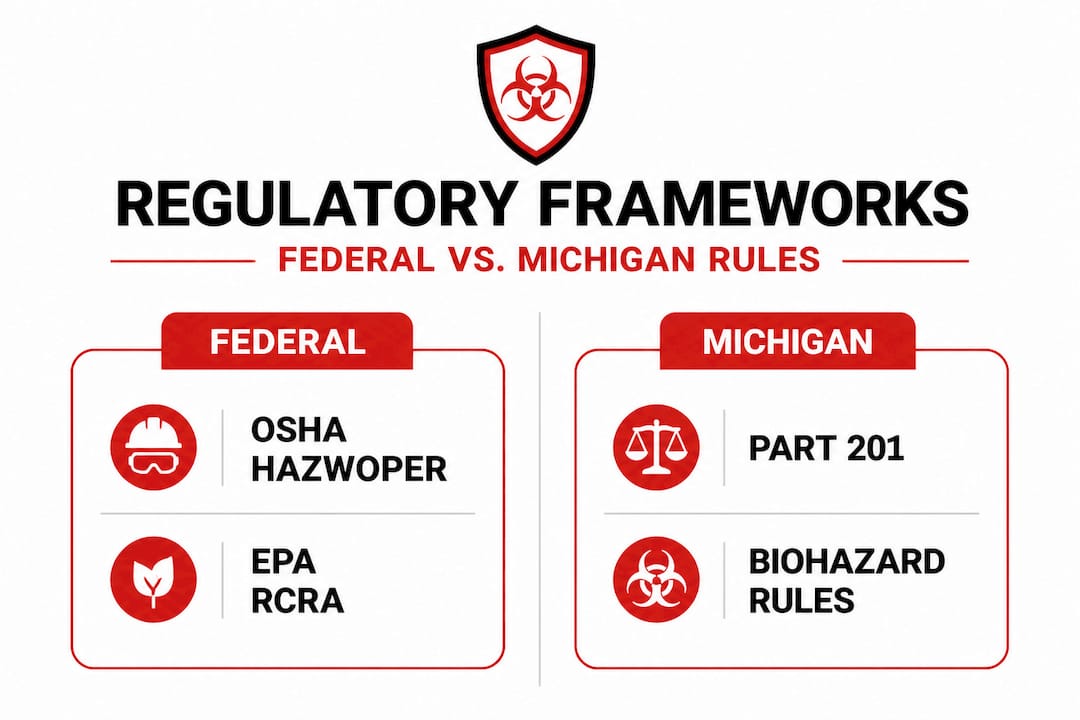
EPA’s RCRA framework takes over when it comes to waste management and disposal. The EPA’s waste generator rules under the Resource Conservation and Recovery Act (RCRA) determine how hazardous waste must be classified, stored, transported, and sent to a licensed treatment, storage, and disposal facility, known as a TSDF. Generator status, whether large, small, or very small quantity, determines your specific paperwork and timeline obligations.
Michigan’s Part 201 adds a third layer. Unlike federal rules that primarily trigger after a regulatory notice, Michigan Part 201 requires property owners to proactively prevent worsening contamination and mitigate hazard exposure. You don’t wait for an enforcement letter. The duty to act is continuous.
Here is a side-by-side look at how each framework divides responsibility:
| Framework | Primary focus | Who it targets | Key obligation |
|---|---|---|---|
| OSHA HAZWOPER | Worker safety | Cleanup contractors | Documented training, PPE, air monitoring |
| EPA RCRA | Waste management | Generators (often owners) | Classification, disposal, manifests |
| Michigan Part 201 | Environmental liability | Property owners | Prevent spread, mitigate exposure |
Understanding this table matters because owners often believe OSHA compliance is purely their contractor’s problem. It is not. If your contractor violates OSHA on your property and workers are harmed, you can be named in enforcement actions. Review the federal cleanup guide for a deeper breakdown of how these frameworks intersect for Michigan property owners, and consult the Michigan hazardous waste rules guide to understand your state-level duties in plain language.
Key compliance elements across all three frameworks include:
- Written site safety plans before work begins
- Air monitoring logs maintained throughout removal
- Waste characterization records for every material removed
- Chain-of-custody manifests from site to disposal facility
- Post-cleanup verification sampling where required
The hazardous removal process: Step-by-step industry standards
Once you know who sets the rules, you need to see how these standards play out in actual removal operations. A professional-grade, legally defensible removal follows a defined sequence. Skipping any step creates documentation gaps that regulators will find.
EPA Detroit remediation records confirm that a defensible process includes assessment, site security, air monitoring, waste characterization, compliant handling and disposal, off-site transport, and full documentation and verification. OSHA’s HAZWOPER practices also organize work into these exact phases, making this structure the industry baseline.
The standard removal sequence:
- Hazard identification and assessment. Qualified professionals survey the site, identify all potential contaminants, and document findings before any physical work begins.
- Site safety plan development. A written plan specifying PPE levels, emergency protocols, decontamination procedures, and communication pathways is prepared and signed off.
- Site security and control zones. Exclusion, contamination reduction, and support zones are established. Unauthorized personnel are kept out. This protects bystanders and limits liability.
- Air and environmental monitoring. Real-time air quality monitoring runs throughout the project. Results are logged. This data becomes part of your compliance file.
- Waste characterization. Every material to be removed is tested and categorized under RCRA criteria before it is touched. You cannot legally dispose of waste you haven’t characterized.
- Safe on-site handling and packaging. Hazardous waste is containerized in DOT-compliant packaging, labeled accurately, and staged in a designated accumulation area.
- Regulated transport and final disposal. A licensed hazardous waste transporter moves materials using a completed EPA Uniform Hazardous Waste Manifest to an approved TSDF.
- Documentation and verification. Final records including manifests, air monitoring logs, waste characterization data, and disposal confirmations are compiled and retained.
Pro Tip: Request a copy of your contractor’s site safety plan and the air monitoring logs before they leave. These two documents alone tell you whether the job was done to OSHA standards. If they can’t produce them on the spot, that is a compliance failure.
The table below shows what proper documentation looks like at each stage:
| Process stage | Required document | Retained by |
|---|---|---|
| Hazard assessment | Site survey report | Owner and contractor |
| Worker safety | HAZWOPER training records | Contractor (owner should request copies) |
| Air monitoring | Real-time log sheets | Contractor (owner should file copies) |
| Waste characterization | Laboratory analysis or generator knowledge form | Both parties |
| Transport | EPA Uniform Hazardous Waste Manifest | Both parties |
| Disposal | TSDF acceptance confirmation | Owner’s permanent file |
For specific guidance on how this process applies to properties previously used for drug manufacturing, the drug lab cleaning steps resource walks through the exact sequence. Owners returning to a site after any hazardous event should also review hazmat cleaning service protocols before setting foot inside.
Special considerations: PCBs and other regulated material categories
While most hazardous removal follows the standard steps above, Detroit property owners often encounter unique material types that are regulated quite differently. Treating every contaminant as interchangeable is a compliance error.
Polychlorinated biphenyls (PCBs), lead, mercury, and asbestos each carry their own regulatory rules, sampling requirements, disposal pathways, and documentation obligations. PCBs in particular are governed by the Toxic Substances Control Act (TSCA), not RCRA, which means a contractor experienced in RCRA waste handling may not be qualified to handle PCB-contaminated building materials.
EPA’s PCB cleanup standards include performance-based remediation thresholds, mandatory sampling before and after removal, detailed recordkeeping, and post-cleanup notifications filed directly with the EPA. Missing a post-cleanup notification is a violation, even if the physical cleanup was done correctly.
Different rules apply for hazardous waste, hazardous chemicals, and TSCA-era substances like PCBs. Contractors must prove, with documentation, that they are following the correct rule set for the specific material on your property.
“If your contractor cannot tell you whether your situation is governed by RCRA, TSCA, or both, you should not allow them to proceed. The regulatory category of your contaminant determines every step that follows.”
Key considerations for regulated material categories:
- PCBs: Require TSCA-specific disposal at an approved facility, plus EPA notifications. Not all licensed TSDFs accept PCB waste.
- Lead: Removal in pre-1978 buildings must follow EPA’s RRP (Renovation, Repair, and Painting) Rule, with certified contractors only.
- Asbestos: Michigan DEQ (now EGLE) requires licensed asbestos abatement contractors and specific notification procedures for commercial properties.
- Mercury: Regulated under both RCRA and EPA’s universal waste rules, with separate packaging and disposal requirements.
Pro Tip: Before signing a contract, ask your contractor to show you the specific federal and state rule set governing your contaminant type. A compliant contractor will name the specific regulation and provide their license or certification for that category.
For a broader view of how Michigan law governs biohazardous materials on properties, the biohazard disposal regulations guide is a practical starting point. Property owners uncertain whether a situation qualifies as a regulated hazard should review biohazard risk indicators to assess their specific circumstances.
Transportation and disposal: DOT standards and local responsibilities
Even after hazardous material is removed from your site, your legal responsibilities aren’t over until transport and disposal meet DOT and EPA standards. This phase is where many property owners unknowingly create their biggest legal exposure.
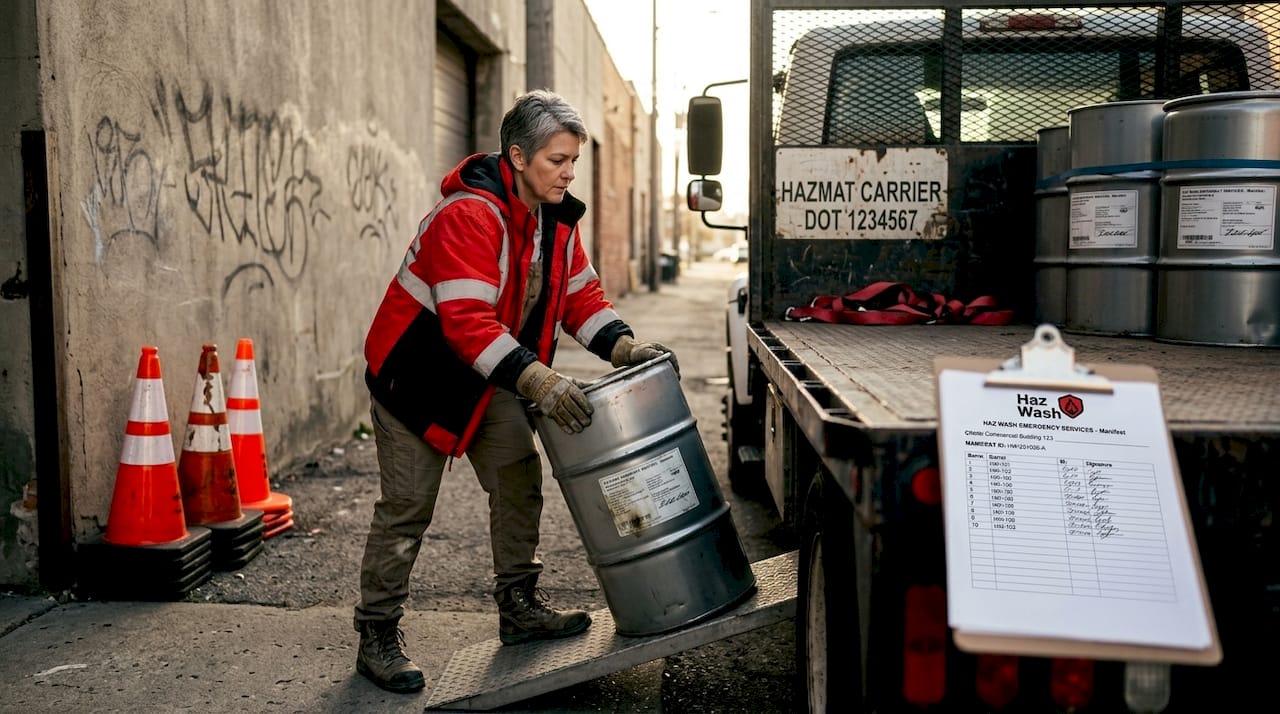
The Department of Transportation (DOT) regulates every stage of hazardous waste shipment, from how waste is packaged at your property to the paperwork that must accompany the truck to the disposal facility. EPA and DOT require strict packaging specifications, accurate labeling, completed shipping papers, and recurring training for all personnel who handle or arrange hazardous material shipments.
The most common violations in transport:
- Missing or incomplete manifests. The EPA Uniform Hazardous Waste Manifest must accompany every shipment. Gaps in manifest information are among the most cited violations during inspections.
- Non-compliant packaging. DOT specifies container types, closure requirements, and compatibility standards by waste category. A container that looks adequate may not be legally compliant.
- Unlabeled or mislabeled containers. Every package must display the proper DOT hazard class labels, UN identification numbers, and generator contact information.
- Untrained staff arranging shipments. Anyone who selects packaging, prepares shipping papers, or directs a hazardous waste shipment must have documented DOT hazmat training, renewed every three years.
- No signed manifest return. Once the TSDF receives and signs your manifest, a copy must be returned to you. If you don’t receive it within 45 days, you are required to report the discrepancy to your state agency.
Pro Tip: Ask your contractor for the TSDF’s signed manifest copy before you consider the job complete. This is the only proof that your waste reached a legal disposal facility and was accepted. Without it, your liability remains open.
Owners managing multiple properties or recurring hazardous situations should have the DOT hazardous waste guide bookmarked as a working reference. The hazardous waste disposal guide also covers local disposal options and how to verify a facility’s TSDF license before committing to a contractor.
Expert perspective: What most property owners overlook about compliance
With the core steps and legal pathways clear, it’s worth addressing the real-world pattern we see most often in Detroit: property owners who believed their contractor handled everything, only to learn during an enforcement inspection that critical documentation was never created.
Contractors routinely advertise compliance. They use words like certified, OSHA-trained, and fully licensed on their websites and in their proposals. That language is not legally protective for you. Contractor assurances are not enough. Owners must demand method statements, waste characterization results, transport plans, and proof of HAZWOPER training before authorizing any work to proceed.
Here is what we have seen go wrong. A property manager hires a contractor who arrives with the right equipment and a confident attitude. The job gets done in two days. The property looks clean. Six months later, the Michigan Department of Environment, Great Lakes, and Energy (EGLE) contacts the owner because waste manifests were never filed, and the transporter used was not licensed. The owner, not the contractor, faces the enforcement action. That is how the law works.
Your role is not passive. Under Michigan Part 201, you are an active participant in regulatory compliance, not just a bystander. This means requesting and filing every document before, during, and after removal, not after a regulatory inquiry forces your hand.
The three documents that provide real protection:
- Waste characterization report: Proves you identified what was on your property and categorized it correctly before disposal.
- Chain-of-custody manifest: Proves the waste traveled from your property to a licensed TSDF without gaps.
- Post-cleanup verification sampling: Proves the contaminant was removed to the required standard.
Reviewing an OSHA-compliant cleanup protocol will show you exactly what documentation a compliant project produces. Use that as your checklist when evaluating any contractor’s proposal.
Get compliant, safe hazardous removal in Detroit
When your situation requires professional support, the right service provider can handle every detail, safely and lawfully, so you can move forward with confidence.
HazWash LLC provides Detroit biohazard cleaning and hazardous removal services built around full regulatory compliance. We hold OSHA HAZWOPER, IICRC, and DOT certifications, and we document every step from hazard assessment through final disposal so that you have a complete compliance file when the job is done. Whether you need help with a single-event cleanup or ongoing property management support, our team knows federal compliance hazardous cleanup requirements inside and out. Contact HazWash today for a confidential consultation and emergency response available 24/7 across Detroit and the surrounding region.
Frequently asked questions
What is the required training for hazardous removal workers in Detroit?
Workers must have OSHA HAZWOPER training, with the specific level, 40-hour, 24-hour, or 8-hour refresher, matched to their exposure risk and job duties on your site.
Are property owners responsible for post-cleanup documentation?
Yes. Property owners must maintain cleanup records and, for materials like PCBs, submit post-removal notifications directly to the EPA as a condition of regulatory closure.
What rules apply to transporting hazardous waste off-site?
DOT and EPA rules require proper packaging, accurate labeling, completed shipping papers, and trained transport staff for every hazardous waste shipment leaving your property.
How is hazardous waste disposal regulated in Michigan?
Disposal is governed by both EPA RCRA and Michigan Part 201, which together assign generator duties, disposal pathway requirements, and ongoing owner obligations that extend past the point of physical removal.
What counts as a PCB under hazardous material regulations?
Polychlorinated biphenyls found in building materials, electrical equipment, soil, or cleanup debris are regulated under EPA’s TSCA rules, which require specific cleanup and disposal methods distinct from standard RCRA hazardous waste pathways.