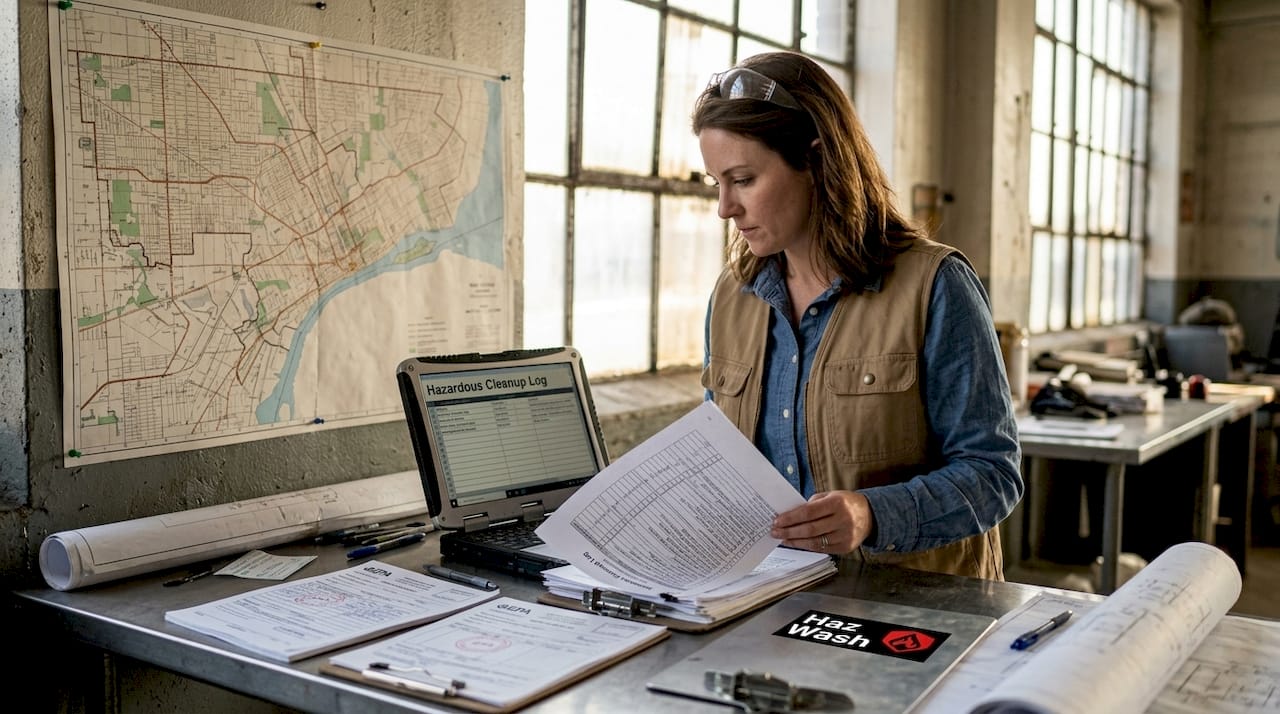
Detroit hazardous cleanup: documentation compliance guide
Detroit hazardous cleanup: documentation compliance guide
Proper documentation protects property owners legally, financially, and from regulatory fines.
Essential records include waste manifests, incident logs, photos, certifications, and Certificates of Compliance.
Thorough recordkeeping is critical for compliance, insurance claims, and minimizing liability after hazardous incidents.
When a biohazard incident strikes a Detroit property, most owners focus entirely on the physical cleanup. That instinct is understandable, but it leaves a critical gap. OSHA fines reach $161,000 for non-compliance in biohazard documentation alone, meaning incomplete records can cost more than the cleanup itself. Property managers, landlords, and families in Detroit must navigate both federal EPA and OSHA standards and Michigan-specific requirements simultaneously. This guide walks you through exactly what to document, when to do it, and how to stay protected under local regulations.
Table of Contents
Essential records: What to document during hazardous cleanup
Best practices and common pitfalls in hazardous cleanup documentation
Our take: Why documentation is your strongest defense, not a paperwork chore
Ready for expert help? Detroit biohazard cleanup and documentation services
Key Takeaways
PointDetailsDocumentation is mandatoryEvery hazardous cleanup in Detroit legally requires meticulous recordkeeping for compliance.Records protect ownersAccurate documentation shields property managers and families from fines and legal liability.Certificates of ComplianceDetroit landlords must secure and retain Certificates of Compliance to re-rent safely after cleanup.Records aid insurance claimsInsurance companies rely on detailed incident logs and manifests to process trauma cleanup claims.
Why documentation matters in hazardous cleanup
Documentation is not a formality. It is the foundation that holds every other part of a hazardous cleanup together. Without it, you have no proof that the work was done correctly, no protection if a tenant files a complaint, and no leverage if an insurer disputes your claim.
Think of your records as a paper trail that speaks for you when you cannot. Regulators, insurers, and courts all rely on written evidence. A cleanup that left no records is, legally speaking, a cleanup that may not have happened at all.
Here is what that paper trail must include:
Waste manifests: Tracks hazardous materials from point of origin to licensed disposal facility
Incident logs: Dates, times, nature of the hazard, and personnel involved
Inventory and sampling reports: Baseline measurements before and after remediation
Training certificates: OSHA HAZWOPER and IICRC credentials for everyone on site
Medical surveillance records: Required for workers exposed to bloodborne pathogens
Regulatory compliance in hazardous waste cleanup depends on tracking manifests, notifications, and records at every stage. The EPA treats missing manifests as a violation, regardless of how thorough the physical cleanup was.
“Records are gold. They limit your liability, satisfy your insurer, and prove due care to every regulator who asks.” This is not an exaggeration. Hazmat records protect legally, aid insurance claims, and demonstrate due care, making them essential for re-renting properties with proper disclosures.
For landlords specifically, understanding trauma scene legal liabilities is critical before re-renting. Michigan law requires disclosure of certain traumatic events, and your documentation is what proves you handled remediation correctly. On the insurance side, insurance documentation requirements are strict: carriers routinely deny claims that lack incident logs or remediation reports.
Essential records: What to document during hazardous cleanup
Knowing why documentation matters leads directly to knowing what to capture at each stage. Federal and Michigan requirements overlap but are not identical.
Federal requirements (EPA and OSHA):
EPA uniform hazardous waste manifests for all regulated waste transported off-site
OSHA Exposure Control Plans updated annually or after each incident
Incident reports filed within required timeframes
Training records for every worker, including refresher courses
Medical surveillance records retained for the duration of employment plus 30 years
OSHA requires Exposure Control Plans, training records, incident reports, and medical records for biohazard handling, with retention periods reaching up to 30 years for medical files.
Detroit-specific requirements:
Detroit landlords require Certificates of Compliance post-cleanup, valid for 2 to 3 years, before a rental unit can legally be re-occupied.
Record typeWho must documentRetention periodEPA hazardous waste manifestGenerator/transporter3 years minimumOSHA incident reportEmployer5 yearsMedical surveillance recordsEmployer30 years post-employmentTraining certificatesEmployerDuration of employmentCertificate of ComplianceDetroit landlord2 to 3 years (renew as needed)Baseline environmental assessmentProperty ownerIndefiniteSampling and photo reportsCleanup contractor5 years minimum
Photos deserve special attention. Take timestamped photos before any work begins, during remediation, and after completion. These images establish your baseline and verify the final condition. They are often the first thing an insurer or regulator requests.
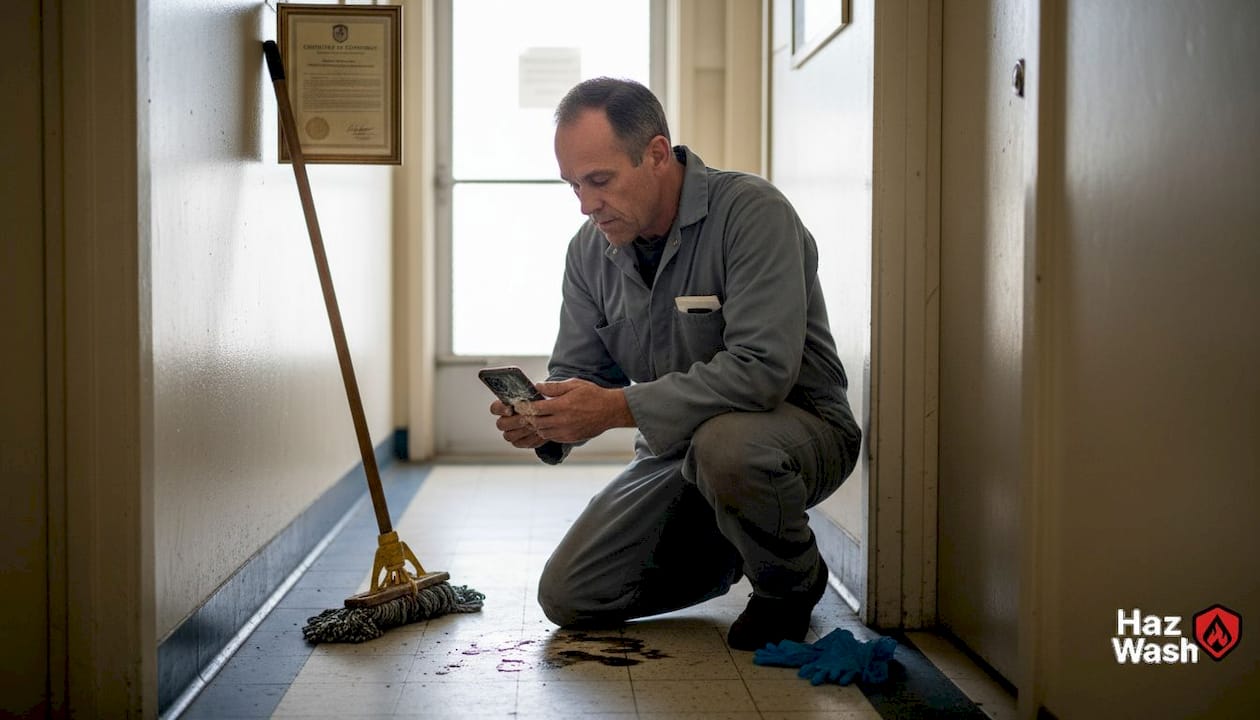
For properties with complex histories, such as biohazard hoarding situations, documentation layers multiply quickly. You may need separate logs for each category of waste removed. Review the full range of incident type records to make sure nothing is missed.
Pro Tip: Keep both a digital backup (cloud storage with access controls) and a physical binder for every project. Update records immediately after each step, not at the end of the job. Delays create gaps that regulators notice. Your step-by-step landlord documentation process should follow the same sequence every time.
Navigating Detroit and Michigan regulations
Detroit landlords and property managers face a layered regulatory environment. Federal EPA and OSHA rules set the floor. Michigan’s Natural Resources and Environmental Protection Act (NREPA) and the Bureau of Buildings, Safety Engineering, and Environmental Department (BSEED) add requirements on top.
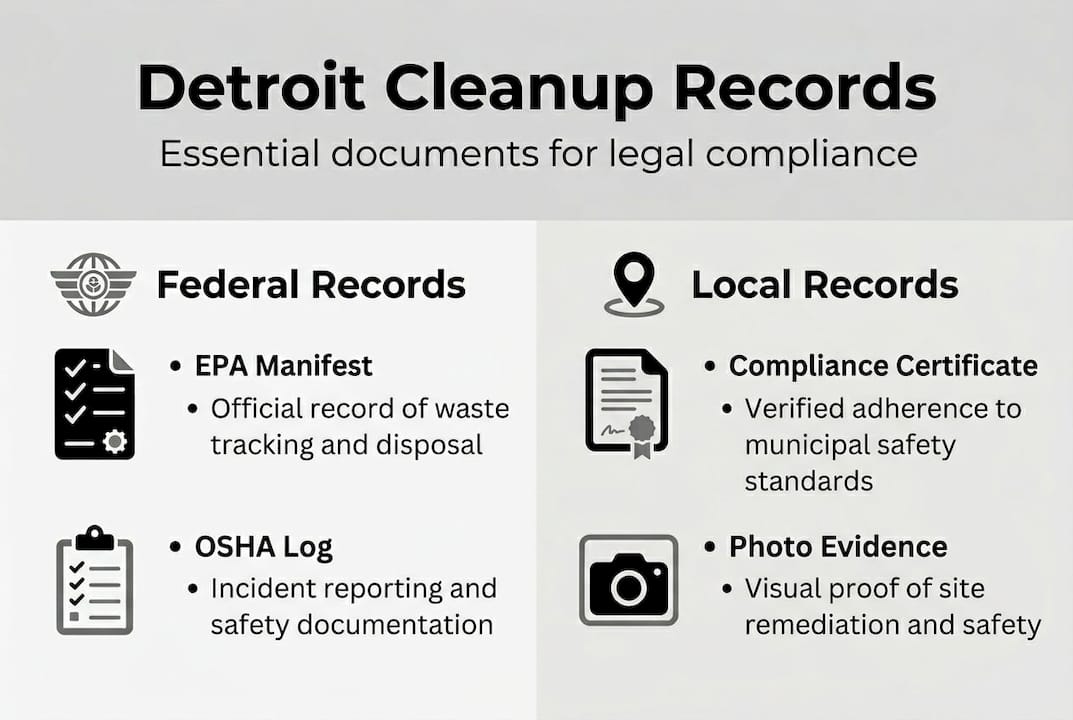
NREPA Part 201 requires baseline environmental assessments, no-further-action reports, and certificates of completion for contaminated sites. For rental properties, a Certificate of Compliance is mandatory before re-occupancy after any qualifying cleanup event.
Federal vs. Michigan requirements:
RequirementFederal (EPA/OSHA)Michigan/DetroitWaste manifestsRequiredRequired plus state trackingEnvironmental assessmentNot always requiredBaseline assessment requiredCertificate of completionNot standardCertificate of Compliance requiredDisclosure to tenantsVaries by stateMichigan requires disclosure for certain eventsLead paint recordsRequired for pre-1978 homesAdditional state protocols apply
Steps Detroit landlords must take to meet NREPA and BSEED standards:
Hire a licensed environmental consultant to conduct the baseline environmental assessment
Submit all required notifications to the Michigan Department of Environment, Great Lakes, and Energy (EGLE)
Obtain a Certificate of Compliance from BSEED before re-renting
Maintain disclosure logs for any traumatic events that occurred on the property
Verify that your cleanup contractor holds current state and federal certifications
Two notable Michigan-specific situations: homes built before 1978 require special lead paint documentation, and certain waterfront properties involving stamp sands carry state exemptions from standard hazardous waste documentation rules.
Use an odor documentation checklist for incidents involving decomposition or chemical exposure, since odor reports are often required as supporting evidence. Understanding the full scope of Detroit hazardous incident types helps you identify which documentation tier applies to your situation. For a broader view of exposure risks, review Michigan risk indicators before starting any remediation.
Best practices and common pitfalls in hazardous cleanup documentation
Regulations tell you what to document. Experience tells you where people go wrong. The most costly mistakes in hazardous cleanup documentation are almost always preventable.
Common pitfalls:
Incomplete logbooks: Missing dates, personnel names, or waste quantities create audit vulnerabilities
No photographic baseline: Without before-and-after photos, you cannot prove the scope of contamination or the quality of remediation
Delayed record updates: Filling in logs days after the work introduces inconsistencies that regulators flag immediately
Missing contractor credentials: If your cleanup company cannot provide current OSHA HAZWOPER and IICRC certificates, your documentation is incomplete regardless of what else you have
Failure to renew Certificates of Compliance: Detroit CoCs expire, and re-renting on an expired certificate creates serious liability
Empirical records enable audits, insurance claims, and penalty prevention; poor documentation leads directly to fines and extended liability exposure. One well-documented DNAPL (dense non-aqueous phase liquid) remediation case showed that consistent recordkeeping enabled a 99% contamination reduction over nine years, verified at every audit.
Edge cases require extra care. Unattended death scenes demand sensitive handling of documentation, including discretion about personal details while still meeting OSHA and Michigan reporting requirements. Michigan stamp sand exemptions apply to specific waterfront properties, but most urban Detroit properties do not qualify, so do not assume an exemption applies without confirming it.
For medical waste documentation found in residential settings, a separate waste stream log is required. Hoarding situations often involve mixed waste categories, each needing its own manifest.
Pro Tip: Before re-renting any unit after a biohazard event, verify your Certificate of Compliance is current and keep copies for a minimum of five years. Follow the full landlord step-by-step guide to make sure nothing is skipped.
Our take: Why documentation is your strongest defense, not a paperwork chore
Most property owners treat documentation as the last thing on their list after a biohazard incident. We understand why. The physical cleanup feels urgent. The paperwork feels secondary. But that mindset is exactly what creates liability.
In our experience, cleanups are only as secure as their records. A property that was remediated perfectly but documented poorly is still a liability waiting to surface. Regulators do not take your word for it. Insurers do not either.
The contrarian reality is this: investing in certified professionals and thorough recordkeeping, even for incidents that seem minor, is the single most cost-effective decision you can make. A small spill with no documentation can become a five-figure fine. A major remediation with complete records becomes a closed file.
“Records aren’t just compliance. They’re your evidence, your audit trail, and your best defense.”
Understanding legal liabilities in hazardous cleanups shifts your perspective from reactive to proactive. Documentation is not bureaucracy. It is protection.
Ready for expert help? Detroit biohazard cleanup and documentation services
If you are managing a biohazard situation in Detroit and need both certified cleanup and airtight documentation, HazWash LLC is ready to help. We handle the physical remediation and the paperwork, so you are covered on every front.
Our team provides Detroit biohazard cleanup with full documentation support, including Certificates of Compliance, EPA manifests, OSHA-compliant incident reports, and insurance-ready records. Whether you need a trauma cleanup service or a structured response to a complex hazardous incident, we bring OSHA HAZWOPER, IICRC, and DOT certifications to every job. Call us 24/7. We respond fast, work discreetly, and leave you with records that stand up to any audit.
Frequently asked questions
How long should hazardous cleanup records be kept in Detroit?
OSHA requires most records be kept between 3 and 30 years depending on record type. Detroit Certificates of Compliance for rentals are valid for 2 to 3 years and should be retained for at least five years after the cleanup date.
What documents are essential for biohazard cleanup compliance in Michigan?
EPA manifests, OSHA incident logs, baseline environmental assessments, and Certificates of Compliance are all required. NREPA Part 201 specifically mandates baseline assessments, no-further-action reports, and certificates of completion for contaminated properties.
Can proper documentation help with insurance claims after hazardous cleanup?
Yes. Detailed records and incident logs are critical for substantiating claims and demonstrating due care. Insurers routinely deny claims that lack supporting documentation of the incident and the remediation process.
Are there exemptions for hazardous cleanup documentation in Michigan?
Michigan stamp sands are exempt from standard hazardous cleanup documentation requirements under state law. Lead paint in homes built before 1978 requires its own separate documentation protocol under both federal and Michigan rules.