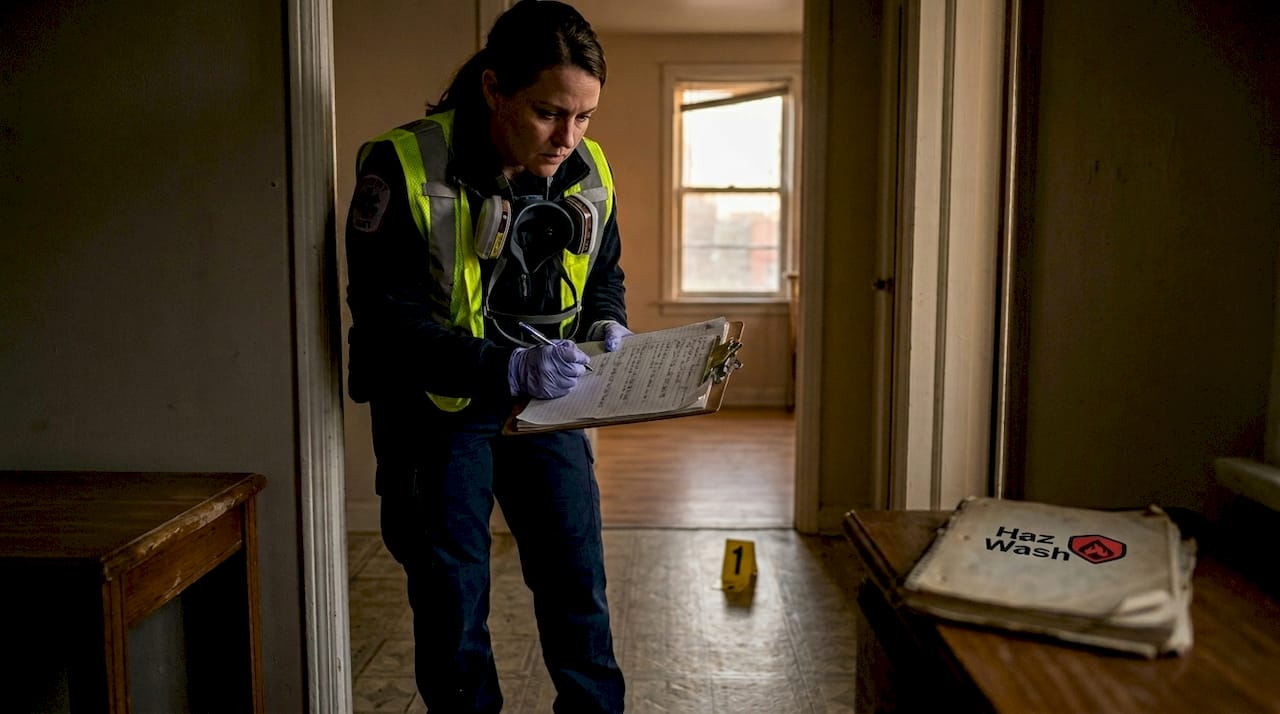
First responder cleanup procedures: Detroit guide
First responder cleanup procedures: Detroit guide
TL;DR:
Accurate hazard classification is crucial for first responder safety and compliance during trauma scene cleanup.
Proper PPE, scene control, and adherence to protocols prevent exposure to bloodborne pathogens and hazardous substances.
When you arrive at a trauma scene in Detroit, the biohazard risk does not pause for uncertainty. First responder cleanup procedures require more than good intentions — they require a structured decision framework, the right protective equipment, and strict adherence to federal and state regulations. A single misstep, whether misclassifying a hazard or skipping a decontamination step, can expose you or your crew to bloodborne pathogens like HIV, hepatitis B, or hepatitis C. This guide lays out standardized, compliant procedures for emergency service personnel working trauma and biohazard scenes across Detroit and surrounding areas.
Table of Contents
Understanding biohazard risks and threat classification at trauma scenes
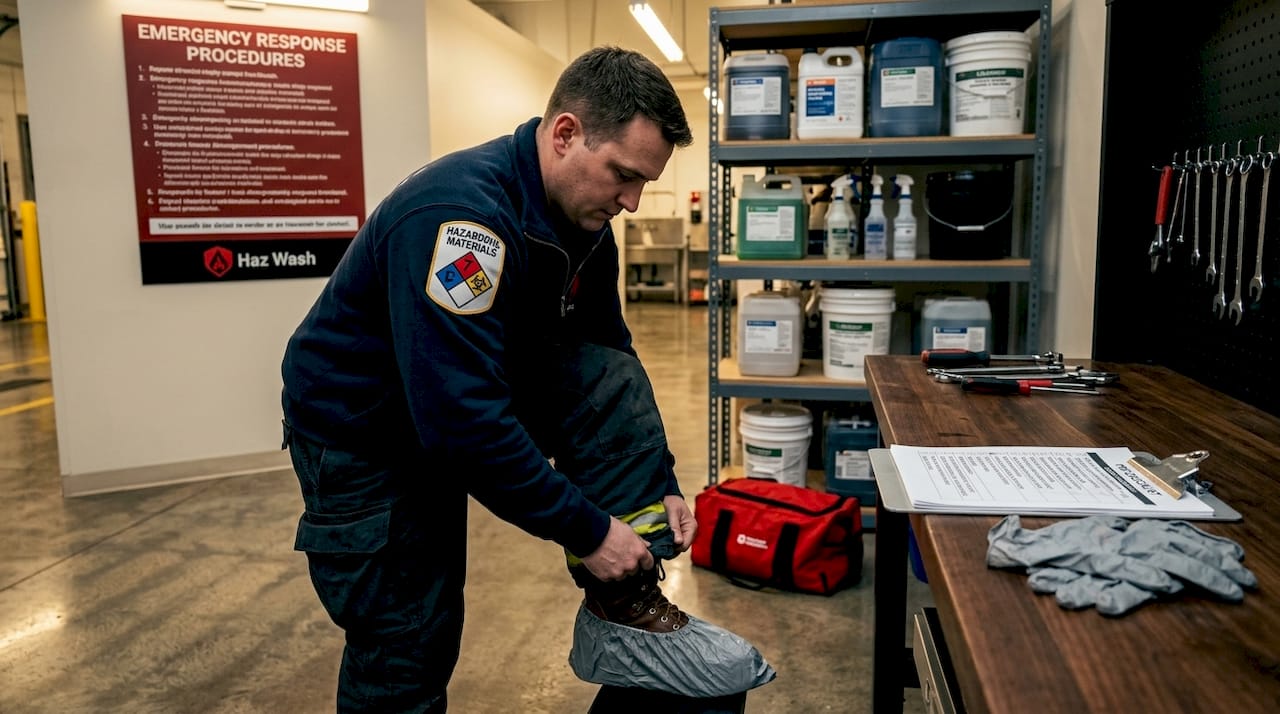
Preparing for cleanup: required personal protective equipment and scene setup
Step-by-step cleanup procedures: from bulk material removal to surface decontamination
Why mastering threat classification is the key to safer, more efficient cleanup
Partner with Hazwash LLC for compliant biohazard cleanup in Detroit
Key Takeaways
Understanding biohazard risks and threat classification at trauma scenes
Before any first responder cleanup procedures begin, accurate hazard classification shapes every decision that follows. Misclassifying a scene does not just affect cleanup; it determines PPE selection, zone control, team safety, and whether hazmat must be called. Both over-response and under-response carry real costs. Over-response strains limited resources and delays patient care. Under-response puts responders and bystanders at direct infection risk.
When you first enter a scene, scan for these key visual indicators:
Visible blood or body fluids on surfaces, furnishings, or victims
Biohazard symbols on containers, sharps disposal units, or medical equipment
Unknown powders, liquids, or odors without an obvious trauma explanation
Aerosol devices, chemical containers, or evidence of intentional dispersal
The critical distinction is between scenes with known bloodborne pathogen exposure and scenes involving unknown substances. A stabbing or unattended death scene with visible blood falls under OSHA’s bloodborne pathogen standard. An unknown white powder with no trauma context triggers a different path entirely. As Biohazard Authority notes, correctly determining whether a scene requires standard bloodborne-pathogen precautions or hazmat/CBRN response is the single most consequential decision you will make.
When in doubt, isolate and escalate. If an unknown substance is present, do not enter the zone to start cleanup. Secure the perimeter, remove bystanders, and call hazmat. Starting cleanup before proper classification removes your ability to collect evidence and dramatically increases exposure risk.
Understanding biohazard threat classification helps you apply the right response level without guesswork. Detroit emergency personnel should also consult biohazard protocols specific to Detroit to ensure local regulatory compliance is factored in from the start.
Preparing for cleanup: required personal protective equipment and scene setup
Once the hazard is classified, equip yourself properly and prepare the scene to contain contamination before cleanup starts. The exposure pathway determines the PPE level. Biological hazards reach responders via contact, percutaneous injury, inhalation, and ingestion, and each pathway requires a specific barrier.
Minimum PPE for bloodborne pathogen exposure (OSHA standard):
Nitrile or latex gloves (double-gloving recommended for bulk blood)
Fluid-resistant or impermeable gown
Eye protection: goggles or face shield
Closed-toe, fluid-resistant footwear
Additional PPE when aerosolization is possible:
N95 respirator or powered air-purifying respirator (PAPR)
Full face shield
Higher-level gown or coverall suit
The table below summarizes PPE selection by scene type:
Scene setup matters as much as PPE selection. Establish a clean zone, contamination zone, and decontamination corridor before entering. Mark boundaries clearly so crew members do not inadvertently track contamination outward. Place all biohazard waste containers at the edge of the contamination zone, never in the clean zone. Refer to our OSHA cleanup PPE guide for Michigan-specific requirements.
Pro Tip: Always don PPE in the clean zone before entering the contaminated area, and doff it in the decontamination corridor. Removing gloves first, then gown, then eye protection, then hand hygiene reduces cross-contamination during the removal sequence. Skipping this order is where most exposure incidents actually happen.
Following established cleanup preparation practices consistently, even on scenes that appear minor, builds the muscle memory that protects you on scenes that are not.
Step-by-step cleanup procedures: from bulk material removal to surface decontamination
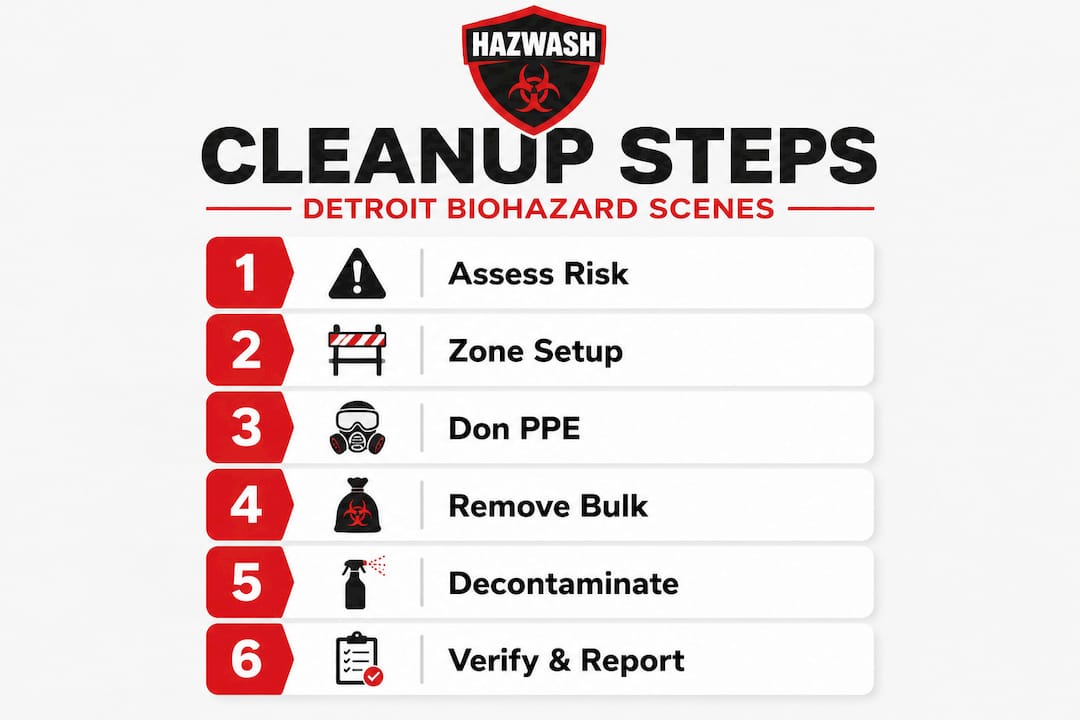
With full PPE and scene controls in place, follow these cleanup steps carefully. The sequence is not arbitrary. Each phase builds on the previous one, and skipping ahead creates exposure gaps.
Phase 1: Scene assessment and contamination mapping. Walk the perimeter of the contamination zone. Photograph or document the full extent of visible biohazard material before touching anything. Identify all affected surfaces, including porous materials like carpet, drywall, and upholstery that may require removal rather than decontamination.
Phase 2: Bulk material removal. Remove all large quantities of blood, tissue, or bodily fluid using disposable absorbent materials. Place all waste directly into labeled, leak-proof biohazard bags. Seal each bag before moving it. Do not overfill; bags should close completely and securely.
Phase 3: Surface decontamination. Apply an EPA-registered hospital-grade disinfectant following the manufacturer’s dwell time requirements. Never wipe before the dwell time is complete. Effective surface decontamination requires the disinfectant to remain wet on the surface for the full recommended contact period, often 5 to 10 minutes for bloodborne pathogen kill claims.
Phase 4: Regulated waste packaging and transport. All biohazard waste must be double-bagged, labeled with the universal biohazard symbol, and transported in DOT-compliant secondary containers. Michigan regulations follow EPA and DOT standards for regulated biohazard waste handling. Improper transport is a federal violation, not just a procedural one.
Phase 5: Post-cleanup verification. Do not release the scene until verification is complete. Visual inspection alone is insufficient. Hepatitis B virus can survive up to 7 days on dry surfaces, meaning a visually clean surface is not necessarily a safe one.
Pro Tip: Porous materials contaminated with blood almost always require removal, not just disinfection. Bloodborne pathogens penetrate carpet backing, subfloor materials, and grout within minutes. If you cannot confirm that a disinfectant reached the full depth of contamination, the material needs to come out. See our breakdown of what professional cleanup steps actually involve for a more detailed picture of depth-of-penetration assessment.
Post-cleanup verification and documentation protocols
After thorough cleanup, verification and documentation complete the process and protect everyone involved, including you. Verification confirms the scene is genuinely free from infectious materials, not just visually tidy. Post-remediation verification can involve ATP (adenosine triphosphate) bioluminescence testing or detailed visual inspection before restoration begins. ATP testing detects organic residue that is invisible to the naked eye and provides a measurable confirmation of decontamination success.
Documentation requirements are equally non-negotiable. Every exposure incident, near-miss, and cleanup action must be recorded. Your records should include:
Date, time, and location of the incident and cleanup
Hazard classification and the basis for that determination
PPE used by each team member throughout the operation
Disinfectants applied, including product name, EPA registration number, and dwell time
Waste disposal records, including container IDs and transport chain of custody
Names of all personnel present during cleanup
Any potential exposure triggers mandatory incident reporting under OSHA 29 CFR 1904 and initiation of a medical evaluation within 24 hours. This is not optional. Delaying medical evaluation after a potential bloodborne pathogen exposure, particularly for hepatitis B or HIV post-exposure prophylaxis, reduces treatment effectiveness significantly.
Pro Tip: Assign one team member as the documentation lead during every biohazard cleanup operation. When everyone is responsible for documentation, it often means no one is. A single designated recorder maintains consistency and ensures nothing is omitted under pressure. Learn more about the importance of exposure documentation for first responder health and legal compliance.
Why mastering threat classification is the key to safer, more efficient cleanup
Here is the part most cleanup training programs miss: every procedural checklist in the world is only as reliable as the classification decision made in the first 60 seconds on scene. Most responders understand the cleanup sequence. Far fewer have internalized when to change the classification mid-scene, and what that change means for every action already taken.
We have seen scenarios where a responder correctly identified blood as the primary hazard, started cleanup under bloodborne pathogen protocols, and then discovered a discarded syringe with residual unknown substance. At that point, the classification changes. The scene changes. The PPE may be inadequate. This is not a procedural edge case; it is a real gap in how cleanup training typically frames hazard assessment as a one-time entry step rather than a continuous evaluation.
The single most consequential decision at a potential biohazard scene is whether it falls into standard bloodborne-pathogen precautions or escalates to hazmat-level response. That decision must be revisited, not just made once at the door.
Integrated zone-based response treats the clean zone, contamination zone, and decontamination corridor as living boundaries that shift with new information. Responders trained to update their threat model as conditions evolve make better decisions than those trained to lock in a classification and execute a script. Understanding the full framework for hazard classification in Detroit’s regulatory environment gives responders the flexibility to respond accurately, not just quickly.
Cleanup team training that embeds classification logic as a recurring decision point, not a checkbox, produces measurably safer outcomes. That is not opinion. That is what post-incident reviews consistently show.
Partner with Hazwash LLC for compliant biohazard cleanup in Detroit
When a trauma scene exceeds your department’s scope or requires specialized remediation beyond first aid cleanup measures, professional support is the responsible next step.
HazWash LLC provides certified trauma scene cleanup in Detroit and surrounding areas, fully compliant with OSHA, Michigan DEQ, and DOT regulations. Our team holds OSHA HAZWOPER, IICRC, and DOT certifications and is available 24/7 for emergency response. We handle everything from bulk biohazard removal to post-remediation verification, with complete documentation for your records. Explore our professional biohazard cleaning Detroit services, learn more about hazardous incident cleanup Detroit, or review our infectious waste remediation services. We take the burden of safe, compliant remediation off your team entirely.
Frequently asked questions
What PPE is required for first responder biohazard cleanup?
Minimum PPE includes gloves and eye protection per OSHA bloodborne pathogen standards, plus a fluid-resistant gown, with N95 masks or powered air-purifying respirators added when aerosolized particles are suspected.
How long can hepatitis B virus survive on surfaces at trauma scenes?
Hepatitis B virus can survive up to seven days on dry environmental surfaces, which is why thorough decontamination is required even when a surface appears visually clean.
When should a first responder call hazmat instead of starting cleanup?
If an unknown powder or liquid is present without a clear trauma explanation, isolate the area and call hazmat; unknown substances require escalation, not cleanup, until the agent is identified.
What are the four main exposure pathways for biological hazards to first responders?
Biological hazards reach responders through four routes: direct contact with broken skin or mucous membranes, percutaneous injury from sharps, inhalation of aerosolized particles, and ingestion through contaminated hands touching the mouth or face.