Scene Clean: What Families and Property Owners Must Know
Scene Clean: What Families and Property Owners Must Know
TL;DR:
Property owners and families are legally responsible for biohazard cleanup after traumatic incidents, not law enforcement or responders. Certified professionals must handle porous surface contamination exceeding 1 square foot, using proper PPE, disinfection protocols, and thorough documentation. Proper cleanup prevents health risks, legal liability, and provides a definitive end point for affected spaces.
When a traumatic incident occurs, the scene clean process that follows carries real health risks and legal consequences most people never expect. Law enforcement leaves. Emergency responders pack up and go. And then the property owner or family faces a contaminated space with no guidance and a lot of liability. Many assume the mess will be handled by someone official. It will not. The responsibility falls directly on the people who own or control the property. This guide breaks down the legal requirements, the right tools, the correct step-by-step process, and how to confirm the cleanup actually worked.
Table of Contents
Key takeaways
When a scene clean requires certified professionals
Not every spill requires a biohazard team. But the threshold for when it does is lower than most people realize.
Biohazards include blood, bodily fluids, and other potentially infectious materials (OPIM) as defined by OSHA. When these substances are present in a space after a traumatic incident, such as an unattended death, violent assault, or suicide, the contamination is rarely limited to what is visible on the surface.
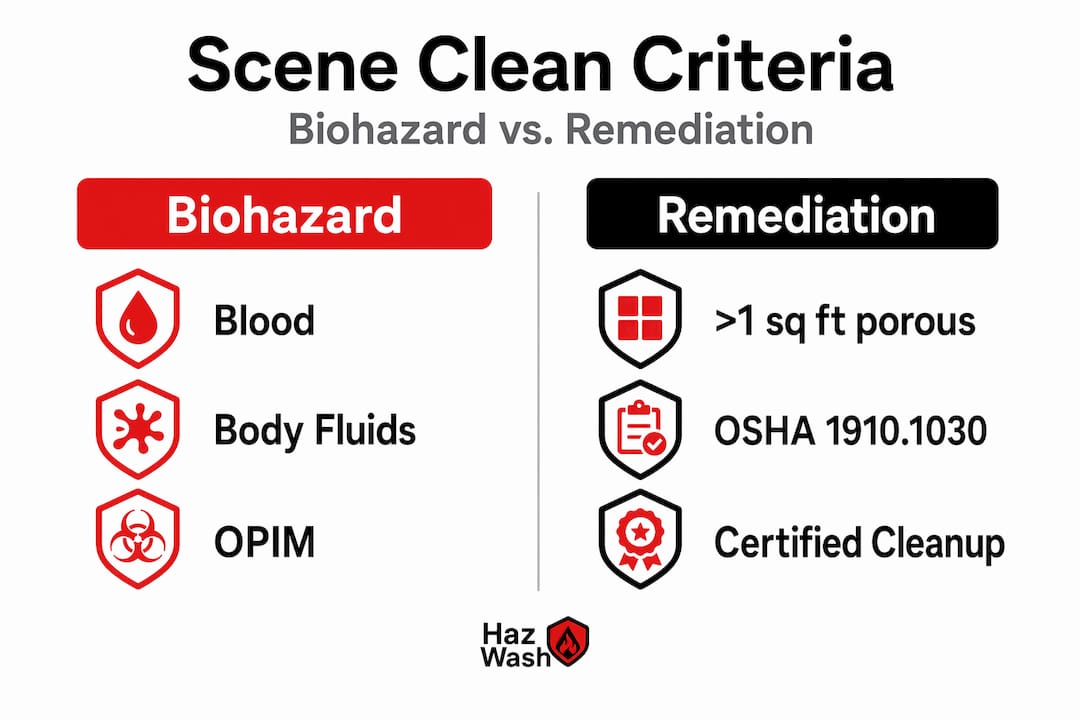
Professional remediation is required under OSHA 29 CFR 1910.1030 when contamination covers more than 1 sq ft of a porous surface or involves regulated biological waste. Porous materials include carpet, drywall, subflooring, and upholstered furniture. These materials absorb fluids rapidly, which means the contamination you can see is often the smaller part of the problem.
The legal responsibilities here are serious. As a property owner or manager, failing to arrange certified cleanup after a qualifying incident can expose you to liability under OSHA, EPA, and state environmental regulations. Michigan property owners have specific obligations that go beyond general hygiene. Understanding those legal liabilities in trauma cleanup before an incident occurs is far better than discovering them afterward.
One of the most misunderstood facts in this field: cleanup responsibility belongs to property owners and families, not to police, fire, or EMS. First responders are not trained or equipped to perform biohazard remediation. They leave the scene as-is.
Here is when you must call certified professionals:
Contamination involves blood, bodily fluids, or tissue on any porous material
The affected area covers more than 1 sq ft of any surface type
The incident involves an unattended death, homicide, or severe trauma
Any regulated biological waste is present, including sharps or medical waste
The property is a rental unit, commercial space, or subject to health inspections
Pro Tip: If you are unsure whether a scene qualifies for professional cleanup, treat it as if it does. The cost of certified remediation is far less than the legal and health cost of getting it wrong.
Preparation: PPE, tools, and safety protocols
Attempting a scene clean without the right preparation will not just produce poor results. It can cause serious illness, pathogen exposure, and regulatory violations.
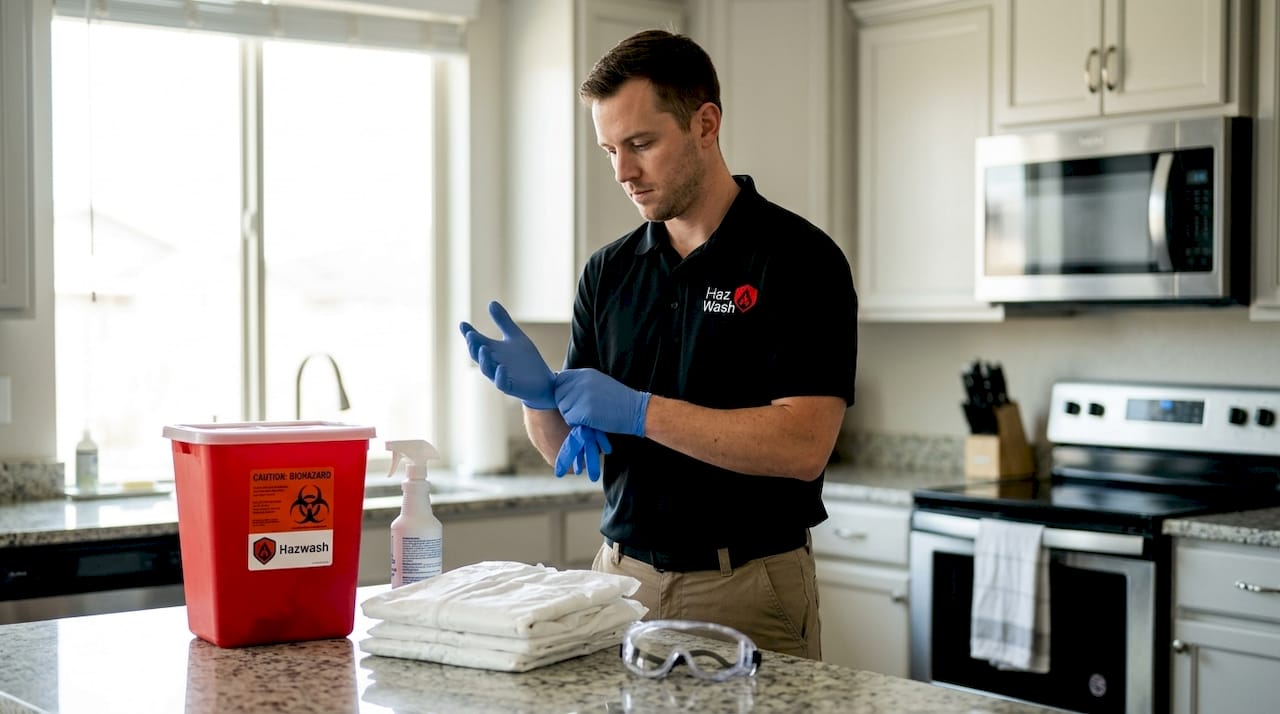
The required PPE for any biohazard cleanup includes more than rubber gloves and a face mask. Certified technicians follow OSHA Bloodborne Pathogens Standard requirements regardless of the setting. Federal OSHA applies equally to residential and commercial environments when paid work involving bloodborne pathogens is performed.
Required personal protective equipment
Fluid-resistant Tyvek coveralls or equivalent
Double nitrile gloves (minimum), with outer utility gloves for sharp debris
Full-face respirator with appropriate cartridges (N95 minimum, P100 preferred)
Disposable boot covers or rubber boots
Eye protection with full seal, not just safety glasses
Essential tools and chemical supplies
Containment is a step many property owners overlook. Before any cleaning begins, the affected area must be sealed off with plastic sheeting and negative air pressure, where possible, to stop cross-contamination to adjacent rooms. This is especially important in HVAC-connected spaces where airborne particles can spread rapidly.
Pro Tip: Never wipe bulk biohazardous liquids. Always absorb them first with disposable absorbent pads. Wiping bulk contamination spreads pathogens over a larger surface area and dramatically increases the scope of the cleanup.
Step-by-step execution of biohazard scene cleaning
Professional post-incident cleaning follows a defined sequence. Skipping steps or changing the order reduces effectiveness and increases risk. Here is how it works.
Hazard assessment. Before touching anything, the technician surveys the full area. This includes identifying visible contamination, assessing surface materials, checking for secondary spread (footprints, contact points, ventilation pathways), and mapping the full affected zone.
Containment setup. Plastic sheeting is applied at entry and exit points. An air scrubber with HEPA filtration is placed to create negative pressure in the room, containing airborne particles during active cleanup.
Gross contamination removal. Bulk biological material is absorbed, not wiped. Absorbent materials are then placed into labeled biohazard bags. Porous materials like carpet and drywall that show deep seepage must be physically removed and bagged as regulated waste, not treated in place.
Mechanical cleaning. All remaining surfaces are scrubbed to remove organic residue. Mechanical cleaning must precede chemical disinfection because organic material inactivates disinfectants, reducing their ability to kill pathogens.
Chemical disinfection. OSHA 29 CFR 1910.1030 requires EPA-registered tuberculocidal disinfectants or a 1:10 bleach solution for surfaces contaminated with blood. The disinfectant is applied and left wet on the surface for the full contact time, typically 10 minutes.
Contact time compliance. This is where most amateur and uncertified cleanups fail. Ignoring the required dwell time is the single most common error in biohazard cleanup. Wiping a surface before the disinfectant has worked is the equivalent of not disinfecting at all.
Secondary rinse and surface restoration. After the dwell time is complete, surfaces are wiped, rinsed, and dried. Some materials may need sealing or priming before being considered restored.
Waste disposal. All bagged materials are inventoried, labeled, and transported to a licensed disposal facility. A waste disposal manifest is created and retained. This document is your legal record that the waste was handled in compliance with OSHA and EPA regulations.
Common cleanup mistakes and how to avoid them
Verification and documentation after cleanup
Finishing the physical cleaning is not the end of the process. Verification and documentation are what separate a legally defensible cleanup from one that leaves you exposed.

Post-cleanup verification using ATP bioluminescence testing is the industry standard for confirming decontamination. ATP testing detects biological residue at levels invisible to the eye and produces a measurable result that can be documented. Visual inspection alone is not sufficient for compliance purposes.
Proper documentation includes the following:
A written cleanup report detailing all areas treated, products used, and dwell times observed
A waste disposal manifest confirming regulated waste was removed and transported legally
ATP test results or equivalent verification records
Chain of custody documentation if the incident involved law enforcement
Photographs taken before and after remediation for record purposes
IICRC S540 standards govern trauma and crime scene remediation and specify phased workflows, worker protection protocols, disinfection procedures, and documentation requirements. Courts and insurers reference these standards when evaluating liability. Having documentation that your cleanup met IICRC S540 requirements can be the difference between a resolved claim and extended legal exposure.
For landlords and property managers, this documentation also matters for tenant safety disclosures and future property transactions. The OSHA-compliant cleanup guide for Michigan property owners provides additional detail on state-specific documentation obligations.
My take on the misconceptions that get people hurt
I have worked in this field long enough to know that the most dangerous situation is not the one that looks obviously hazardous. It is the one that looks like it has already been handled.
I have seen families scrub a room with household bleach, declare it clean, and move back in. I have seen property managers paint over blood-saturated drywall without removing it first. In both cases, the underlying contamination remained. The health risk did not go away because the surface looked clean.
The two misconceptions I see most often are that police will handle it, and that household disinfectants are good enough. Neither is true. Certified biohazard professionals follow IICRC S540 and OSHA-compliant exposure plans. Uncertified cleaners, whether that is a family member or a general cleaning service, typically use consumer-grade products at the wrong concentration with no timed dwell periods. That is not cleanup. That is surface aesthetics.
What I want families and property owners to understand is this: a proper scene clean does more than protect your health. It creates a real end point. When a space is genuinely decontaminated, documented, and cleared, people can begin to move forward. That is worth doing correctly. The biohazard cleanup professionals who do this work well understand that they are not just cleaning a room. They are closing a chapter for a real family.
Cutting corners in this work does not save time. It extends the harm.
— David
Certified scene cleanup when you need it most
When you are dealing with the aftermath of a traumatic incident, you should not have to figure out OSHA compliance on your own. Hazwash provides certified biohazard cleanup in Detroit and surrounding Michigan communities, 24 hours a day, 7 days a week.
Hazwash technicians hold OSHA HAZWOPER, IICRC, and DOT certifications. Every job includes full regulatory compliance, discreet service, ATP verification testing, and complete waste disposal documentation. Whether you are a family facing an unimaginable situation, a landlord managing a tenant incident, or a property manager with a legal deadline, Hazwash delivers fast, discreet response and peace of mind. Contact Hazwash now to speak with a certified technician.
FAQ
Who is responsible for biohazard cleanup after a crime?
Cleanup after a crime, death, or traumatic incident is the responsibility of the property owner or family. Law enforcement and first responders do not perform scene cleaning as part of their duties.
When does a scene clean require a certified professional?
A certified professional is required when contamination covers more than 1 sq ft of a porous surface or involves regulated biological waste, per OSHA 29 CFR 1910.1030.
What disinfectants are approved for biohazard cleanup?
OSHA requires EPA-registered tuberculocidal disinfectants or a 1:10 bleach-to-water solution for surfaces contaminated with blood. The product must remain wet on the surface for the full contact time, typically 10 minutes.
How do professionals verify a scene is actually clean?
Certified technicians use ATP bioluminescence testing to detect biological residue invisible to the naked eye, combined with written documentation and waste disposal manifests to confirm compliance.
Can porous materials like carpet be disinfected in place?
No. Porous materials including carpet, drywall, and subflooring that show seepage from blood or bodily fluids must be physically removed and disposed of as regulated waste. Surface disinfection alone is not sufficient.