How to document hazardous incidents for Detroit landlords
How to document hazardous incidents for Detroit landlords
Proper documentation is essential for legal, regulatory, and financial protection after a biohazard incident.
Landlords must follow OSHA and EGLE guidelines, using specific forms and retaining records for years.
Over-documentation and working with certified professionals help ensure compliance and smooth recovery.
When a biohazard incident strikes your rental property, the financial and legal pressure starts immediately. Detroit landlords and property managers who skip or mishandle incident documentation risk fines, failed inspections, voided insurance claims, and civil lawsuits. A single blood spill or unattended death can generate cleanup costs between $2,000 and $25,000, and without proper records, you absorb every dollar out of pocket. This guide walks you through the exact forms, steps, and safeguards required to stay compliant under Detroit, Michigan, and federal rules.
Table of Contents
Why standard documentation isn’t enough: Lessons from Detroit’s toughest incidents
Connect with certified biohazard experts for hassle-free compliance
Key Takeaways
PointDetailsUse required formsDetroit landlords must use OSHA and EPA forms to document biohazard incidents and hazardous waste.Keep records for yearsRetain all photos, manifests, and communications for at least three years to ensure legal compliance.Certified cleanup onlyUsing trained professionals minimizes liability and maximizes regulatory protection.Documentation enables recoveryDetailed records help recover costs from tenants and prove claims for insurance or inspections.
What you need before documenting hazardous incidents
With the stakes clear, it is critical to gather the right documentation tools and understand the processes required before your cleanup team steps in.
Most landlords treat biohazard documentation as an afterthought. That mistake can cost you your Certificate of Compliance. Before any cleanup begins, you need to know which regulatory agencies are watching and what each one demands from you.
The two regulatory tracks you must understand
Hazardous incident documentation falls under two parallel frameworks:
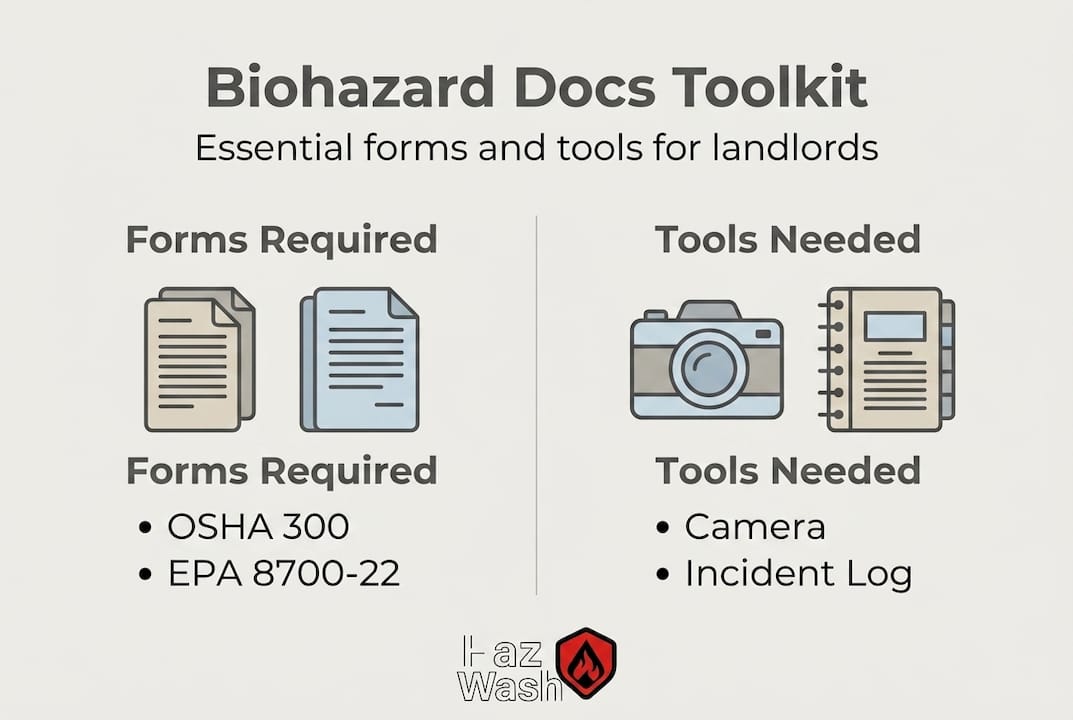
OSHA (Occupational Safety and Health Administration): Applies when employees are involved in managing or cleaning up the incident. OSHA recording requirements mandate the use of Forms 300, 300A, and 301 for any work-related injury or illness connected to the incident.
EGLE/EPA (Michigan Environment, Great Lakes, and Energy / Environmental Protection Agency): Applies when biohazardous materials become regulated hazardous waste, such as blood-soaked materials or sharps. Per Michigan EGLE SQG requirements, you must obtain a Site ID number by filing EQP Form 5150, use Uniform Hazardous Waste Manifest (EPA Form 8700-22) for any transport to a licensed disposal facility, and retain manifests and all related records for a minimum of three years.
Understanding biohazard disposal regulations in Michigan separates landlords who stay protected from those who face regulatory penalties.
Who is allowed on that scene
Only certified personnel with proper personal protective equipment (PPE) should enter a contaminated area. Safe biohazard response roles are clearly defined: in-house maintenance staff without documented BBP (Bloodborne Pathogen) or HAZWOPER (Hazardous Waste Operations and Emergency Response) training should never touch contaminated materials. Demand proof of current insurance from every contractor before they enter the property.
Verify OSHA HAZWOPER certification
Confirm IICRC (Institute of Inspection, Cleaning and Restoration Certification) credentials
Request a Certificate of Insurance naming you as an additional insured
Confirm DOT compliance for hazardous waste transport
Safety warning: If documentation or cleanup is not handled by qualified, certified teams, liability for health outcomes, regulatory penalties, and civil claims transfers directly to you as the property manager or landlord. This is not a risk worth taking.
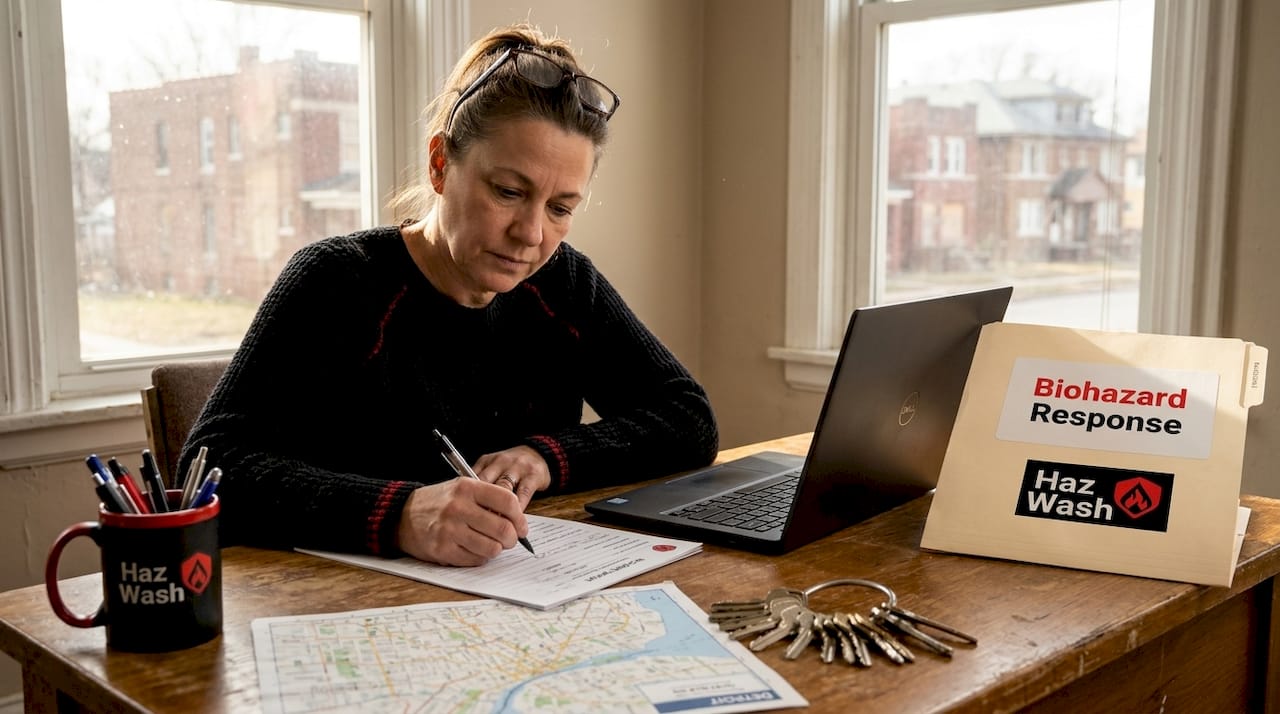
Pro Tip: Create a “biohazard response folder” for each property. Include blank copies of all required forms, your contractor contact list, and the property’s Site ID number. When an incident happens, you won’t be scrambling.
Step-by-step documentation after a hazardous incident
Once you have your tools and forms ready, use this step-by-step process immediately after any hazardous incident.
Speed and accuracy both matter here. Missing a step early in the process creates gaps that are nearly impossible to close later, especially when insurance adjusters or city inspectors start asking questions.
Step 1: Secure and assess the scene
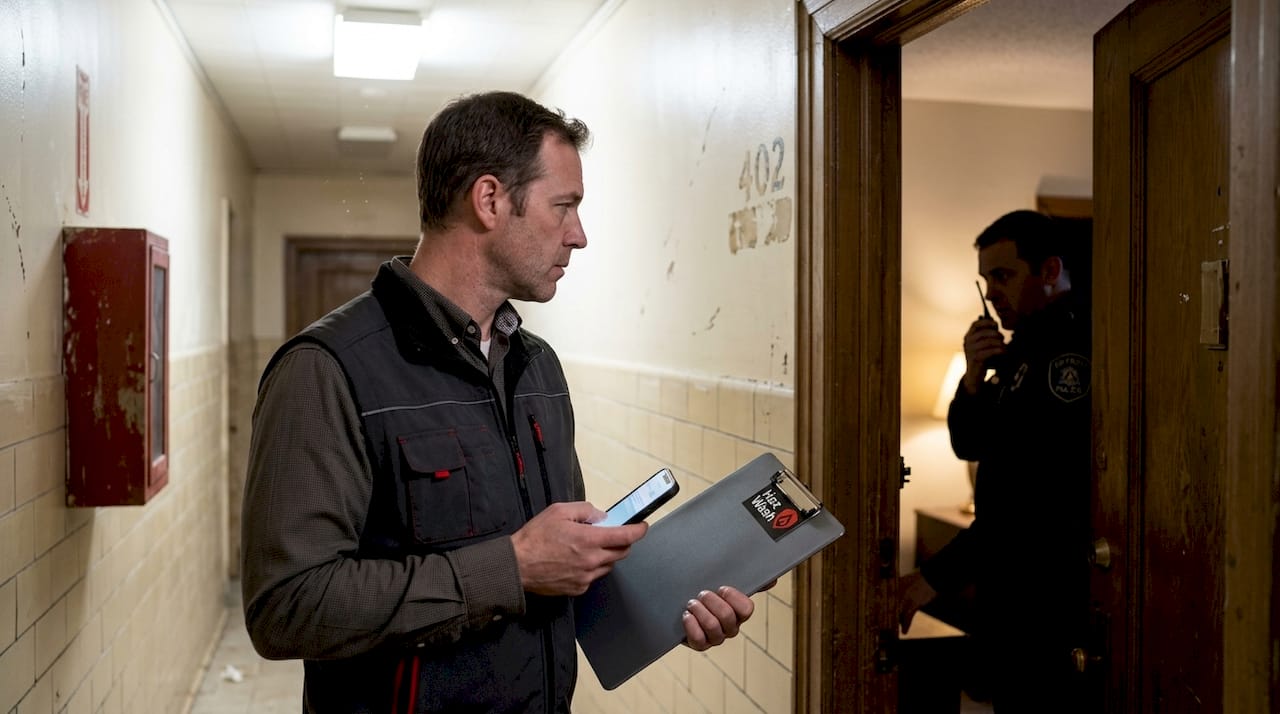
Wait for law enforcement to officially release the scene before you or any contractor enters. Get that release in writing if possible. Note the date and time of the release.
Step 2: Photograph everything before cleanup
Take wide-angle shots of the full room or space, then detailed close-up photos of contamination areas. Use a timestamp feature on your camera or phone. Courts and insurance companies have dismissed claims due to undated photos. Document every surface, every item, and the full scope of contamination.
Step 3: Write your incident summary
Record the date, exact location within the property, a factual description of the incident, and whether any employees were present or involved. Note any tenant communications received. Do not editorialize. Stick to verifiable facts.
Step 4: Complete OSHA forms within 7 days
OSHA recording requirements are clear: property managers and landlords must record incident details within 7 days, including date, location, description, and outcomes such as days away from work if an employee was injured. Late filings create compliance gaps that can trigger audits.
Step 5: Process and retain hazardous waste manifests
Once your certified contractor removes biohazardous materials, they should provide you with a completed EPA Form 8700-22. Review it carefully before signing. Retain it in both physical and digital formats. Pair it with the contractor’s disposal facility receipt and final clearance certificate.
The cleanup documentation guide breaks down each document type in detail and provides additional context for complex multi-unit scenarios.
Pro Tip: Digitize every document immediately after you receive it. Store files in a cloud folder organized by property address and incident date. This creates an audit-ready record that you can share with inspectors, insurance adjusters, or attorneys within minutes.
Following landlord response best practices means you are not just reacting to the incident. You are managing it professionally from the first hour.
Common mistakes and how to avoid them
Even with a checklist, property managers often stumble on critical points. Here are the errors you must avoid.
These are not theoretical risks. Detroit landlords have faced fines, lawsuits, and certificate denials because of these exact mistakes.
The most frequent documentation failures
Missing or incomplete OSHA forms after an employee-involved cleanup
Failing to obtain EPA Form 8700-22 from the cleanup contractor
No photographic evidence taken before cleanup begins
Allowing in-house maintenance staff to handle contaminated materials
Not naming the landlord as additional insured on contractor’s Certificate of Insurance
Disposing of records before the 3-year minimum retention period
Each of these errors can cost you during a city inspection or a legal dispute. Using untrained cleanup crews shifts the full liability for health violations and regulatory penalties onto you as the property manager. Certified contractors carry that liability for their portion of the work.
The disclosure issue Detroit landlords miss
Michigan does not have a specific biohazard disclosure statute. However, landlords are still legally required to reveal known habitability defects to future tenants. A prior biohazard incident that was not fully remediated qualifies as a material defect. Failing to disclose it creates liability even if the original incident is years old.
Important reminder: Michigan law requires landlords to disclose known material defects affecting habitability, even where no explicit biohazard disclosure statute exists. A remediated trauma scene with proper clearance documentation protects you. One without documentation leaves you exposed to future claims.
Always check your insurance policy for biohazard or vandalism endorsements. Many standard landlord policies do not cover biohazard remediation unless a specific rider is added. Discovering that after the incident is too late.
Review the biohazard compliance checklist to ensure your current procedures cover every compliance requirement before an incident occurs.
Pro Tip: Always require that the cleanup contractor’s Certificate of Insurance specifically names you, the landlord or property management company, as an “additional insured.” This is not standard on every policy. You have to ask for it, and you have to confirm it before work begins.
How documentation supports compliance and recovery
When the hard work is done, your documentation can make the difference for legal protection, financial recovery, and smooth management.
A completed file does more than prove compliance. It becomes your financial recovery tool, your shield against future tenant claims, and your evidence during city inspections.
Financial protection and cost recovery
Biohazard cleanup is expensive. Cleanup costs typically range from $2,000 to $25,000, depending on the severity and scope of the incident. As the landlord, you are responsible for those costs upfront. But thorough documentation opens specific recovery paths:
Security deposit recovery: If tenant negligence caused the incident, documented evidence supports a claim against the security deposit.
Estate claims: In cases involving a tenant death, you may be able to recover costs from the tenant’s estate if documentation clearly links the damage to the tenancy.
Insurance claims: Detailed photos, contractor invoices, manifests, and clearance certificates are exactly what adjusters need to process biohazard or vandalism claims quickly.
Staying compliant during Detroit inspections
Detroit’s Certificate of Compliance program requires proof that rental properties meet habitability standards. A biohazard incident that was not properly documented and remediated can block certificate renewal. Inspectors increasingly ask for clearance letters from certified remediation firms, not just a landlord’s verbal confirmation.
Records must be maintained for at least 3 to 5 years to satisfy inspection requirements, support Certificate of Compliance renewals, and meet disclosure obligations for future tenants.
Benefits of complete documentation
Provides evidence that remediation met regulatory standards
Supports insurance claims for faster reimbursement
Creates a defensible record if a tenant or former tenant files a complaint
Enables legal cost recovery from responsible parties
Demonstrates due diligence to city inspectors and code enforcement officers
Identifying biohazard risk indicators early allows property managers to respond faster and build stronger documentation from the start of an incident.
Every dollar you spend on thorough documentation is protection against far larger losses down the road. This is not bureaucratic box-checking. It is financial self-defense.
Why standard documentation isn’t enough: Lessons from Detroit’s toughest incidents
Most guides give you the forms and stop there. In Detroit’s rental market, that approach leaves property managers exposed in ways that only become visible when something goes wrong.
We have seen property managers who checked every standard compliance box, submitted their OSHA forms on time, and kept their waste manifests. Then a city inspector requested a clearance certificate from a licensed remediation firm and they had nothing. The cleanup was done, but nobody could prove it met the required decontamination standard. The certificate renewal stalled. Legal exposure remained.
Cross-agency compliance is the real challenge
Most property managers focus on one agency, either OSHA or EGLE, and miss the fact that a single incident can trigger requirements from both, plus local city code enforcement. Detroit has its own rental ordinance framework that adds another layer. Managing all three at once requires a coordinated approach, not a checklist from a single source.
Remediation professionals who work Detroit properties consistently report that clearance certificates are the most overlooked document in the process. A clearance certificate from a certified firm confirms that contamination levels have been reduced to safe standards. It is the final proof that the job was done correctly, and it is what separates “we cleaned it” from “it is certified clean.”
Over-document to stay fully protected
The strongest position is to document more than required. That means:
Full photographic records taken at multiple stages of cleanup
Written communications with your cleanup contractor preserved and dated
Clearance certificates stored permanently alongside your other property records
Inspector communications logged and filed
Detroit’s inspection environment has grown more rigorous. Inspectors are asking for evidence beyond the basic required forms. The landlords who sail through inspections are the ones who can produce a complete, organized file in minutes. Thoroughness is not overcaution. It is your strongest asset in this market.
Review documentation compliance case studies from the Detroit market to see how these principles apply to real incidents and the outcomes they produced.
Connect with certified biohazard experts for hassle-free compliance
When your reputation, finances, and compliance are on the line, connecting with local experts makes documentation and cleanup straightforward and stress-free.
HazWash LLC works directly with Detroit landlords and property managers to handle certified biohazard cleanup, complete all required documentation, and prepare records that support insurance claims, certificate renewals, and tenant recovery. We know what Detroit inspectors look for and what forms need to be filed to satisfy OSHA, EGLE, and local ordinance requirements simultaneously.
Access federal compliance guidance tailored for Michigan property owners, or review our DOT hazardous waste checklist to make sure your waste transport procedures are fully covered. Whether you are dealing with a trauma scene, an unattended death, or a hazardous spill, Detroit biohazard pros at HazWash are available 24/7 to respond, remediate, and document. Your compliance file will be ready when you need it most.
Frequently asked questions
Which forms do Detroit landlords need after a biohazard incident?
Landlords must use OSHA Forms 300, 300A, and 301 for any employee-related injuries or illnesses and EPA Form 8700-22 for tracking and transporting hazardous waste generated by the incident.
How long must records be kept after hazardous cleanup?
You must retain all documentation for 3 to 5 years to satisfy Detroit inspection requirements, support Certificate of Compliance renewals, and meet future tenant disclosure obligations.
Can landlords recover biohazard cleanup costs from tenants?
If tenant negligence caused the incident, thorough documentation of costs, photos, and contractor records supports a claim against the security deposit or the tenant’s estate, and your insurance policy may cover additional amounts under a biohazard or vandalism endorsement.
Is it safe to use my maintenance crew for biohazard cleanup?
Only crews with certified BBP/HAZWOPER training should perform these cleanups. Using untrained staff shifts the full legal and health liability to you as the property manager or landlord.