What Is Medical Waste Management: A Compliance Guide
What Is Medical Waste Management: A Compliance Guide
TL;DR:
Medical waste management involves proper segregation, treatment, and disposal to prevent health and environmental risks. Compliance is primarily governed by state regulations, requiring accurate classification, secure storage, and thorough documentation for all waste streams. Implementing staff training, regular audits, and effective treatment methods like autoclaving ensures safety and regulatory adherence.
Medical waste management is the systematic process of segregating, treating, and disposing of waste generated by healthcare facilities to prevent infection, environmental contamination, and regulatory violations. Formally called regulated medical waste (RMW) management, this discipline covers everything from syringes and blood-soaked bandages to unused pharmaceuticals and biological cultures. The U.S. EPA defines medical waste as a subset of healthcare-generated waste contaminated by blood, body fluids, or potentially infectious materials. Healthcare facilities generate between 0.5 to 3 pounds of medical waste per bed daily, a volume that demands structured, auditable management systems.
What is medical waste management and why does it matter?
Medical waste management is defined as the end-to-end system for handling, treating, and disposing of healthcare waste in a manner that protects patients, staff, and the surrounding community. The importance of medical waste management extends beyond infection control. Improper disposal creates legal liability, environmental damage, and public health crises that can affect entire neighborhoods.
Regulation of this process sits primarily at the state level. The federal Medical Waste Tracking Act (MWTA) expired in 1991, leaving the EPA with a limited baseline role under the Resource Conservation and Recovery Act (RCRA). Today, state environmental and health departments set the specific rules your facility must follow. That means compliance requirements in Michigan differ from those in Texas or California, and your compliance officer must know the rules for your jurisdiction specifically.
The World Health Organization (WHO) and the EPA both recognize that poor medical waste practices contribute to the spread of infectious disease and the release of toxic compounds into soil and groundwater. For healthcare professionals and waste management coordinators, understanding this system from classification through final disposal is not optional. It is a core operational responsibility.
What are the types of medical waste?
Medical waste falls into five primary categories, each requiring distinct handling and disposal protocols:
Infectious waste: Materials contaminated with blood, body fluids, or pathogens. This includes used wound dressings, culture dishes, and materials from isolation wards. Infectious waste carries the highest transmission risk and requires treatment before disposal.
Sharps waste: Needles, scalpels, lancets, and broken glass. Sharps puncture standard waste bags and containers, creating immediate injury and exposure risk. Puncture-proof, rigid containers are mandatory.
Pharmaceutical waste: Unused medications, expired drugs, and damaged pharmaceutical products. The WHO’s 2025 global guidelines classify pharmaceutical waste as a distinct sub-stream requiring trackable, hazardous waste protocols separate from general RMW.
Pathological waste: Human tissues, organs, and body parts removed during surgery or autopsy. This category carries both biological and ethical handling requirements.
Operational waste: Gloves, gowns, and packaging that contact patients but are not directly contaminated. This category is often over-classified as regulated medical waste, which inflates disposal costs unnecessarily.
The distinction between regulated and non-regulated waste matters operationally. Over-classification of waste as RMW inflates treatment volume, increases costs, and adds unnecessary environmental burden. Periodic waste-stream audits and staff training are the most effective tools for keeping classification accurate.
How does the medical waste management workflow operate?
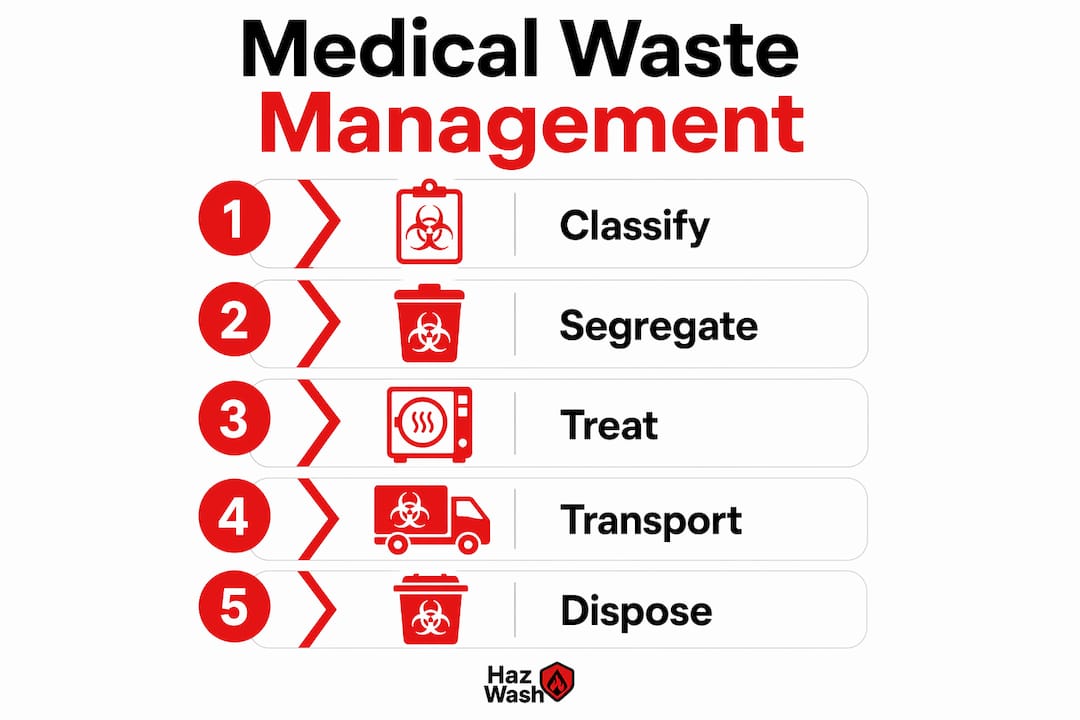
Managing regulated medical waste follows a defined sequence. Skipping or shortcutting any step creates compliance gaps and exposure risk. Here is the operational workflow used by compliant healthcare facilities:
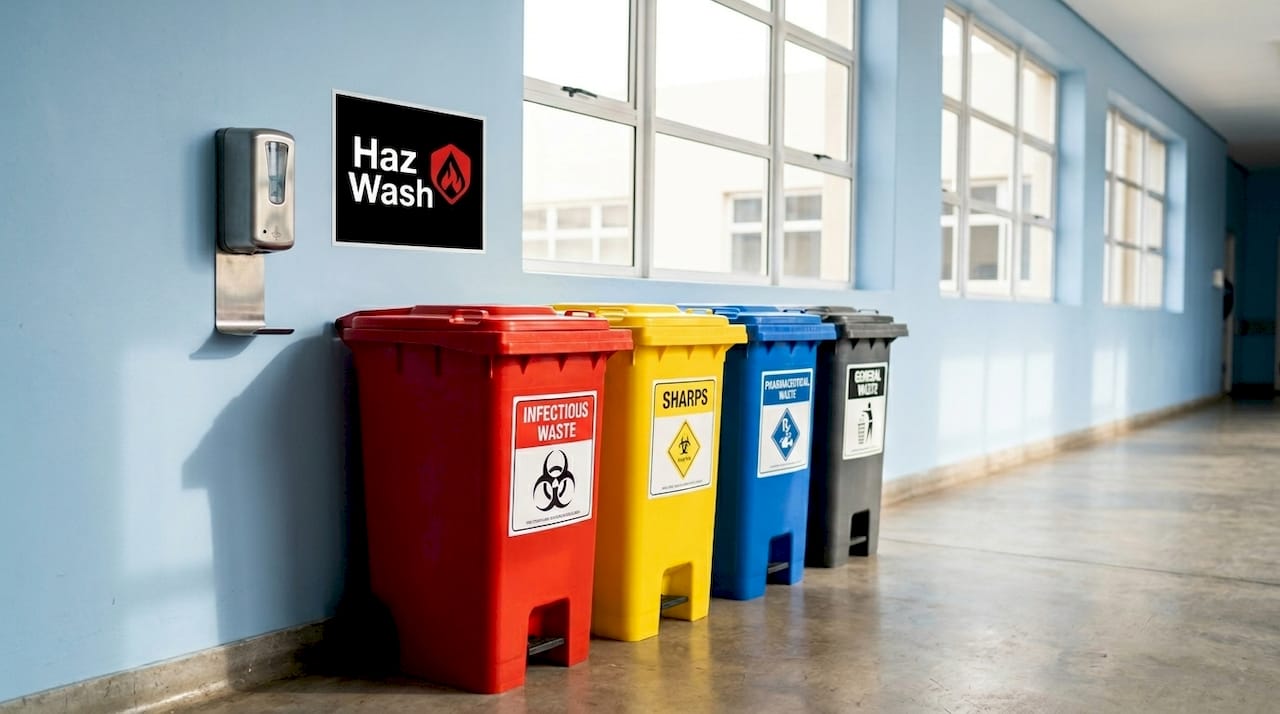
Segregation at the point of generation. Staff separate waste into color-coded containers immediately at the bedside or procedure area. Red biohazard bags hold infectious waste. Yellow containers hold sharps. Pharmaceutical waste goes into dedicated pharmaceutical waste containers. Segregation at generation is the single most critical risk control step in the entire process.
Sealing and labeling. Filled containers are sealed, labeled with the biohazard symbol, and tagged with the date and generating department. Accurate labeling supports the audit trail required by state regulators.
Transport to on-site storage. Sealed containers move through designated routes to a secured soiled utility room or dedicated waste storage area. Access is restricted to authorized personnel only.
Autoclave treatment. Most facilities use steam sterilization (autoclaving) as the primary treatment method. The UVA operational model runs autoclave cycles at 285°F with timed exposure periods, followed by spore testing to confirm sterilization efficacy. The University of Virginia also undergoes quarterly unannounced inspections by the Virginia Department of Environmental Quality (DEQ) to verify consistent compliance.
Final disposal. Treated waste goes to a lined, regulated landfill. Untreated infectious waste never enters the general waste stream.
Documentation and recordkeeping. Every step generates a paper or digital record. Manifests, treatment logs, and inspection reports form the compliance audit trail your facility needs if regulators or legal counsel request evidence of proper handling.
Pro Tip: Run spore testing after every autoclave cycle, not just periodically. A single failed cycle that goes undetected can result in untreated infectious waste reaching the landfill, triggering regulatory action and potential facility shutdown.
What are the main medical waste disposal methods?
Disposal method selection depends on waste type, state regulations, and facility capacity. The table below compares the three primary methods used in compliant medical waste programs.
Incineration was once the dominant method. More than 90% of infectious medical waste was incinerated before 1997. Tighter EPA emission standards after that year drove a major shift toward autoclaving and other alternative technologies that sterilize waste before landfill disposal. Today, incineration is reserved for waste streams that cannot be effectively treated by steam sterilization, particularly pathological and pharmaceutical waste.
State regulators require treatment facilities to hold certification or licensing for each technology they operate. If your facility contracts with a third-party treatment vendor, verify their state certification before signing any service agreement.
Pro Tip: Request your vendor’s most recent state inspection report before renewing a disposal contract. A vendor with unresolved compliance violations transfers legal risk to your facility if a regulatory audit traces improperly treated waste back to your generator account.
How do medical waste regulations affect your compliance program?
Medical waste regulations in the United States operate on a split federal and state model. The EPA provides a baseline framework through RCRA, which governs hazardous solid waste broadly. However, medical waste regulation is primarily state-driven, meaning your facility’s compliance program must be built around your specific state’s rules, not federal minimums alone.
Key compliance requirements across most state programs include:
Generator registration: Facilities that produce RMW above threshold quantities must register with the state environmental or health agency.
Staff training documentation: All personnel who handle, transport, or treat medical waste must receive documented training. OSHA’s Bloodborne Pathogens Standard (29 CFR 1910.1030) sets the federal baseline for training content.
Manifest and tracking records: Each waste shipment requires a manifest that travels with the waste from generator to treatment facility. Manifests must be retained for a state-specified period, typically three to five years.
Treatment technology certification: Autoclaves, incinerators, and alternative treatment units must be certified by the state and operated within approved parameters.
Inspection readiness: State inspectors can conduct unannounced visits. The UVA program, for example, receives quarterly unannounced DEQ inspections to verify autoclave performance and documentation accuracy.
Non-compliance carries serious consequences. Facilities face civil penalties, mandatory corrective action plans, and in severe cases, criminal charges for knowing violations. Beyond legal exposure, a compliance failure that results in a community infection event creates reputational damage that no facility recovers from quickly. Consulting your state’s environmental and health departments directly is the most reliable way to confirm current requirements. Michigan facilities can also reference Michigan biohazard disposal regulations for jurisdiction-specific guidance.
What are best practices for safe storage and handling of medical waste?
Safe storage and handling practices protect your staff, patients, and the surrounding community between the point of waste generation and final treatment. Improperly stored medical waste creates immediate health risks. Children and animals can access unsecured waste before treatment, spreading infections beyond the facility perimeter.
Effective storage and handling programs include these core elements:
Dedicated, secured storage areas. Medical waste storage rooms must be locked, clearly labeled with biohazard signage, and accessible only to authorized personnel. Storage areas should be separate from general waste and supply areas.
Color-coded containers used consistently. Red bags and containers for infectious waste. Yellow rigid containers for sharps. Pharmaceutical waste containers that are clearly distinct from both. Consistent color-coding reduces misclassification errors at the point of generation.
Puncture-proof sharps containers at every point of use. Sharps containers must be placed within arm’s reach of where sharps are used. A sharps container located across the room is a sharps container that will not be used consistently.
Personal protective equipment (PPE) for all handlers. Anyone transporting or managing medical waste containers must wear appropriate PPE, including gloves, gowns, and eye protection where splash risk exists.
Regular container inspection and replacement. Overfilled containers are a primary cause of sharps injuries and bag failures. Containers should be sealed and replaced at the three-quarters-full mark, not when completely full.
Pro Tip: Conduct a monthly walk-through of all waste generation points with your compliance officer. Spot-check container fill levels, PPE availability, and segregation accuracy. This takes less than an hour and catches problems before a state inspector does.
Waste reduction also belongs in this conversation. Reusable sharps containers, where state regulations permit, reduce both disposal volume and cost. Reviewing purchasing practices to minimize pharmaceutical waste generation is another area where small operational changes produce measurable compliance and cost benefits. For facilities managing infectious waste remediation in Michigan, state-specific handling requirements add another layer to these baseline practices.
Key takeaways
Medical waste management requires a documented, multi-step system covering classification, segregation, treatment, and disposal, governed primarily by state regulations rather than a single federal standard.
What I’ve learned from working in biohazard cleanup
After years of responding to regulated medical waste incidents across Michigan, one pattern stands out clearly. Facilities with strong segregation discipline almost never have serious compliance failures. The problems almost always trace back to the same root cause: staff who were trained once, years ago, and never retrained as procedures or regulations changed.
The other overlooked issue is over-bagging. When staff are uncertain whether something is regulated medical waste, they bag it as RMW to be safe. That instinct is understandable, but it inflates treatment volume, increases costs, and creates a false picture of your waste stream that makes auditing harder. A well-designed waste audit, done quarterly, corrects this drift before it becomes a budget or compliance problem.
I also think the industry underestimates how much pharmaceutical waste management has changed since the WHO published its 2025 global best practice guidelines. Facilities that are still treating pharmaceutical waste as a subset of general RMW are operating outside current best practice and, in many states, outside current regulations. Dedicated pharmaceutical waste streams, with their own documentation and disposal pathways, are no longer optional for any facility generating meaningful quantities of unused or expired medications.
The future of medical waste management will involve more technology, including digital manifest tracking and real-time autoclave monitoring. But the fundamentals will not change. Classify accurately. Store securely. Treat completely. Document everything. Those four principles have never failed a compliant facility.
— David
How Hazwash supports compliant medical waste cleanup
When a biohazard incident occurs at a healthcare facility, property, or residential setting, the cleanup must meet the same regulatory standards as routine medical waste management. Hazwash provides 24/7 certified biohazard cleanup services across Detroit and surrounding Michigan communities, with OSHA HAZWOPER, IICRC, and DOT certifications backing every response.
Hazwash handles blood spills, infectious waste remediation, trauma scene restoration, and hazardous material removal with full documentation for your compliance records. Every job produces the audit trail your facility or property needs to demonstrate regulatory adherence. If you need a certified, discreet, and compliant response, contact Hazwash’s biohazard cleanup team to discuss your situation and get a same-day assessment.
FAQ
What is regulated medical waste (RMW)?
Regulated medical waste is a subset of healthcare-generated waste contaminated by blood, body fluids, or potentially infectious materials, as defined by the U.S. EPA. Primary regulation occurs at the state level, meaning specific requirements vary by jurisdiction.
What are the main types of medical waste?
The five primary categories are infectious waste, sharps waste, pharmaceutical waste, pathological waste, and operational waste. Each category requires distinct containers, treatment methods, and disposal pathways.
How do you manage medical waste safely?
Safe management follows a documented workflow: segregate at the point of generation, seal and label containers, transport to secured storage, treat with autoclaving or incineration, and dispose in a regulated landfill with full documentation at each step.
Which medical waste disposal method is most common today?
Autoclaving (steam sterilization) is the most widely used treatment method for regulated medical waste. Incineration declined sharply after 1997 when the EPA tightened emission standards, shifting most facilities toward steam-based alternatives.
What happens if a facility fails to comply with medical waste regulations?
Non-compliant facilities face civil penalties, mandatory corrective action, and potential criminal charges for knowing violations. State environmental agencies conduct both scheduled and unannounced inspections to verify compliance with treatment, storage, and documentation requirements.