The Role of Insurance in Biohazard Cases Explained
The Role of Insurance in Biohazard Cases Explained
TL;DR:
Biohazard incidents in homes involve biological hazards that pose health risks and require professional remediation. Standard homeowners policies typically cover sudden, accidental events like crime scenes or unattended deaths but often exclude contamination from illegal acts, hoarding, or intentional damage. Proper documentation, prompt action, and understanding policy details are essential to successfully file and defend insurance claims.
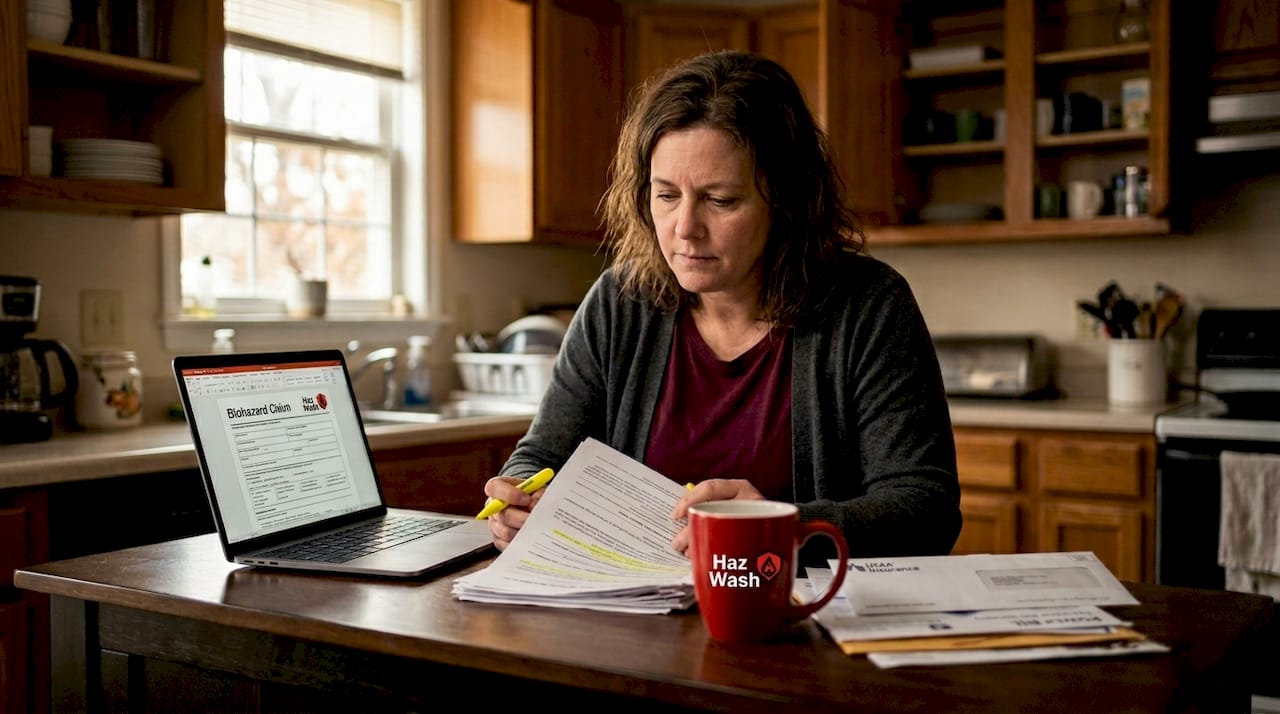
When a biohazard incident strikes your home, the last thing you need is a surprise denial from your insurance company. Yet that happens more often than most families expect. The role of insurance in biohazard cases is far more conditional than a standard policy summary suggests. Coverage depends on how the incident happened, who was involved, and how quickly you acted. This article breaks down what your policy likely covers, what it typically excludes, and exactly how to protect your claim from the moment you discover a biohazard situation on your property.
Table of Contents
Key Takeaways
What biohazard incidents actually are
Before you can understand insurance coverage, you need a clear picture of what qualifies as a biohazard incident. These are not ordinary cleaning situations. They involve biological materials that pose direct health risks to anyone present.
Common biohazard events include:
Unattended deaths, where decomposition creates widespread contamination
Violent crime scenes with blood and bodily fluid exposure
Suicide and traumatic accident scenes
Infectious disease contamination, including MRSA and other pathogens
Hoarding situations where sewage, mold, or animal waste has accumulated
Fentanyl or methamphetamine residue from drug activity on the property
Each of these scenarios carries serious health risks. OSHA standards require specialized personal protective equipment, proper containment, and legal disposal of biological waste. There is a meaningful difference between “cleaning” a space and professionally remediating and restoring it. Restoration means the property is returned to a habitable, safe condition, not just visibly tidied. For more on what that process actually involves, see what biohazard professionals do beyond surface-level cleaning.
Certified professionals also provide documentation that insurers require. Without that paperwork, your claim can stall or be denied outright. Privacy matters too. Certified teams handle these situations discreetly, which protects your family and your reputation in the community.
Pro Tip: Never attempt to clean a trauma or death scene yourself. Beyond the health risks, doing so can compromise the professional documentation that your insurer needs to process a claim.
How homeowners insurance handles biohazard coverage
This is where most people get surprised. Standard homeowners policies cover biohazard cleanup for sudden and accidental events. The phrase “sudden and accidental” is the linchpin of nearly every coverage decision.
Here is how the most common policy types approach biohazard events:
Policy TypeWho It CoversBiohazard Coverage LikelihoodHO-3 (homeowners)Owner-occupied homesModerate, subject to exclusionsHO-5 (premium homeowners)Owner-occupied, broader perilsHigher, with fewer exclusionsHO-4 (renters)Renters/tenantsLimited, contents onlyDP-3 (dwelling fire)Landlord-owned rentalsVaries, often narrower
Most policies cover the structural cleanup and some contents replacement when the triggering event qualifies. Crime scenes, traumatic accidents, and unattended deaths are generally covered. Suicide cleanup varies by policy language and state. Some insurers treat it as an accidental death. Others categorize it as an intentional act and deny the claim.
What is almost always excluded:
Meth lab or fentanyl decontamination when the homeowner had knowledge of the activity
Hoarding-related contamination, which insurers classify as gradual contamination from maintenance neglect
Damage caused by intentional acts of the insured or household members
Events tied to illegal activity on the property
Your policy has three sections worth reading carefully: Covered Perils, Exclusions, and Endorsements. Endorsements are optional add-ons that can expand coverage. Some insurers offer specific endorsements for trauma cleanup. If yours does, it is worth adding before you ever need it.
Pro Tip: Call your insurer now, before any incident occurs, and ask directly: “Does my policy cover biohazard remediation after an unattended death or crime scene?” The answer will tell you exactly where you stand and whether you need an endorsement.

The insurance claims process for biohazard incidents
The first hours after discovering a biohazard event are disorienting. Knowing what to do in sequence makes an enormous difference in whether your claim succeeds.
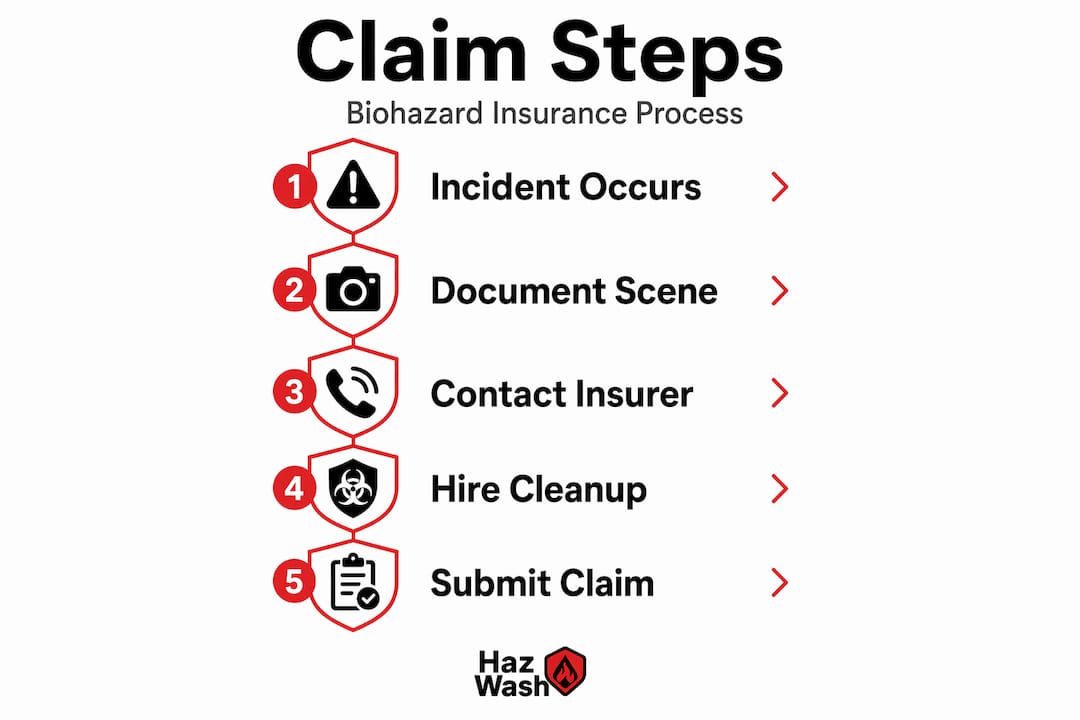
Contact law enforcement first. If the scene involves a death or crime, the scene must be released by authorities before any cleanup begins.
Call your insurer immediately. Report the incident as soon as the scene is released. Document the call with the agent’s name and timestamp.
Hire a certified cleanup company promptly. Delaying cleanup while waiting for insurer authorization can cost you. Your policy likely includes a duty-to-mitigate clause, meaning you are required to take reasonable steps to prevent further damage.
Assert your right to choose your vendor. Insurers are prohibited from steering you to use a specific cleanup company. You may hire any licensed, certified professional and your insurer must cover the reasonable cost.
Document everything. Photograph the scene before cleanup begins. Keep all invoices, correspondence, and technician reports.
Obtain a certificate of decontamination. An independent hygienist’s decontamination certificate is often required by insurers. It confirms the property is biologically safe and protects resale value.
Submit a complete claim package. Include photos, cleanup invoices, the certificate of decontamination, and any law enforcement reports.
If your claim is denied, you have the right to appeal. Request the denial in writing and ask for the specific policy language used to justify it. Many denials can be successfully challenged, especially when documentation is strong.
Pro Tip: Keep a dedicated folder, either physical or digital, for all incident-related documents. Insurers evaluate not just what happened but how well you can prove what happened and how you responded.
Common pitfalls and contested coverage areas
Even when you do everything right, certain situations create friction in the claims process. Understanding where denials cluster most often gives you a real advantage.
The pollution exclusion problem deserves special attention. Some insurers broadly apply pollution exclusions to biological contamination, even though biological matter is fundamentally different from industrial pollutants. Courts have not consistently upheld these denials, meaning a denied claim on those grounds is often worth appealing.
Other contested areas include:
Suicide and mental health-related deaths. Coverage is inconsistent across policy language. Some policies now explicitly include suicide cleanup under accidental death provisions. Others do not.
Meth lab discovery by new owners. If you purchased a property and later discovered prior drug activity, some policies may provide limited coverage since you were not the party responsible for the contamination.
Sewage backup with secondary contamination. If a covered event like a burst pipe leads to biological contamination, some portion of cleanup may qualify even if raw sewage alone would not. For more on why untreated hoarding or neglect situations rarely receive coverage, see what happens when hoarding biohazards go untreated.
The involvement of a household member in an intentional act is a major coverage killer. If the insured or a family member caused the event deliberately, most policies exclude the entire claim. This applies even in tragic circumstances.
Legal experts note that claims involving pathogens are highly fact-sensitive. The quality of your documented response protocols often determines whether a claim is accepted or challenged.
Gradual contamination from hoarding or long-term sewage exposure is routinely excluded because insurers classify it as maintenance neglect rather than a sudden event. The exception is when a separately covered peril, like a fire, occurs and causes additional contamination requiring remediation.
Practical steps to protect your claim
Managing a biohazard event with insurance in mind does not require a law degree. It requires preparation, timing, and professional support.
Here is what protects your claim and your health:
Review your policy annually. Look specifically at the Covered Perils and Exclusions sections. If biohazard or trauma cleanup is not addressed, ask your insurer about available endorsements.
Call a certified remediation company before assessing damage yourself. Entering a contaminated scene without proper PPE puts you at risk and may disturb evidence needed for the claim.
Communicate in writing with your insurer. Follow up every phone call with an email summary. This creates a paper trail that protects you if a dispute arises later.
Understand your local regulations. Detroit and surrounding areas have specific requirements for biological waste disposal. Using a company that complies with OSHA HAZWOPER, IICRC, and DOT standards protects you from regulatory violations that could complicate a claim.
Know your coverage limits. Even covered events have dollar limits. If cleanup costs exceed those limits, having documentation of every expense gives you grounds to negotiate or appeal.
Hire a public adjuster for complex claims. A licensed public adjuster works on your behalf, not the insurer’s, and can help recover more when a claim is contested.
Pro Tip: If you receive a denial, do not accept it without requesting the exact policy language cited. Many families successfully overturn denials simply by pointing to wording that does not clearly exclude their specific situation.
For time-sensitive situations, immediate biohazard response is not just about health. Acting fast is one of the strongest signals to your insurer that you fulfilled your duty to mitigate.
My honest take on insurance and biohazard claims
Working alongside families who have faced some of the most traumatic moments of their lives, I have seen firsthand how the insurance dimension adds a layer of stress that most people are completely unprepared for.
Here is what I have learned: documentation almost always makes or breaks a biohazard claim. Not the severity of the incident. Not the sympathy of the adjuster. The paperwork. Families who have a certified cleanup crew on site quickly, who get a certificate of decontamination, who keep every invoice and photo — those families recover their costs. Families who delay, who try to clean it themselves, or who let weeks pass without contacting their insurer? They lose coverage they were entitled to.
I have also seen insurers lean on the pollution exclusion in situations where it clearly does not apply. Do not accept that without pushing back. Ask for the specific language. Consult a public adjuster or an attorney if the amount at stake justifies it.
The other misconception I encounter constantly is that all biohazard events are treated equally by insurers. They are not. An unattended death in a home is treated very differently from a meth lab discovery. A crime scene involving a stranger is treated differently from one involving a household member. Knowing these distinctions before you file saves enormous time and prevents missteps that insurers use to justify denial.
Choose your cleanup company carefully. The right team does not just clean safely — they provide the documentation structure that your insurer is looking for. That matters more than most people realize.
— David
How Hazwash supports your cleanup and your claim
When you are dealing with a biohazard incident in the Detroit area, you need a team that understands both the remediation and the insurance side of the process.
Hazwash is a certified biohazard cleanup company serving Detroit and surrounding communities. Every technician holds OSHA HAZWOPER, IICRC, and DOT certifications, and every project produces the professional documentation that insurers require — including detailed invoices, cleanup protocols, and certificates of decontamination. Hazwash responds 24/7 with discretion, meaning your neighbors and colleagues do not need to know what happened on your property.
When you choose Hazwash, you are not just getting a safe, thoroughly restored space. You are getting a documented response that satisfies insurer standards and protects your property’s value long term. Explore Hazwash’s full biohazard services to understand how the team handles trauma scenes, unattended deaths, crime scenes, hoarding situations, and more. For urgent needs, 24/7 emergency cleanup is available now.
FAQ
Does homeowners insurance cover biohazard cleanup?
Most standard homeowners policies cover biohazard cleanup for sudden and accidental events such as crime scenes, traumatic accidents, and unattended deaths. Events involving illegal activity, hoarding, or intentional acts are typically excluded.
What does insurance exclude in biohazard cases?
Insurance commonly excludes meth lab decontamination, hoarding-related gradual contamination, and any event caused by an intentional act of the insured or a household member. Illegal activity exclusions are especially difficult to challenge.
Can my insurer make me use a specific cleanup company?
No. Insurers are prohibited from steering homeowners to a preferred vendor. You have the legal right to hire any licensed, certified biohazard cleanup company, and your insurer must cover reasonable costs for that service.
What is a certificate of decontamination and why does it matter?
A certificate of decontamination is issued by an independent hygienist after cleanup to confirm the property is free from biological contamination. Insurers often require it to close a claim, and it also protects your property’s resale value.
What should I do if my biohazard insurance claim is denied?
Request the denial in writing and ask for the specific policy language used to justify it. Many denials, especially those citing pollution exclusions for biological events, can be successfully appealed with the right documentation and, if needed, legal or public adjuster support.