DOT's Role in Biohazard Transport: 2026 Compliance Guide
DOT’s Role in Biohazard Transport: 2026 Compliance Guide
TL;DR:
The DOT governs biohazard transport by enforcing classification, packaging, labeling, and documentation standards across the US. Correct hazard classification—especially distinguishing Category A from Category B—is crucial for compliance and safety during transport. Proper training, vehicle standards, and adherence to state requirements complement the federal regulations to ensure safe handling and shipping of infectious materials.
The Department of Transportation (DOT) defines the role of DOT in biohazard transport as the mandatory regulatory authority governing how infectious substances are classified, packaged, labeled, documented, and safely moved across U.S. roads and airways. Under 49 CFR Parts 171 through 180, DOT treats infectious substances as hazardous materials, placing them under Hazard Class 6.2 with specific obligations that apply from the moment a shipment is prepared to the moment it reaches its destination. These rules exist alongside OSHA’s bloodborne pathogen standards and state-level mandates, forming a layered compliance framework that every biohazard transport professional must understand and follow. Getting any element wrong, whether classification, packaging, or documentation, creates legal exposure and genuine public safety risk.
What are the key DOT classifications for biohazardous materials?
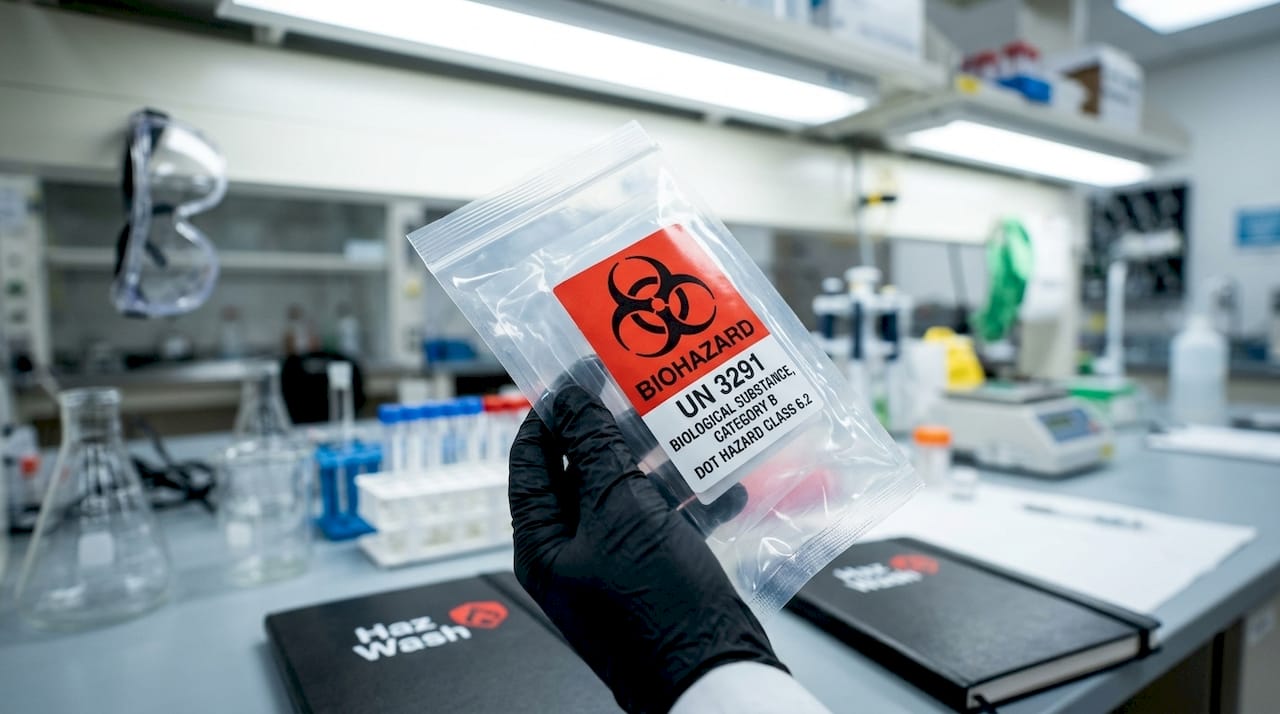
Infectious substances are regulated as Hazard Class 6.2 under 49 CFR Part 173.134, and the classification you assign to a material determines every downstream compliance obligation. The two primary categories are Category A and Category B, and the distinction between them is not administrative. It is the difference between the most stringent packaging requirements in the hazmat system and a more manageable but still strictly regulated set of controls.
Category A vs. Category B: what actually changes
Category A substances are those capable of causing permanent disability or life-threatening disease in healthy humans or animals when exposure occurs. These ship under UN 2814 (affecting humans) or UN 2900 (affecting animals only) and require packaging that meets the most rigorous performance standards in the DOT system. Category B substances, shipped under UN 3373, are infectious but do not meet the Category A threshold. Regulated medical waste, which includes sharps, blood-soaked materials, and pathological waste, ships under UN 3291 as a separate designation.
The table below summarizes the classification framework:
One critical point that trips up even experienced handlers: a red bag alone is insufficient to establish shipping compliance. Color-coded waste bags identify the material internally, but DOT classification and matching UN numbers govern what happens the moment that material enters transport. The classification drives the packaging test standards, the required markings, and the shipping paper entries. Skipping the classification step and relying on visual cues is one of the most common compliance failures in the field.
The default-to-risk principle applies when classification is uncertain. If you cannot confirm that a substance falls below the Category A threshold, you treat it as Category A. This conservative approach protects both the transporter and the public.
How does DOT regulate packaging and labeling for biohazard transport?
Packaging is the primary physical barrier between an infectious substance and the outside world, and DOT’s packaging requirements under the DOT regulations biohazard transport framework are specific, testable, and non-negotiable. The triple-containment system is the foundational engineering control for Category B substances, and it functions as a layered defense against leakage caused by transport vibration, pressure changes, and handling impacts.
The three layers work as follows:
Primary container: A leak-proof container holding the specimen directly, such as a sealed tube or vial. This container must be watertight and capable of withstanding normal transport conditions without leaking.
Secondary container: A second leak-proof container that encloses the primary. An absorbent material sufficient to absorb the entire contents of the primary container must be placed between the two layers.
Outer packaging: A rigid outer container that protects the secondary container from physical damage. For UN 3373 shipments, this outer container must display the UN 3373 diamond mark and the proper shipping name “Biological Substance, Category B.”
For regulated medical waste shipped as UN 3291, packages must not exceed 4 liters or 4 kilograms per package under 49 CFR §173.197. This limit exists to contain the consequences of a breach and to keep individual packages manageable for emergency responders. Exceeding this limit is a direct violation, regardless of how well the package is otherwise constructed.
Labeling requirements add another layer of specificity. Every outer container must display the correct UN identification number, the proper shipping name, the hazard class label (the biohazard symbol for Class 6.2), and the shipper’s name and address. Category A packages require additional orientation arrows and “Infectious Substance, Affecting Humans” or “Affecting Animals” language.
Pro Tip: Verify that the UN number on the outer package matches the classification on the shipping paper before the carrier arrives. A mismatch between the package marking and the shipping document is a common rejection trigger at carrier acceptance, and correcting it after the driver is at your door wastes time and creates a compliance gap.
What are the shipping paper requirements under DOT?
Shipping papers are not administrative formalities. PHMSA treats shipping papers as a critical on-board safety resource that first responders and carriers use to identify hazards and take appropriate action during an incident. Every biohazard shipment moving by ground or air must be accompanied by a shipping paper that meets DOT’s content requirements.
The required elements on every shipping paper are:
Proper shipping name: The exact DOT-recognized name, such as “Infectious Substance, Affecting Humans” or “Biological Substance, Category B.”
Identification number: The UN number corresponding to the classification, such as UN 2814 or UN 3373.
Hazard class: The hazard class designation, which for infectious substances is 6.2.
Packing group: Where applicable, though many Class 6.2 materials are not assigned a packing group.
Emergency contact information: A 24-hour emergency response telephone number, either the shipper’s own or a registered emergency response provider such as CHEMTREC.
Shipping papers provide the rapid identification mechanism that emergency responders depend on during incidents. Accuracy and clarity are not optional. A paper that is correct in every technical detail but difficult to read under stress fails its core purpose.
PHMSA guidance explicitly warns against mixing hazardous material identification information with non-hazardous text on shipping papers. Standard operating procedures at your facility should control exactly how shipping papers are formatted and what extraneous information, if any, appears on them. For regulated medical waste, a manifest tracking custody from generation to disposal must accompany the shipment and be retained by both the generator and the disposal facility.
What operational standards does DOT require for vehicles and personnel?
DOT compliance for hazardous materials transport extends beyond the package itself. The vehicle carrying the shipment and the personnel handling it are both subject to specific requirements under the biohazard transportation safety guidelines framework.
For vehicles transporting regulated medical waste or infectious substances, the operational requirements include:
Locked or secured compartments that prevent unauthorized access and reduce container movement during transit
Visible hazard markings on the vehicle where required by quantity and classification thresholds
Emergency response equipment on board, including spill containment materials appropriate for the substances being transported
Manifests and chain-of-custody documentation accessible in the cab for inspection
Personnel requirements are equally specific. DOT hazmat training must be renewed every three years and must cover hazard classification, packaging verification, labeling standards, emergency response procedures, and security awareness. This is not a one-time certification. It is a recurring obligation, and lapsed training is a direct compliance violation that exposes both the employee and the employer to enforcement action.
Training content must be specific to the function the employee performs. A driver who only transports pre-packaged regulated medical waste needs different training depth than a technician who classifies and packages Category A substances. DOT requires that training records be maintained and available for inspection.
Pro Tip: Build a pre-pickup verification checklist that your staff completes before any carrier accepts a biohazard shipment. Compliance failures at handoff are common because once a carrier takes custody, correcting a labeling or packaging defect becomes significantly harder. Catching errors before the driver arrives keeps the shipment moving and keeps your compliance record clean.
How do DOT regulations integrate with OSHA and state requirements?
DOT regulations do not operate in isolation. The full compliance picture for biohazard transport professionals includes OSHA’s bloodborne pathogen standard under 29 CFR 1910.1030, state environmental and health department rules, and in some cases, EPA regulations governing medical waste disposal. Understanding how these frameworks interact is a practical necessity for anyone operating across multiple jurisdictions.
The key integration points are:
OSHA alignment: OSHA’s bloodborne pathogen standard requires engineering controls, personal protective equipment, and exposure control plans that parallel DOT’s packaging and handling requirements. A facility that meets DOT packaging standards for Category B substances is generally also meeting OSHA’s containment expectations, but the two frameworks are not identical. OSHA governs the workplace; DOT governs the transport.
State-level additions: States including California and New York impose requirements that exceed federal DOT minimums. California’s Medical Waste Management Act requires specific manifest formats and licensed hauler credentials beyond what 49 CFR mandates. New York adds tracking and reporting obligations for regulated medical waste generators. For Michigan-specific disposal rules, state requirements layer on top of federal DOT standards and must be reviewed separately.
Most-restrictive rule: When federal and state requirements conflict, the more restrictive standard applies. Transporters operating across state lines must identify the most stringent requirement in each jurisdiction their route passes through and build that standard into their operating procedures.
Multi-jurisdictional shipments: For shipments crossing multiple state lines, the practical approach is to meet the most stringent packaging and documentation standard applicable to any state on the route. This eliminates the need to reconfigure shipments at state borders and reduces the risk of a compliance gap mid-transit.
For professionals operating in the Detroit area and surrounding Michigan regions, the Detroit biohazard compliance guide for 2026 provides jurisdiction-specific guidance on how DOT classifications apply to local transport and cleanup operations.
Key takeaways
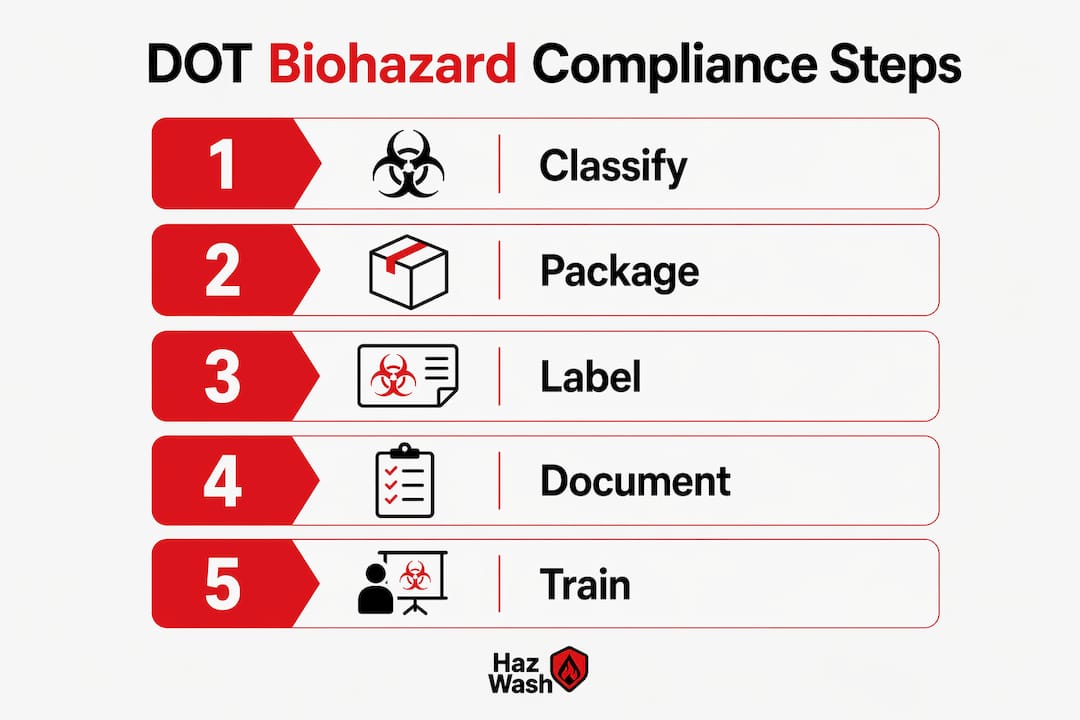
DOT compliance for biohazard transport requires correct classification, triple-containment packaging, accurate shipping papers, trained personnel, and awareness of state-level requirements that may exceed federal minimums.
Why classification matters more than the biohazard symbol
The biohazard symbol gets a lot of attention, and it should. It signals danger clearly. But in my experience working within the DOT compliance framework, the symbol is where many transport professionals stop thinking, and that is exactly where compliance problems start.
DOT’s classification framework prioritizes hazard category over visual identifiers. A package can display the biohazard symbol and still be non-compliant if the UN number is wrong, the packaging does not meet the performance standard for the assigned category, or the shipping paper lists the wrong proper shipping name. The symbol tells you something is dangerous. The classification tells you exactly how to handle it.
The other pattern I see consistently is underestimating the handoff moment. Facilities invest in training and packaging procedures, then lose control of compliance at the point where the carrier takes custody. That is the highest-risk moment in the entire transport chain, and it gets the least attention. A pre-pickup verification protocol is not bureaucratic overhead. It is the last line of defense before your shipment leaves your control.
Regulatory amendments also move faster than most training programs. The 2026 Federal Register updates from PHMSA include clarifications on shipping paper formatting and emergency contact requirements that some facilities have not yet incorporated into their SOPs. Staying current is not optional. It is the difference between a compliant operation and a citation waiting to happen.
— David
Hazwash supports compliant biohazard transport in Detroit
Hazwash provides certified biohazard cleanup and disposal services in Detroit and surrounding areas, operating in full compliance with DOT regulations for hazardous materials transport. Every Hazwash technician holds current DOT hazmat training, and every removal follows the classification, packaging, and documentation standards outlined in this guide. When a trauma scene, medical waste removal, or contamination event requires transport of regulated biological materials, Hazwash handles the packaging, labeling, manifest documentation, and licensed carrier coordination so nothing falls through the gaps. For professional biohazard cleanup that meets federal and Michigan state compliance requirements, contact Hazwash directly. The team is available 24/7 for emergency response.
FAQ
What does DOT regulate in biohazard transport?
DOT regulates the classification, packaging, labeling, shipping documentation, and personnel training requirements for transporting infectious substances as hazardous materials under 49 CFR Parts 171 through 180. Infectious substances fall under Hazard Class 6.2, with Category A and Category B designations determining the specific compliance obligations.
What is the difference between Category A and Category B substances?
Category A substances (UN 2814 or UN 2900) are capable of causing life-threatening disease and require the most stringent packaging standards, while Category B substances (UN 3373) are infectious but less severe and require triple-containment packaging with a rigid outer container marked with the UN 3373 diamond.
What must be on a DOT shipping paper for biohazard shipments?
Every shipping paper must include the proper shipping name, UN identification number, hazard class (6.2), and a 24-hour emergency contact number. PHMSA treats these papers as active safety tools for first responders, so accuracy and clarity are mandatory, not optional.
How often must DOT hazmat training be renewed?
DOT hazmat training must be renewed every three years and must cover classification, packaging verification, labeling, and emergency response procedures specific to the employee’s role in the transport process.
Does a red biohazard bag meet DOT transport requirements?
No. A red biohazard bag identifies waste internally but does not satisfy DOT transport compliance. Proper classification with the correct UN number, compliant outer packaging, and accurate shipping papers are all required before regulated medical waste can legally enter transport.