What Is IICRC Certification? A Clear Guide
What Is IICRC Certification? A Clear Guide
TL;DR:
- IICRC certification verifies that professionals follow standardized, documentable methods in the inspection, cleaning, and restoration industry. It includes individual technician credentials and Certified Firm status, both essential for ensuring quality and accountability. Verifying active certification through official tools is crucial before hiring to avoid subpar work and health risks.
IICRC certification is a professional credential issued by the Institute of Inspection, Cleaning and Restoration Certification, the recognized standards body for the inspection, cleaning, and restoration industry. It confirms that a technician or firm has completed approved training and passed standardized exams tied to ANSI-accredited technical standards. For property managers, families, and restoration professionals, this credential is the clearest signal that a contractor follows documented, repeatable methods rather than improvised ones. In biohazard cleanup specifically, where improper handling creates serious health and legal risks, understanding what IICRC certification means is not optional. It is the baseline for choosing a safe, qualified provider.
What is IICRC certification and what types exist?
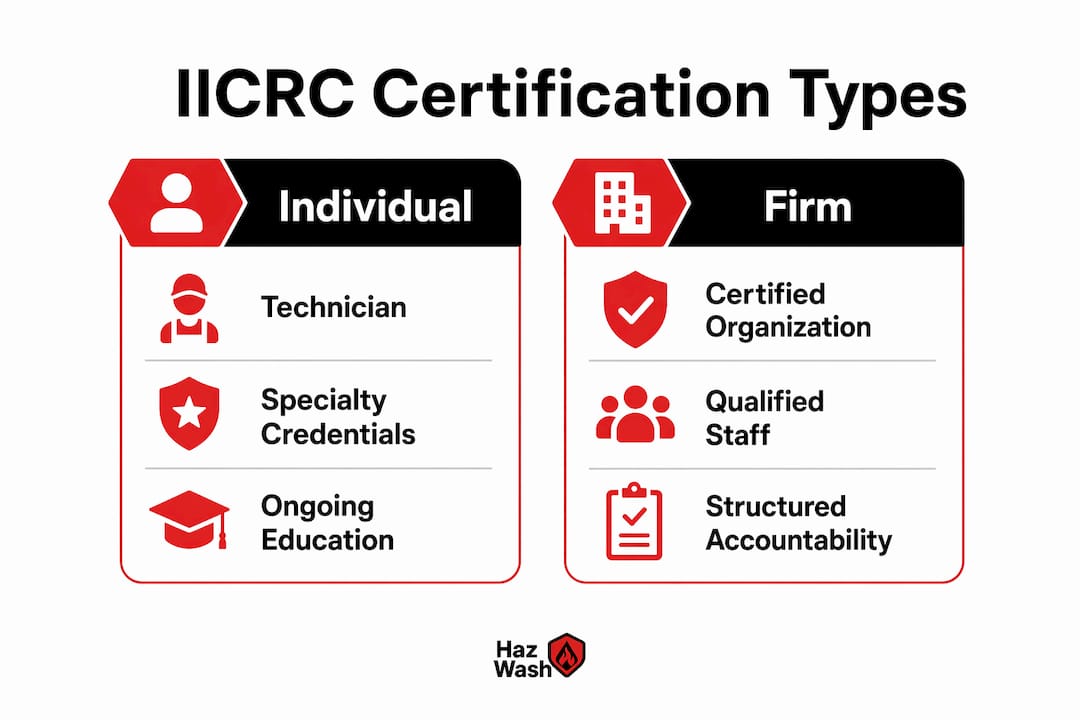
IICRC certification covers two distinct categories: individual technician credentials and Certified Firm status. Each serves a different purpose, and understanding the difference protects you from hiring a company that markets credentials it does not actually hold.
Individual technician certifications are earned by completing an approved IICRC course and passing a standardized exam. Each certification corresponds to a specific technical specialty. The most widely referenced include:
- WRT (Water Damage Restoration Technician): Aligned with the ANSI/IICRC S500 standard for water damage
- AMRT (Applied Microbial Remediation Technician): Aligned with S520 for mold remediation
- FSRT (Fire and Smoke Restoration Technician): Aligned with S700 for fire and smoke damage
- HVAC Technician: Aligned with S800 for HVAC system cleaning
- Trauma and Crime Scene Technician: Covers biohazard decontamination and trauma scene restoration
Each specialty certification defines the technical scope of what a qualified technician is trained to handle. A technician certified in AMRT, for example, has demonstrated knowledge of containment protocols, air quality testing, and clearance verification specific to mold, not just general cleaning.
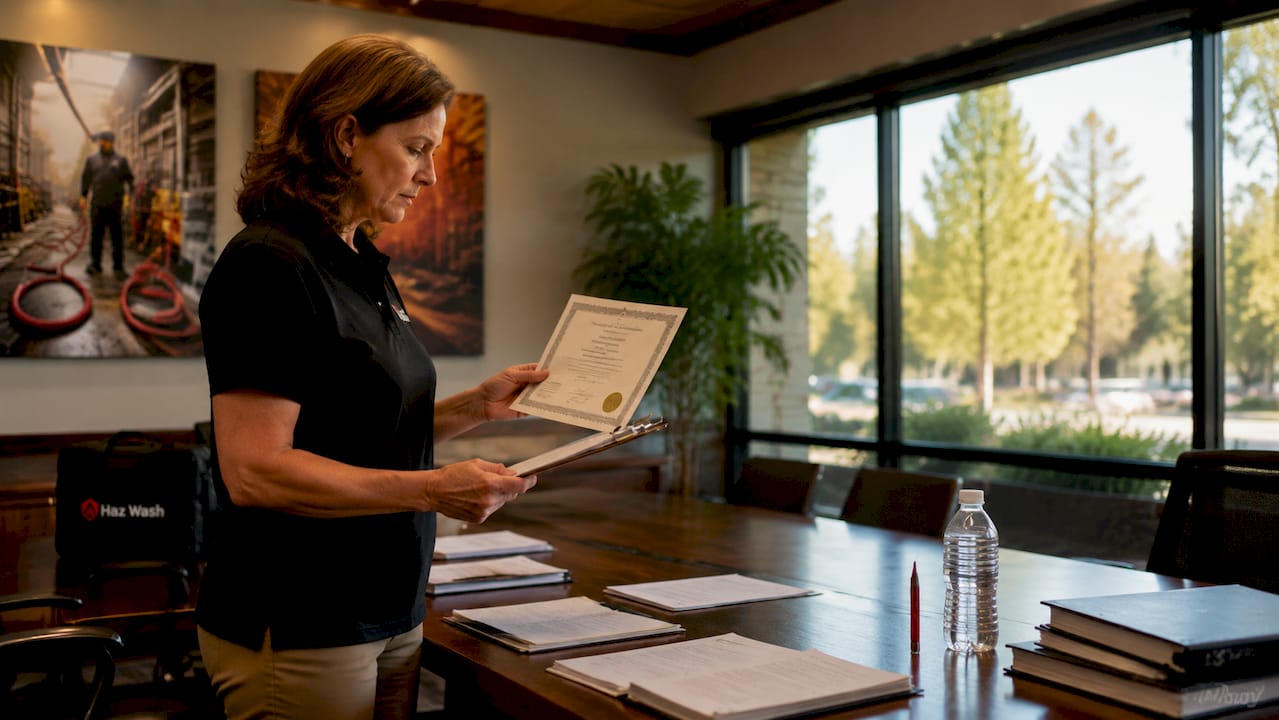
Certified Firm status is a separate, organization-level credential. It requires documentation of qualified staff, active insurance, a signed code of ethics, and participation in a customer complaint resolution program. A firm cannot simply claim Certified Firm status because one employee holds a technician card. The organization itself must meet ongoing compliance requirements.
This distinction matters. When you hire a Certified Firm, you are engaging an organization that has structured accountability, not just one skilled individual.
Why does IICRC certification matter in restoration?
IICRC standards function as the standard of care for restoration practice. They are ANSI-accredited, internationally recognized, and used as benchmarks in insurance claims, legal disputes, and regulatory compliance reviews. That gives them real weight beyond marketing language.
Here is why certification matters in practice, especially in biohazard and trauma cleanup:
- Standardized methods reduce health risks. Biohazard scenes involve bloodborne pathogens, chemical hazards, and structural contamination. IICRC-trained technicians follow documented containment, decontamination, and clearance procedures that minimize exposure risk for occupants and workers.
- Documented work plans protect property owners legally. Certified professionals are expected to produce written assessments, scope-of-work documents, and clearance verification. This paper trail matters when dealing with insurers, landlords, or regulators.
- Credibility with insurers and vendors. Insurance adjusters and property management companies increasingly require IICRC credentials before approving restoration vendors. Certification signals that a contractor’s methods are defensible and documented.
- Accountability through the firm certification structure. A Certified Firm has agreed to a code of ethics and a complaint resolution process. That creates a formal accountability layer that uncertified contractors simply do not have.
Pro Tip: Ask any restoration contractor to show you their IICRC certificate number, not just a logo on their website. A certificate number can be verified directly on iicrc.org.
The ANSI/IICRC S700 standard, for instance, provides a defensible benchmark for professional competence in fire and smoke restoration, focusing on documented processes rather than general training manuals. That specificity is what separates certified work from uncertified work.
How do you verify IICRC certification status?
Verification is straightforward, but most property managers and families skip this step entirely. That oversight creates real risk.
The IICRC maintains a public find-a-pro search tool on its official website. You can search by technician name, firm name, or location to confirm active certification status, the specific credentials held, and whether those credentials are current. A logo on a truck or a badge on a website is not verification.
Watch for these red flags when evaluating a restoration contractor:
- No certificate number provided on request. Legitimate certified technicians carry documentation and can provide their IICRC ID.
- Certification listed but not searchable on iicrc.org. This is a direct sign of a false claim.
- Firm claims certification but has no Certified Firm listing. Individual technician credentials do not make a firm IICRC certified at the organizational level.
- Outdated credentials. Certifications require ongoing education to remain active. A certificate from five years ago with no renewal is not a current credential.
Pro Tip: Before signing any restoration contract, run both the firm name and the lead technician’s name through the IICRC search tool at iicrc.org. It takes under two minutes and confirms what their marketing cannot.
Knowing how to spot certified cleanup services versus uncertified ones protects you from liability, substandard work, and potential health hazards.
What is the IICRC certification process?
Becoming IICRC certified follows a structured path. The process is practical and standards-based rather than product-specific, which means training focuses on methods and documentation rather than brand-specific equipment or chemicals.
The core steps are:
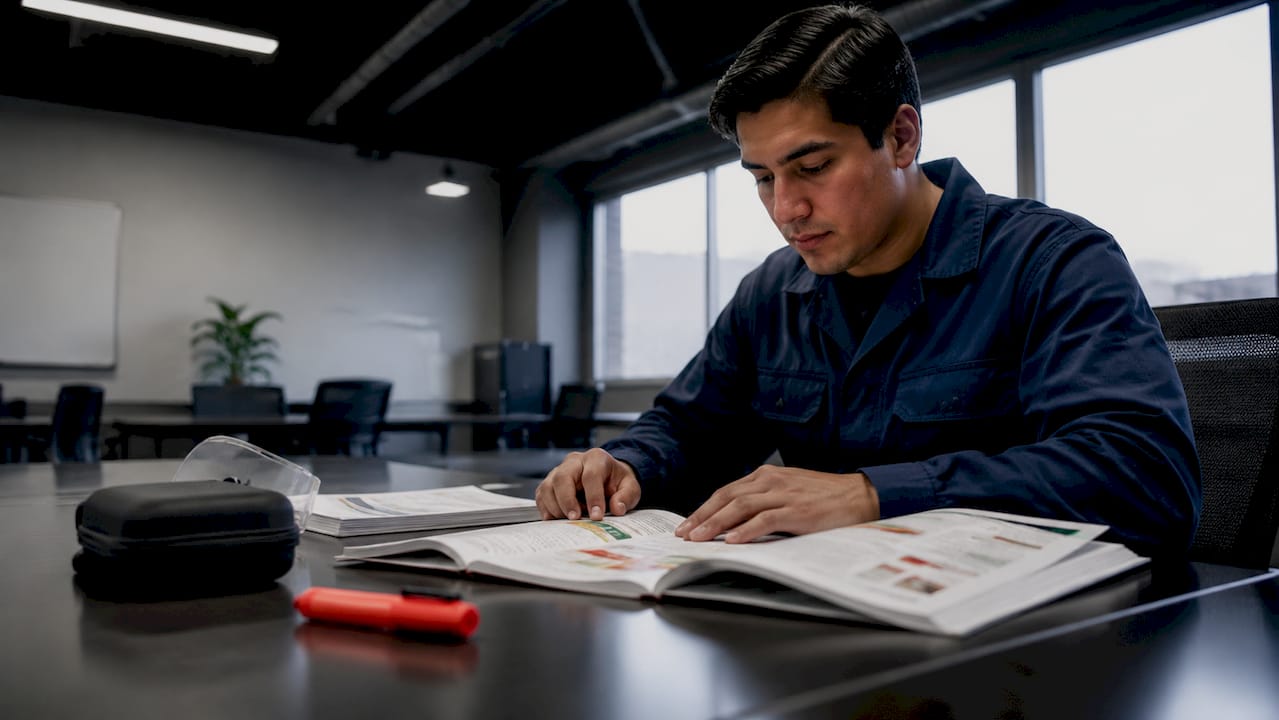
- Complete an approved IICRC training course for the chosen specialty
- Pass the standardized certification exam with a minimum score of 75%
- If needed, retest within 45 days of the exam scoring date
- Maintain active certification through continuing education as standards evolve
The table below compares the certification pathways for the most relevant specialties in biohazard and restoration work:
| Certification | Standard | Focus Area | Typical Audience |
|---|---|---|---|
| WRT | ANSI/IICRC S500 | Water damage restoration | Restoration technicians |
| AMRT | ANSI/IICRC S520 | Mold and microbial remediation | Mold remediation specialists |
| FSRT | ANSI/IICRC S700 | Fire and smoke restoration | Fire damage contractors |
| Trauma/Biohazard | Biohazard standards | Crime scene, trauma, blood cleanup | Biohazard cleanup professionals |
| HVAC Technician | ANSI/IICRC S800 | HVAC system cleaning | HVAC and IAQ specialists |
One detail most people miss: IICRC certification is voluntary and industry-driven, not a government license. This means a contractor can legally operate without it in most states. The certification exists to align and elevate practice, not to replace state licensing. Confusing the two leads property managers to accept uncertified contractors who technically meet the legal minimum but not the professional standard.
Continuing education is not optional for maintaining credentials. Standards like S500, S520, and S700 are updated as science and best practices evolve. A technician who earned a WRT certificate in 2018 and has not renewed it may be working from outdated protocols.
How IICRC certification applies to biohazard cleanup projects
In biohazard and trauma cleanup, IICRC certification is not a background credential. It directly shapes how a project is scoped, executed, and documented. Understanding what certified professionals actually do clarifies why this matters at every stage of a cleanup project.
The table below shows how certification requirements translate into specific project deliverables:
| Project Phase | What Certification Requires | Why It Matters |
|---|---|---|
| Initial Assessment | Written scope of contamination | Defines the full extent of hazard before work begins |
| Containment Setup | Barrier and negative air pressure protocols | Prevents cross-contamination to unaffected areas |
| Decontamination | Methods aligned with S-standard for the hazard type | Ensures pathogen elimination, not surface cleaning |
| Clearance Verification | Documented testing or visual confirmation | Confirms the space is safe for re-occupancy |
| Final Documentation | Work plan, photos, disposal records | Protects property owners in insurance and legal contexts |
Certified Firm status carries particular weight in insurance and procurement workflows. Insurers and property management companies often require Certified Firm credentials before approving a vendor, because firm-level certification signals organizational accountability, not just one technician’s skill set. A firm with Certified status has insurance, multiple credentialed technicians, and a formal ethics agreement.
For trauma scenes, crime scenes, and mold remediation, the S-standards specify detailed assessment, containment, and clearance methods. This is not general cleaning. It is a structured technical process with defined deliverables at each stage. Families and property managers who understand this are far better positioned to evaluate whether a contractor is actually doing the job correctly.
Key takeaways
IICRC certification is the industry’s primary standard for verifying that restoration and biohazard cleanup professionals follow documented, ANSI-accredited methods rather than improvised ones.
| Point | Details |
|---|---|
| Two certification levels exist | Individual technician credentials and Certified Firm status serve different purposes and both matter. |
| Verification is required | Confirm active status on iicrc.org before hiring; logos and marketing claims are not proof. |
| Standards drive project quality | S-standards like S500, S520, and S700 define specific methods for each restoration specialty. |
| Certification is not government licensing | IICRC credentials are voluntary and industry-driven, separate from state contractor licenses. |
| Active maintenance is required | Certifications expire without continuing education; always confirm current standing before a project. |
What i’ve learned working in certified biohazard cleanup
The most common mistake I see property managers make is treating IICRC certification as a checkbox rather than a working standard. They ask “Are you certified?” and accept a yes without verifying it. That gap between claimed and confirmed credentials is where problems start.
Here is what I have found to be true after years in this field: Certified Firm status is more meaningful than any individual technician’s card. A firm that holds Certified status has committed to insurance coverage, ethics compliance, and complaint resolution at the organizational level. That matters when something goes wrong on a project, and in biohazard work, complications do arise.
The misconception that IICRC certification equals government licensing also causes real confusion. Families dealing with a trauma scene often assume that any licensed contractor is also IICRC certified. Those are two separate things. A contractor can hold a state business license and have zero IICRC training. The license covers legal operation. The certification covers professional standards.
What property managers often overlook is the documentation requirement. Certified professionals do not just clean. They produce written assessments, work plans, and clearance records. That paper trail is what protects you when an insurer questions the scope of work or a future tenant raises a health concern. If your contractor cannot produce those documents, certification or not, the job is not complete.
— David
Hazwash provides certified biohazard cleanup in metro detroit
When a biohazard situation requires immediate, professional response, the credentials behind the crew matter as much as the speed of arrival.
Hazwash provides emergency biohazard cleanup in Detroit and surrounding areas with IICRC-certified technicians trained in trauma scene restoration, blood spill decontamination, and hazardous waste removal. Every project follows documented S-standard protocols with written assessments and clearance verification. Hazwash holds OSHA HAZWOPER, IICRC, and DOT credentials, giving families and property managers the compliance documentation they need. Available 24/7, Hazwash responds to urgent scenes with the discretion and technical rigor the situation demands. Confirm credentials. Confirm compliance. Call Hazwash.
FAQ
What does IICRC stand for?
IICRC stands for the Institute of Inspection, Cleaning and Restoration Certification. It is the primary standards-setting and certification body for the restoration industry.
Is IICRC certification the same as a contractor’s license?
No. IICRC certification is voluntary and industry-driven, while a contractor’s license is a government requirement. A contractor can hold one without the other.
How do i verify a company’s IICRC certification?
Use the official find-a-pro search tool at iicrc.org. Search by technician name or firm name to confirm active certification status and the specific credentials held.
What is the passing score for an IICRC exam?
Candidates must score at least 75% to pass an IICRC certification exam. Retests are allowed within 45 days of the original exam scoring date.
Why does certified firm status matter more than individual credentials?
Certified Firm status requires insurance, multiple certified technicians, a signed code of ethics, and complaint resolution participation. It signals organization-level accountability that a single technician credential does not provide.