Legal Risks of Improper Cleanup for Property Owners
Legal Risks of Improper Cleanup for Property Owners
TL;DR:
Property owners face strict legal liability under CERCLA for contamination on their premises, regardless of fault or causation.
Proper disposal, thorough documentation, and certified professionals reduce legal risks and protect against regulatory fines and lawsuits.
Most property owners assume that dealing with a biohazard incident on their premises is primarily a health and safety issue. The legal risks of improper cleanup tell a different story. Failing to meet federal and state cleanup standards can expose you to regulatory fines, third-party lawsuits, and strict liability under environmental law, sometimes for contamination you never caused. This article covers what liability actually looks like under U.S. law, what happens when cleanup goes wrong, and the practical steps you can take to protect yourself and your property.
Key takeaways
Legal risks of improper cleanup: what owners are actually liable for
The formal term for the legal framework governing cleanup liabilities is environmental remediation liability, and it covers a wide range of situations, from chemical spills to biological contamination. Understanding this framework is not optional for property owners. It is your baseline legal obligation.
The most important federal statute to know is CERCLA, the Comprehensive Environmental Response, Compensation, and Liability Act, commonly called Superfund. Under CERCLA, current owners bear strict liability for contamination on their property, even if that contamination occurred decades before they purchased it. Liability is retroactive, joint and several, and it does not require proof of fault or negligence.
That last point surprises many property owners. You do not have to have done anything wrong to be held responsible. If contamination exists on your property, you are presumed liable. Joint and several liability means a single responsible party can be forced to cover the entire cost of remediation, even if multiple parties contributed to the problem.
Several categories of parties can be named as responsible under Superfund:
Current owners and operators of the contaminated property
Past owners and operators at the time of disposal
Parties who arranged for hazardous waste disposal (generators)
Transporters who selected the disposal site
Strict liability under CERCLA means responsible parties cannot escape costs by demonstrating they followed industry standards or were not negligent. If hazardous material was present and disposal occurred, liability attaches. Additionally, environmental liability can be triggered by past operations and applies to current owners and operators even when they had no involvement in creating the problem.
The practical reality: Under Superfund, your legal strategy shifts from denying responsibility to managing how cleanup costs are allocated. Knowing this early changes how you respond to contamination incidents.
Regulatory enforcement can include consent orders requiring cleanup, substantial civil penalties, injunctions preventing property use, and even criminal referrals in cases of willful violations. For property managers overseeing multiple sites, the exposure compounds with each property.
Consequences of poor biohazard and waste handling
When a biohazard incident is handled improperly, either by an unqualified contractor or by property staff attempting self-remediation, the consequences play out across several dimensions simultaneously.
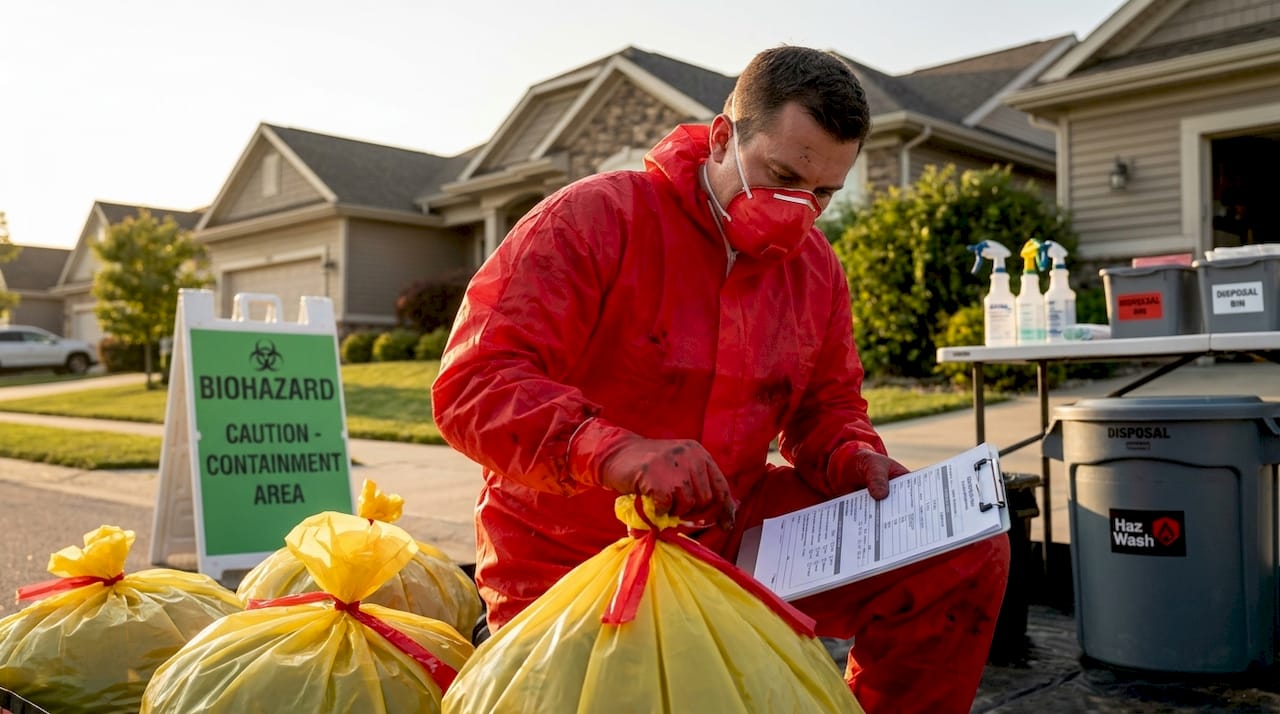
The health and occupant safety risks are immediate. Residual bloodborne pathogens, chemical residue, or biological waste can expose occupants, maintenance workers, and future tenants to serious illness. That exposure creates direct civil liability: personal injury claims, workers’ compensation disputes, and potential premises liability lawsuits. You do not need a government agency involved for this to cost you significantly.
On the regulatory side, the financial exposure is measured in daily fines. Consider these compounding consequences:
The EPA adjusted civil penalty maximums in 2025 to reach up to $124,426 per day for certain violations under the Clean Air Act and RCRA.
Each day of noncompliance is counted separately, which means a two-week enforcement window can generate penalties exceeding $1.7 million before remediation costs are factored in.
Violations related to permit drift and inadequate training are among the most common triggers for EPA enforcement actions against property operators.
Improper waste disposal risks extend beyond fines. State environmental agencies can order mandatory remediation at the property owner’s expense, with cost recovery actions attached.
The operational impact is often underestimated. A contaminated property may be subject to regulatory hold orders preventing occupancy or lease. That translates directly into lost rental income, disrupted business tenants, and property value decline. The reputational damage in a local rental market can outlast even the physical remediation.
Pro Tip: Document the condition of your property at acquisition with photos, inspection reports, and Phase I environmental assessments. This baseline record is your first line of defense if contamination is later discovered.
Third-party lawsuits are a separate and significant hazard. Neighboring property owners can bring nuisance and trespass claims if contamination migrates off your site. Tenants can sue for breach of the implied warranty of habitability. Employees exposed during an improper cleanup can file OSHA complaints and civil claims simultaneously.
Why certified professionals and documentation are non-negotiable
One of the most costly mistakes property owners make is trusting unqualified individuals to handle biohazard cleanup because it appears to be a simpler or cheaper option in the moment. The legal consequences of cleanup errors performed without proper certification are not recoverable through good intentions.
Federal regulations require specific permits, manifests, and reporting for hazardous waste transport and disposal. Under RCRA, hazardous waste must be tracked from generation to final disposal using a manifest system. Any break in that chain, including using a transporter without the correct DOT registration, creates a compliance gap that regulators can and do pursue.
The table below illustrates the critical difference between qualified and unqualified cleanup approaches:
FactorCertified professional cleanupUnqualified or DIY cleanupRegulatory complianceMeets OSHA HAZWOPER, DOT, RCRA standardsHigh risk of violations and permit gapsDocumentationManifests, chain of custody, completion reportsNo enforceable recordsLegal defensibilitySupports BFPP and other CERCLA defensesDefenses may be unavailable or voidHealth risk managementPPE protocols and containment procedures followedContamination cross-spread likelyLiability exposureSignificantly reducedSubstantially increased
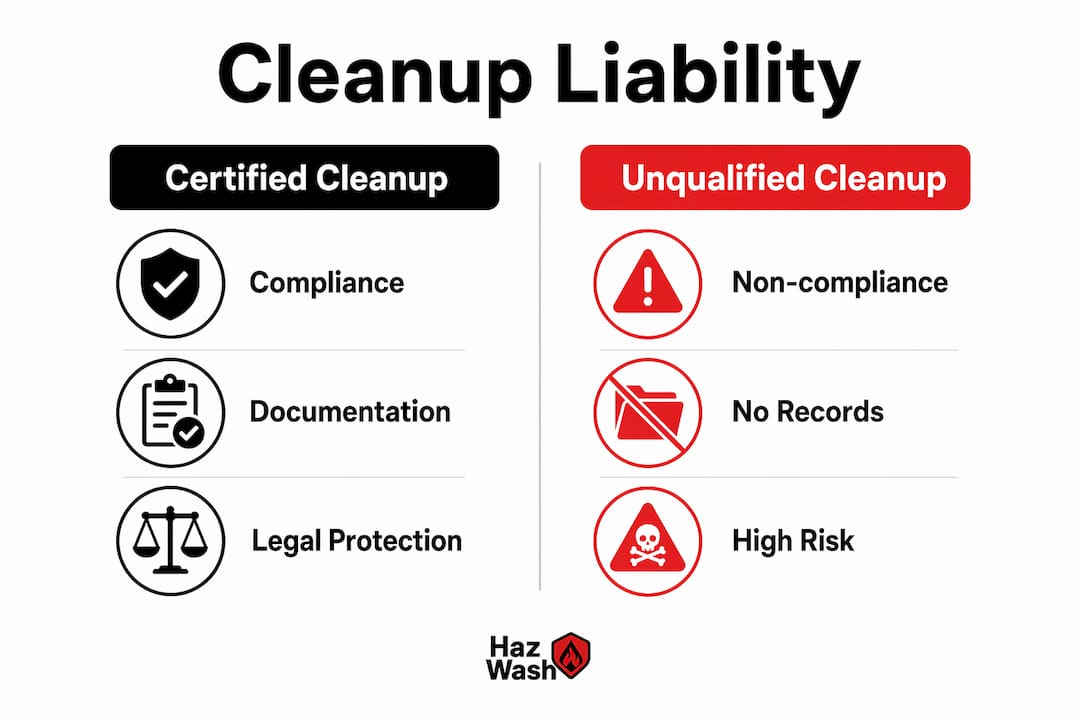
The Bona Fide Prospective Purchaser, or BFPP, defense under CERCLA is one of the most valuable legal protections available to property owners. It limits liability for contamination discovered after purchase, but only if specific conditions are met, including conducting proper environmental due diligence. Owners without proper reliance status in Phase I Environmental Site Assessment reports may lose this defense entirely and face multi-million-dollar cleanup liabilities as a result.
Understanding legal liabilities in biohazard situations requires recognizing that documentation is not paperwork. It is your legal record of compliance. Certified firms generate completion reports, waste manifests, and decontamination certificates that hold up in court and with regulators.
Pro Tip: When hiring a cleanup contractor, request copies of their OSHA HAZWOPER certification, DOT transporter registration, and waste disposal manifests before work begins. If they cannot provide these, your liability does not transfer.
Practical strategies to reduce your cleanup liability
The legal framework governing hazardous cleanup liabilities is complex, but your response to it does not have to be reactive. Property owners and managers who build compliance into their operations before an incident occurs face dramatically lower exposure when something goes wrong.
Here are the most effective preventive measures:
Environmental due diligence before acquisition. Commission Phase I Environmental Site Assessments and, where warranted, Phase II investigations. Make sure your name is listed as a user in the report. Failing to obtain reliance letters from environmental consultants can strip you of the legal protections those assessments are meant to provide.
Contract specificity. Vague cleanup language in leases and purchase agreements is a documented source of expensive disputes. Contracts specifying measurable cleanup standards prevent disagreements about what “cleaned” actually means after an incident.
Immediate response protocol. Delays after contamination discovery increase remediation costs and create the appearance of deliberate noncompliance, both of which invite regulatory action. Have a response plan and a certified contractor contact in place before you need them.
Permit alignment and record keeping. Review your environmental permits regularly against current operations. Permit drift and poor record keeping are high-risk factors for enforcement actions.
Insurance review. Standard commercial property policies often exclude pollution and biohazard events. Review your coverage with a broker who understands environmental exclusions. Know what is and is not covered before you file a claim.
For Detroit-area property managers, the hazardous waste disposal compliance guide from Hazwash provides a solid framework for aligning day-to-day operations with state and federal requirements.
Pro Tip: Build a “contamination response” clause into every lease agreement. Specify who is responsible for notifying regulators, who selects the cleanup contractor, and what certification standards apply. This single clause prevents the majority of post-incident disputes.
My honest take on what most property owners get wrong
I have seen property owners walk into severe financial and legal trouble not because they ignored the rules, but because they genuinely did not know how broad CERCLA’s reach actually is. The strict liability standard catches people off guard every time. They assume that because they did not create the contamination, they cannot be held responsible for cleaning it up. That assumption is wrong, and it is expensive.
The other pattern I see repeatedly is over-reliance on insurance or a third-party contractor without the right contractual protections in place. Over-reliance on contractors without strong contractual safeguards often backfires, leaving owners with uncovered liabilities and no documented chain of custody for cleanup work. You hired someone, something went wrong, and now you have no paperwork to show regulators or a court.
My practical advice is this: treat every biohazard or hazardous waste situation as a documentation exercise first and a physical cleanup second. The physical work matters, but it is the paper trail that protects you legally. The cost of hiring a certified firm and maintaining proper records is always lower than the cost of defending an enforcement action or a civil lawsuit.
— David
Protect your property with compliant cleanup services
Facing a biohazard situation on your property is stressful enough without the added weight of regulatory exposure and legal liability. That is where professional guidance makes a real difference.
Hazwash provides certified biohazard cleanup services in Detroit with full compliance documentation, OSHA HAZWOPER-trained technicians, and proper waste manifests on every job. Whether you are managing a trauma scene, a hazardous spill, or a contamination event at a rental property, Hazwash delivers the documented, compliant cleanup that protects you legally and restores your property safely. Their 24/7 emergency response also includes guidance on how insurance intersects with cleanup costs, helping property managers file claims correctly and avoid coverage gaps. When environmental legal compliance is not optional, working with certified professionals is the most direct way to reduce your exposure.
FAQ
What are cleanup liability laws for property owners?
Cleanup liability laws, primarily CERCLA at the federal level, hold current property owners strictly liable for contamination on their premises, even if they did not cause it. Liability is retroactive and does not require proof of negligence.
Can I be fined for improper biohazard disposal on my property?
Yes. EPA civil penalty maximums were adjusted in 2025 to reach up to $124,426 per day for certain violations under RCRA and the Clean Air Act, and fines compound daily until the violation is resolved.
Does hiring a cleanup contractor protect me from legal liability?
Only if the contractor is properly certified and provides full compliance documentation. Without records like waste manifests and HAZWOPER certifications, the liability remains with the property owner.
What is the BFPP defense and when does it apply?
The Bona Fide Prospective Purchaser defense under CERCLA limits liability for contamination discovered after property acquisition, but only if proper environmental due diligence was completed and the owner is listed as a user in the Phase I ESA report.
How does contract language affect cleanup liability?
Vague cleanup standards in leases and purchase contracts lead to disputes about what level of remediation was required. Contracts with specific, measurable cleanup criteria and clear notification responsibilities are significantly easier to enforce and defend.